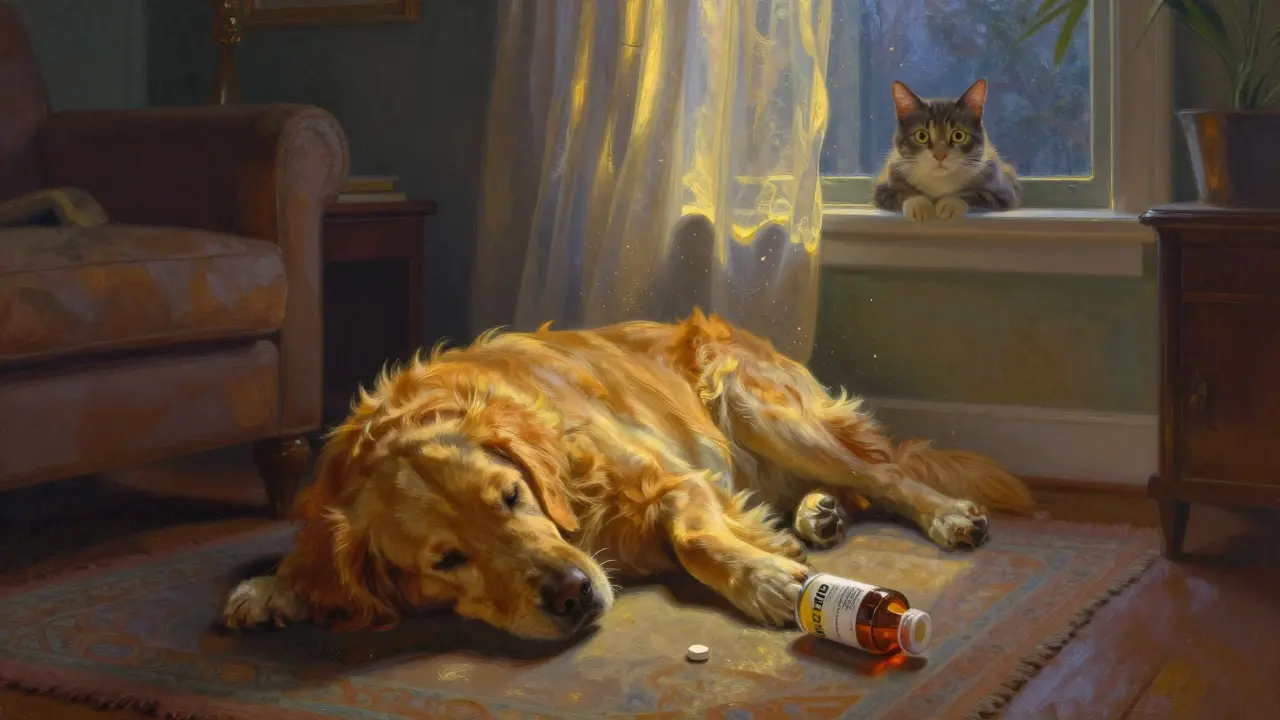
Every year, over 150,000 pets in the U.S. end up in emergency vet clinics because they swallowed something they shouldn’t have-and most of it came from your medicine cabinet. It’s not just curiosity. It’s not just a careless moment. It’s a silent, fast-moving emergency that can kill your dog or cat before you even realize what’s happening. Human medications are the number one cause of pet poisonings, and the symptoms don’t always look like what you’d expect. A trembling dog might seem like it’s cold. A cat that’s vocalizing strangely might seem like it’s just being dramatic. But those could be signs of a life-threatening overdose.
What Happens When Pets Ingest Human Medications?
It’s not the same as when humans take these drugs. Dogs and cats don’t process medications the way we do. Their livers, kidneys, and enzymes break down chemicals differently-and sometimes, that difference is deadly. A single pill meant for you can be a lethal dose for your pet. For example, just one 37.5mg extended-release capsule of Effexor can send a cat into organ failure. A few ibuprofen tablets can cause stomach ulcers and kidney failure in a dog. And acetaminophen? It’s almost always fatal for cats, even at tiny doses.
The most common culprits? NSAIDs like ibuprofen and naproxen, antidepressants like Prozac and Effexor, ADHD meds like Adderall, and painkillers like Tylenol. These aren’t rare drugs-they’re in most homes. And pets don’t care about labels. If it’s small, colorful, or smells like food, they’ll eat it. Dogs account for 85% of cases. Cats, though fewer in number, are more vulnerable because their bodies can’t detoxify certain chemicals at all.
Recognizing Overdose: Key Symptoms by Medication Type
Not all overdoses look the same. The symptoms depend on what was taken, how much, and whether it’s a dog or cat. Here’s what to watch for, broken down by drug class.
Antidepressants (SSRIs and SNRIs)
Drugs like Prozac, Lexapro, Zoloft, and Effexor can trigger serotonin syndrome. This isn’t just anxiety-it’s a neurological storm. Look for:
- High fever (103°F to 106°F)
- Fast, irregular heartbeat
- Shaking, tremors, or muscle rigidity
- Agitation, pacing, or vocalizing nonstop
- Loss of coordination or collapsing
In cats, Effexor is especially dangerous. Even one capsule can cause liver damage so severe that ALT enzyme levels spike past 1,200 U/L (normal is under 100). And unlike in dogs, cats don’t just get nervous-they develop acute liver failure within hours.
ADHD Medications (Adderall, Concerta, Ritalin)
These are stimulants. In pets, they turn the body into overdrive. Symptoms appear within 15 to 60 minutes:
- Heart rate over 220 beats per minute (normal for dogs: 60-140)
- Body temperature above 107°F
- Severe tremors or seizures
- Dilated pupils that don’t react to light
- Restlessness, panting, or extreme aggression
These symptoms are often mistaken for a panic attack or extreme excitement. But they’re not behavioral-they’re toxic. Dogs can die from heart failure or overheating if treatment isn’t started within two hours.
Benzodiazepines (Xanax, Ambien, Klonopin)
You might think these make pets sleepy. In dogs, they often do the opposite. About half of canine cases show paradoxical agitation-barking, running in circles, or trying to climb walls. Cats, on the other hand, develop severe liver damage. Look for:
- Unusual aggression or hyperactivity
- Loss of balance, stumbling
- Yellowing of gums or eyes (jaundice)
- Lethargy or coma (in later stages)
Don’t assume sedation means safety. These drugs are just as deadly in reverse.
NSAIDs (Ibuprofen, Naproxen, Celebrex)
These are the #1 cause of pet poisonings. Dogs may seem fine for a few hours, then start vomiting, then develop black, tarry stools. That’s not just an upset stomach-that’s internal bleeding. Within 24 to 72 hours, kidney failure kicks in:
- Vomiting (92% of cases)
- Black, sticky stools (melena)
- Loss of appetite, lethargy
- Increased thirst and urination (early sign of kidney stress)
- BUN levels above 120 mg/dL (normal: 10-25)
Cats are even more sensitive. A single tablet can cause kidney failure. There’s no safe dose for them.
Acetaminophen (Tylenol)
This is where the difference between dogs and cats becomes terrifying.
In cats: As little as 10mg/kg can be fatal. Within 1-4 hours, you’ll see:
- Brown or gray gums and tongue (methemoglobinemia)
- Swelling in the face or paws
- Difficulty breathing
- Cyanosis (bluish tint to skin)
In dogs: Liver damage shows up later-24 to 72 hours after ingestion. Signs include:
- Vomiting
- Dark urine
- Jaundice
- ALT liver enzymes over 1,000 U/L (normal: 10-100)
That brownish color on the gums? It’s a red flag for acetaminophen in cats. If you see it, get to a vet immediately. Survival rates drop to 12% if treatment is delayed beyond 18 hours.
What to Do If You Suspect an Overdose
Time is everything. Studies show 93% of pets survive if treatment starts within two hours. After that, the odds drop fast.
Here’s your immediate action plan:
- Don’t wait for symptoms. If you saw your pet swallow something, assume it’s dangerous.
- Check for pill fragments. Look around the floor, in their mouth, or on their fur.
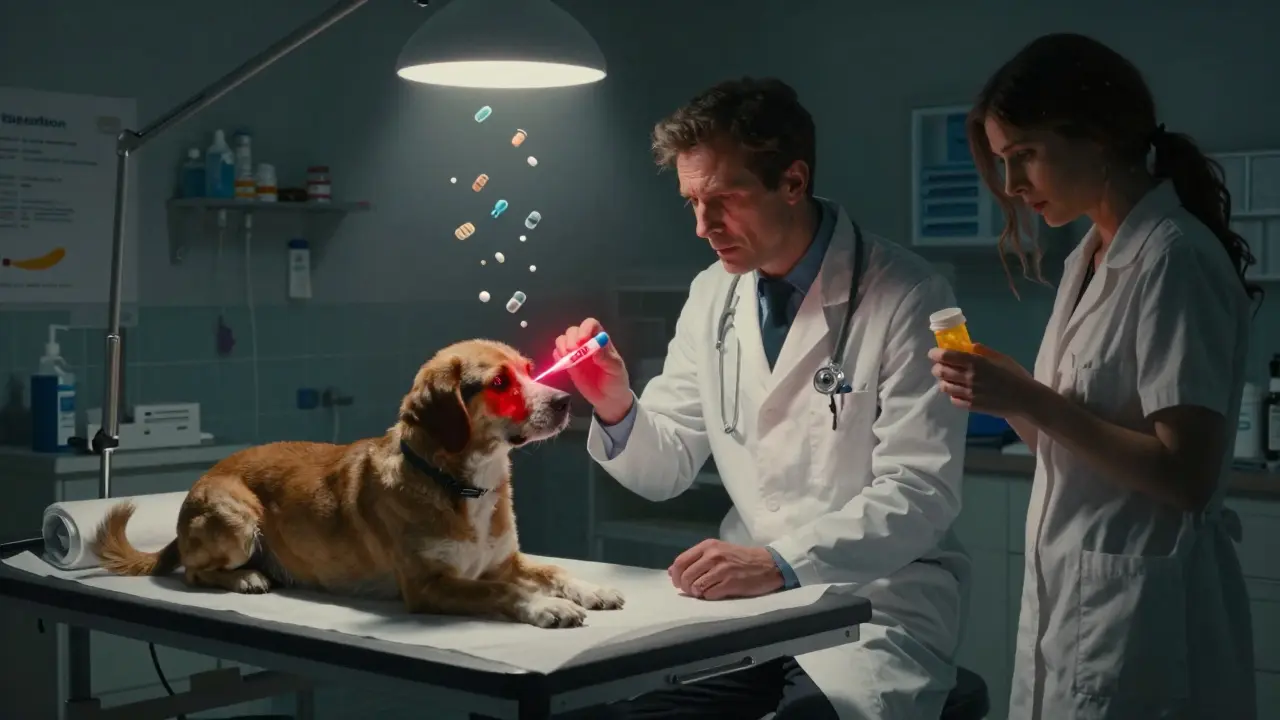
- Measure rectal temperature. If it’s above 103.5°F, it’s likely a stimulant or antidepressant overdose.
- Look at the gums. Brown or gray? Acetaminophen. Pale? Shock or bleeding.
- Call a poison control center. Don’t wait. Use the Pet Poison Helpline (1-800-213-6680) or ASPCA Poison Control. They have vets on standby 24/7.
- Do NOT induce vomiting unless told to. Some drugs cause more damage coming back up.
Bring the medication bottle with you. Even empty ones help. Write down when you think ingestion happened. The more details you give, the faster they can treat your pet.
Why Recognition Is So Hard-and How to Get Better at It
Most owners don’t recognize the signs because they’re confusing. Tremors? Could be cold. Vomiting? Could be bad food. Agitation? Could be anxiety. But the key is clusters. No single symptom is diagnostic. It’s the combination.
For example:
- Hyperthermia + dilated pupils + racing heart = ADD/ADHD drug overdose (94% specificity)
- Brown gums + difficulty breathing + lethargy = Acetaminophen in cats
- Vomiting + black stools + elevated BUN = NSAID toxicity
Training helps. Owners who spend just two hours learning these clusters can correctly identify 92% of NSAID cases. But only 67% recognize early serotonin syndrome. That’s why many pets die-they’re misdiagnosed as having a behavioral issue.
Use the ASPCA Poison Control app. It has symptom checkers for dogs and cats. It’s free, updated in real time, and helps you match symptoms to likely toxins.
Prevention: Keeping Medications Out of Reach
The best treatment is no treatment at all. Here’s how to keep your home safe:
- Store all medications in high cabinets or locked boxes-not on nightstands or countertops.
- Never leave pills on the counter while taking them. Even a dropped pill can be snatched.
- Use child-proof caps-even if you think your pet can’t open them, they can.
- Dispose of old meds properly. Don’t flush them. Take them to a pharmacy drop-off.
- Be extra careful with extended-release pills. They release poison over 12-24 hours, so symptoms last longer and are harder to track.
And if you have a cat? Assume every pill is a potential death sentence. Cats are not small dogs. Their bodies can’t handle many human drugs at all.
What’s Changing in Pet Toxicity Recognition
There’s new tech helping. The American College of Veterinary Emergency and Critical Care launched an AI-powered app in July 2023 that analyzes symptoms and predicts the toxin with 89% accuracy. The ASPCA is rolling out species-specific checkers in 2024-cats first, then dogs.
But the biggest change? Awareness. More vets are training staff. Banfield Pet Hospital now requires all 1,022 locations to complete medication toxicity training. Misdiagnosis rates dropped from 38% to 12% in six months.
Still, most pet owners don’t know this stuff. In a 2023 survey, 68% of owners misread early symptoms. They thought trembling was shivering. They thought agitation was excitement. They didn’t know brown gums meant death.
You can change that-for your pet, and for others.
Can a single pill kill my pet?
Yes. A single pill of certain medications-like Effexor, Adderall, or acetaminophen-can be fatal, especially for cats. Toxicity depends on the drug, your pet’s weight, and species. Never assume a small amount is safe.
What should I do if my dog ate ibuprofen?
Call your vet or the Pet Poison Helpline immediately. Do not wait for vomiting or diarrhea. Ibuprofen causes stomach ulcers and kidney failure. Treatment within two hours-like activated charcoal or IV fluids-can save your dog’s life.
Why do cats react worse to Tylenol than dogs?
Cats lack a key liver enzyme (glucuronyl transferase) that breaks down acetaminophen. Without it, the drug turns into a poison that destroys red blood cells and liver tissue. Even a tiny dose can cause methemoglobinemia-where blood can’t carry oxygen-leading to death within hours.
Is it safe to give my pet human painkillers for arthritis?
No. Never give human NSAIDs like ibuprofen or naproxen to pets. They are not safe. Veterinarians prescribe pet-specific pain meds like carprofen or meloxicam, which are formulated for their metabolism. Human drugs can cause fatal kidney or stomach damage.
How fast do symptoms appear after ingestion?
It varies. Stimulants like Adderall cause symptoms in 15-60 minutes. Antidepressants show signs in 1-12 hours. NSAIDs and acetaminophen may take 6-72 hours to show organ damage. But the first signs-vomiting, tremors, agitation-often come within 2 hours. Never wait.
Can I treat pet overdose at home?
No. Home remedies like milk, salt, or hydrogen peroxide can make things worse. Some drugs cause more damage when vomited. Only a vet can provide the right treatment-like antidotes, IV fluids, or blood transfusions. Time is critical. Call a poison control center immediately.




Comments
Amy Ehinger
16 January 2026I had no idea how dangerous common meds could be for pets. My dog once got into my Advil bottle-thank god I caught it right away. I still get chills thinking about it. Since then, I’ve locked everything up, even my vitamins. I used to think my golden retriever was just a sneaky snack thief, but now I know he’s basically a walking poison detector. It’s scary how fast things can go wrong. I’ve started keeping the Pet Poison Helpline number saved in my phone. I don’t care if it’s 3 a.m.-if I think something’s off, I’m calling. No more guessing. No more waiting. Better safe than sorry, right?
RUTH DE OLIVEIRA ALVES
18 January 2026It is imperative that pet owners recognize the profound physiological disparities between human and canine/feline metabolic pathways. The administration of nonsteroidal anti-inflammatory drugs (NSAIDs) to companion animals constitutes a preventable medical emergency, and the prevalence of such incidents reflects a systemic failure in public education. I urge all guardians to consult veterinary toxicology resources prior to any medication access, and to institutionalize secure storage protocols within the domestic environment. The ethical responsibility is non-negotiable.
Niki Van den Bossche
19 January 2026It’s not just about pills-it’s about the entire human arrogance of assuming our bodies are the universal standard. We medicate ourselves like gods, then wonder why our pets turn into ticking time bombs. Cats don’t just ‘react worse’ to Tylenol-they’re literally evolution’s middle finger to our pharmaceutical hubris. Their bodies weren’t designed to process our chemical fantasies. And yet we leave our meds on the nightstand like we’re in a fucking IKEA catalog. We treat our pets like furry roommates, not sentient beings with alien biochemistry. Maybe if we stopped seeing them as accessories, we’d stop poisoning them like we’re cleaning up after a toddler’s art project.
Nilesh Khedekar
20 January 2026Man, I’ve seen this too many times… and honestly, it’s not the owner’s fault-it’s the system. You go to a pharmacy, they hand you a bottle of ibuprofen, no warning. No ‘this will kill your dog’ sticker. No nothing. Meanwhile, your cat’s just sitting there like, ‘I’m gonna die because you forgot to lock your meds.’ And then you get blamed. I’ve got two rescue dogs. I keep my meds in a locked box under the sink. And I don’t care what anyone says-it’s not paranoia, it’s survival. If you’re not doing this, you’re playing Russian roulette with your pet’s life.
Crystel Ann
21 January 2026This post made me cry. My cat once licked a dropped Xanax off the floor. We got to the vet in 40 minutes. She’s fine now, but I’ll never forget the look in her eyes-like she knew something was wrong but couldn’t tell me. I started using those child-proof caps even for my own meds. I also keep a small notebook by the door with emergency numbers. It’s not about being overprotective-it’s about being ready. If you have a pet, please, please, please do the same. You don’t need to be perfect. Just be prepared.
Nat Young
21 January 2026Okay but let’s be real-how many of these cases are just people being lazy? You leave your meds out, your pet eats them, now you’re shocked? Newsflash: dogs are scavengers. Cats are sneaky little ninjas. You think your ‘pet-proof’ cabinet is safe? My cousin’s dog climbed a bookshelf and ate an entire bottle of Adderall. Guess what? The dog’s fine. The owner’s the one who’s in therapy now. This isn’t a tragedy-it’s a parenting fail. Stop acting like it’s some mysterious medical mystery. It’s just bad habits.
Jan Hess
21 January 2026I’m so glad someone finally put this out there. I used to think my dog was just ‘acting weird’ when he started shaking after I dropped a Zoloft. Turns out, he ate it. We rushed him in and they saved him. Since then, I’ve made it a habit to double-check the floor every time I take a pill. I even have a little ‘medication check’ ritual now-look down, pick up, lock up. It’s not hard. It takes 5 seconds. And if it saves one life? Worth it. I’ve told my whole family. I’ve posted it on my neighborhood group. This info needs to spread like wildfire.
Haley Graves
22 January 2026STOP waiting for symptoms. That’s the biggest mistake. If you think your pet ingested something, treat it like a bomb has been set. Call poison control before you even finish your coffee. Don’t google it. Don’t wait to see if they ‘look okay.’ You’re not a vet. You’re not a diagnostician. You’re a guardian. And guardians act. I used to be the person who said, ‘Oh, he’ll be fine.’ Now I’m the one yelling at strangers in the pet store to lock their meds. If you’re reading this and you haven’t secured your cabinet yet-do it now. Right now. I’ll wait.
Diane Hendriks
24 January 2026It’s not just about meds-it’s about the collapse of American responsibility. We let our kids run wild, our pets eat poison, and then we blame the system. Meanwhile, in other countries, people lock their medicine cabinets like they’re Fort Knox. Why? Because they know their pets aren’t toys. We’ve turned pet ownership into a hobby, not a commitment. If you can’t keep your pills away from your cat, you shouldn’t have one. Simple as that.
Sohan Jindal
26 January 2026They’re lying. The government doesn’t want you to know. Big Pharma is hiding the truth. Cats don’t die from Tylenol-they die because the FDA banned the antidote in 2018 to push more expensive vet bills. You think your vet is helping? They’re making money off your panic. Lock your meds? That’s a distraction. The real problem is the vaccine mandates, the microchips, the lies. Your pet is being poisoned by the system. Don’t fall for it. Don’t trust the vets. Don’t trust the app. Trust yourself. And stop buying pills.
Frank Geurts
26 January 2026As a long-standing member of the Veterinary Ethics and Public Health Committee, I must commend the author for the meticulous, evidence-based presentation of this critical public health issue. The statistical correlation between unsecured pharmaceuticals and canine/feline mortality is not merely anecdotal-it is epidemiologically validated. I strongly encourage all pet guardians to implement the recommended storage protocols and to register with the ASPCA’s real-time toxin database. Furthermore, I propose that all pharmacies distribute a standardized, bilingual (English/Spanish) warning insert with all prescription medications, as is standard in the European Union. This is not an overreach-it is a moral imperative.
Annie Choi
27 January 2026Acetaminophen = mitochondrial dysfunction in felines. Glucuronyl transferase deficiency = Phase II metabolism blockade → NAPQI accumulation → oxidative stress → hepatic necrosis + methemoglobinemia. The 10mg/kg LD50 isn’t arbitrary-it’s biochemically deterministic. If your cat ingests, initiate NAC ASAP. No home remedies. No delay. The window is 18 hours max. Period. I’ve seen too many cases where owners waited for ‘signs’-by then, the glutathione is gone. Don’t be that person.
Arjun Seth
27 January 2026You people are so weak. My dog eats anything. Pills, socks, batteries. He’s still alive. You think you’re protecting your pet by locking up meds? That’s just fear. Real pet owners don’t coddle. They train. You don’t lock the meds-you train the dog to leave them alone. I’ve had three dogs. None ever touched a pill. Because I said no. Simple. No apps. No boxes. Just discipline. Stop making everything so complicated.
Mike Berrange
28 January 2026Let’s be honest-this post is just fearmongering dressed up as helpful advice. How many of these ‘life-threatening’ cases are actually just minor stomach upset? I’ve seen vets charge $1,200 for a 15-minute consultation because someone’s dog licked a pill. Meanwhile, people are paying $300 for a ‘pet wellness app’ that tells them to ‘call the vet.’ Newsflash: if your pet eats one pill, it’s not an emergency unless it’s a full bottle. Stop panicking. Your dog isn’t dying because you dropped a Tylenol. Relax. Let them be dogs.