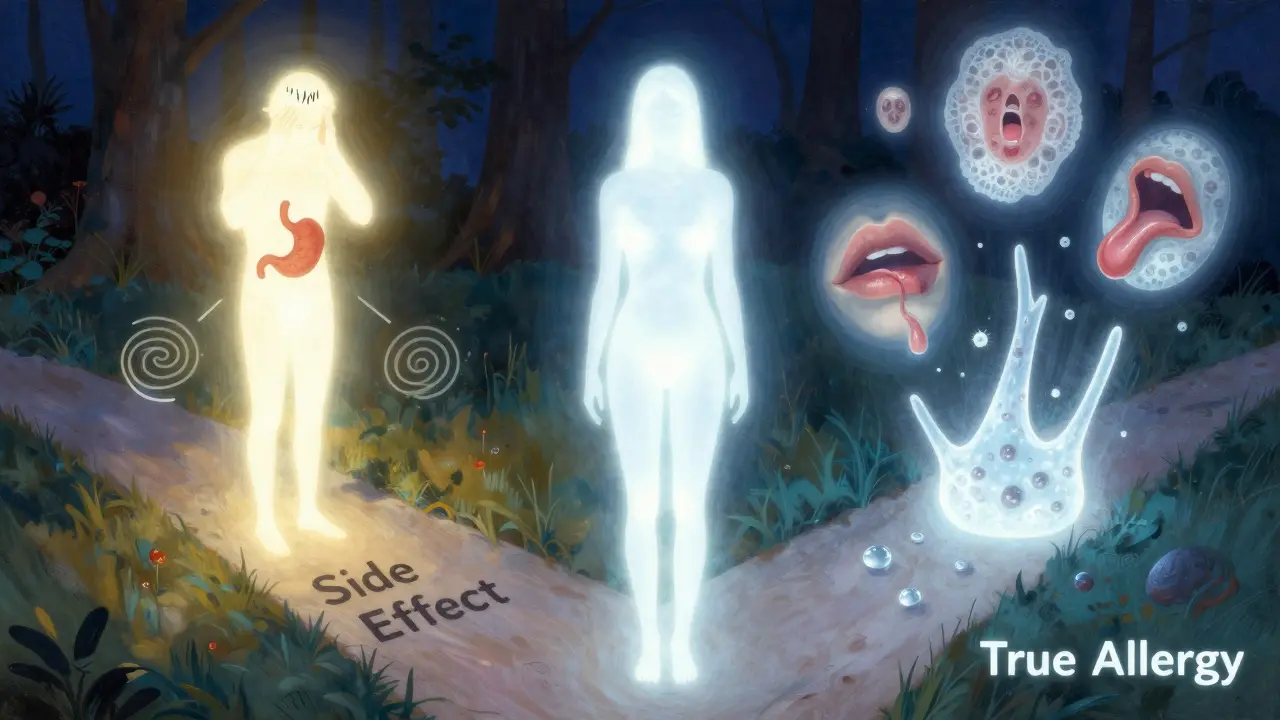
Most people think if a drug makes them feel bad, it’s an allergy. But that’s not always true-and getting it wrong can be dangerous. You might avoid life-saving antibiotics because you think you’re allergic to penicillin, when in reality, you just got nauseous. Or worse, you might take a drug again after a real allergic reaction and end up in the hospital. The difference between a side effect and a true drug allergy is an immune system response to a medication that can cause life-threatening reactions isn’t just medical jargon. It’s about safety, treatment options, and even your life.
What’s Actually Happening in Your Body?
A side effect is just what the drug does that you didn’t expect-or didn’t want. It’s not your immune system fighting back. It’s the medicine doing its job too well, or in the wrong place. For example, antibiotics like amoxicillin can upset your stomach because they kill bacteria in your gut, not just the ones causing your infection. That’s not an allergy. That’s a side effect. It’s common, predictable, and often goes away if you take the drug with food or lower the dose.
A true drug allergy? That’s your immune system mistaking the drug for a threat-like a virus or pollen. It produces antibodies, usually IgE, and triggers inflammation. That’s why you get hives, swelling, trouble breathing, or even anaphylaxis. This isn’t about dosage. It’s about your body’s defense system going rogue. Even a tiny amount can set it off. And it gets worse each time you’re exposed.
Timing Tells the Story
When did the reaction happen? That’s one of the biggest clues.
If you broke out in hives or your lips swelled up within 30 minutes of taking a pill-that’s a red flag for a true allergy. Immediate reactions, especially under an hour, are almost always immune-driven. Anaphylaxis, the most dangerous form, usually hits within minutes. It can cause your blood pressure to drop, your airway to close, and your heart to race. This isn’t something you can just "wait it out."
Side effects? They often show up later. Nausea from aspirin? That might hit 20 minutes after you swallow it-but it won’t get worse with each dose. Dizziness from blood pressure meds? That’s usually tied to how much you took. These reactions don’t escalate. They just… stick around until you stop the drug.
Delayed reactions are trickier. Some allergies show up days or even weeks later. Think of a rash that appears 10 days after starting an antibiotic. That could be a T-cell-mediated allergy-still immune-driven, still serious. Conditions like DRESS (Drug Reaction with Eosinophilia and Systemic Symptoms) or Stevens-Johnson Syndrome fall here. These aren’t "bad stomach bugs." They’re rare but life-threatening immune attacks on your skin and organs.
How Many Systems Are Involved?
Side effects usually stick to one system. Stomach? That’s GI. Headache? That’s nervous system. Drowsiness? Central nervous system again.
True allergies? They rarely stay in one place. If you have a rash and swelling and trouble breathing and vomiting-that’s not a side effect. That’s a multi-system reaction. The American College of Allergy, Asthma, and Immunology found that 87% of confirmed drug allergies involve two or more organ systems. Side effects? Only 22% do.
Think of it this way: if you took a painkiller and your hand went numb, that’s a side effect. If you took the same pill and your hand went numb and your throat closed up and you broke out in hives-that’s an emergency. That’s an allergy.

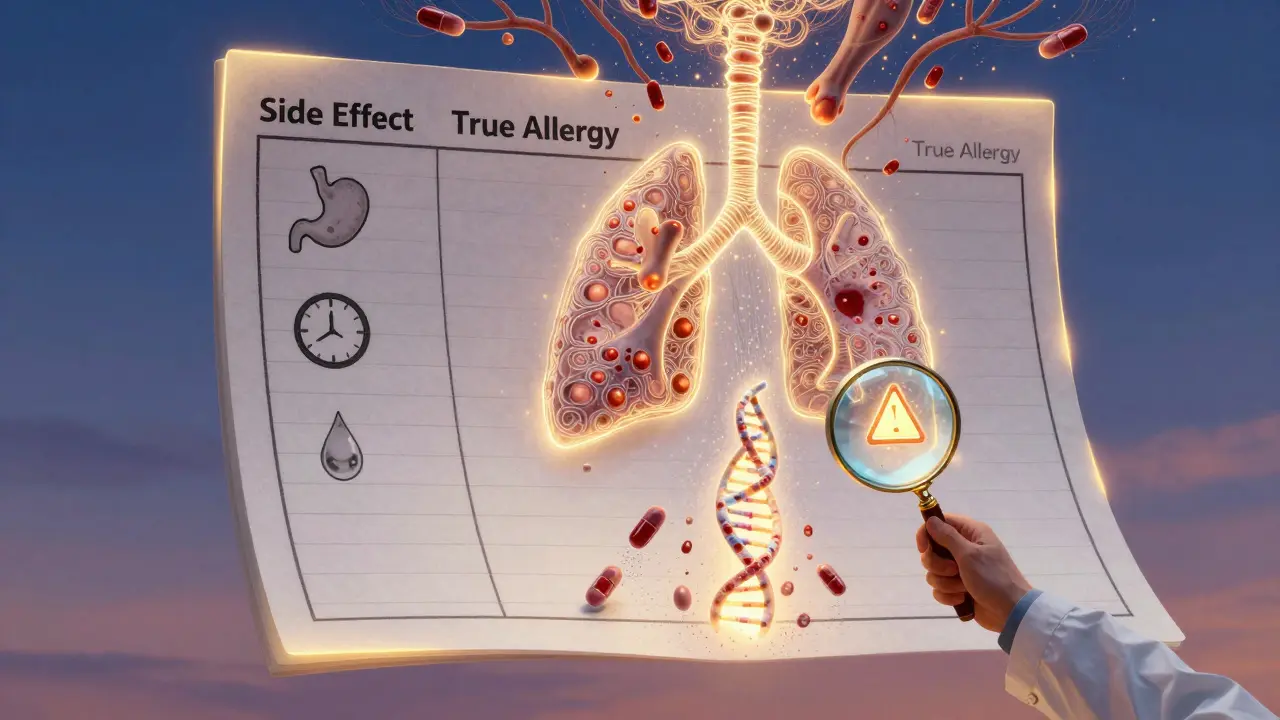
Common Symptoms: Side Effect vs. Allergy
Let’s break down what you might feel-and what it probably means.
| Symptom | Usually a Side Effect | Usually a True Allergy |
|---|---|---|
| Nausea or vomiting | ✔️ Common (22-35% of users) | ❌ Rare alone |
| Headache | ✔️ Common (18% of users) | ❌ Unlikely alone |
| Dizziness | ✔️ Common | ❌ Unlikely alone |
| Hives or rash | ❌ Rare | ✔️ Very common (75% of allergies) |
| Swelling (lips, tongue, throat) | ❌ Never | ✔️ Common (60% of allergies) |
| Wheezing or trouble breathing | ❌ Rare | ✔️ Common in severe cases (30% of anaphylaxis) |
| Fever or joint pain | ❌ Rare | ✔️ Common in delayed reactions |
Here’s the big mistake: people think "I got sick after taking this drug" = allergy. But nausea, diarrhea, and dizziness are the most common side effects-not signs of an immune response. A 2022 JAMA study found that 68% of people who thought they were allergic to penicillin were actually just experiencing stomach upset. That’s why so many people avoid penicillin unnecessarily. And why doctors end up prescribing stronger, costlier antibiotics that increase the risk of dangerous infections like C. diff.
Why Getting It Wrong Costs Lives (and Money)
Labeling a side effect as an allergy isn’t just inconvenient-it’s dangerous. People with a mislabeled penicillin allergy are 69% more likely to get a C. diff infection. Their hospital stays are 30% longer. And they’re more likely to get antibiotics that kill off good bacteria, fueling antibiotic resistance.
The CDC estimates that incorrect penicillin allergy labels cost the U.S. healthcare system over $1 billion a year. That’s because doctors avoid penicillin and reach for drugs like vancomycin or clindamycin-broader-spectrum, more expensive, and more likely to cause side effects themselves.
Meanwhile, 90-95% of people who say they’re allergic to penicillin can actually take it safely. How do we know? Because they’ve been tested. Skin tests and oral challenges under medical supervision can confirm or rule out a true allergy with over 95% accuracy. Yet most people never get tested. They just avoid the drug forever.
What Should You Do?
If you think you have a drug allergy, here’s what to do:
- Write it down. When did it happen? What were you taking? What symptoms did you get? How long did they last?
- Don’t assume. Nausea? Headache? Dizziness? These are likely side effects-not allergies.
- Look for the red flags. Hives, swelling, trouble breathing, or a rash that spread quickly? That’s a signal to get evaluated.
- Ask for a referral. Talk to your doctor about seeing an allergist. Skin testing or a supervised drug challenge can give you a clear answer.
- Update your records. If you’re cleared, make sure your doctor, pharmacist, and hospital records reflect that. Don’t let an old label haunt you.
Many hospitals now have pharmacist-led allergy assessment programs. These programs have cut inappropriate antibiotic use by 27%. And patients who get tested? 87% report better treatment options afterward-with zero bad reactions.
What’s Changing in 2026?
Things are getting better. The FDA now requires medication labels to clearly separate "side effects" from "allergies." Electronic health records must distinguish them too-by January 2025, every doctor’s system in the U.S. has to do it right.
New tools are coming. The Penicillin ImmunoCAP test, approved in 2023, detects specific IgE antibodies with 97% accuracy. Hospitals are using AI-powered decision tools to flag risky labels and suggest testing. The American College of Allergy is pushing for standardized terms: "allergy" (immune), "intolerance" (non-immune reaction), and "side effect" (expected effect).
And research is moving fast. The NIH is studying genetic markers that could predict who’s at risk for severe reactions-before they even take the drug. That’s the future: personalized, precise, and safe.
For now, the best tool you have is knowledge. Don’t let fear or confusion keep you from the right treatment. If you’ve been avoiding a drug because you "had a reaction," ask: Was it really an allergy-or just a side effect? The answer could change your health for the better.
Can you outgrow a drug allergy?
Yes, especially with penicillin. Studies show that up to 80% of people who had a true penicillin allergy as children lose their sensitivity after 10 years. But you shouldn’t assume it’s gone. Always get tested before taking the drug again. A simple skin test can confirm whether your immune system still reacts.
If I had a rash from a drug, does that mean I’m allergic?
Not necessarily. Many rashes from drugs are non-allergic. They can be caused by viral infections, heat, or even the drug’s effect on your skin cells. A true allergic rash is usually raised, itchy, and appears within hours. Delayed rashes (like those from antibiotics) can be allergic too, but only if they’re part of a broader reaction-like fever, swelling, or organ involvement. A doctor can help determine the cause.
Can a side effect become an allergy?
No. A side effect is a pharmacological reaction-it’s not immune-based. But you can develop a true allergy to a drug even if you’ve taken it safely before. Your immune system can suddenly start recognizing it as a threat. That’s why even if you’ve taken a drug without issues, you should still watch for new symptoms like hives or swelling.
What should I do if I think I’m having a drug allergy?
Stop taking the drug immediately. If you have trouble breathing, swelling in your throat, dizziness, or a rapid heartbeat-call 911 or go to the ER. These are signs of anaphylaxis, which can be fatal without treatment. Even if symptoms seem mild, see your doctor or an allergist to find out what really happened. Don’t wait.
Is it safe to take a drug again if I had a side effect before?
Usually, yes. Side effects like nausea, dizziness, or mild headaches often improve with time, lower doses, or taking the drug with food. Talk to your doctor first-they may suggest adjusting your dose or timing. But if you ever develop hives, swelling, or breathing problems on re-exposure, stop immediately and get evaluated. That’s when it may have turned into a real allergy.
Knowing the difference between a side effect and a true drug allergy isn’t just about avoiding discomfort. It’s about making sure you get the right treatment, safely and effectively. Don’t let a mislabeled reaction limit your options. Ask questions. Get tested. Stay informed.






Comments
Demetria Morris
3 February 2026People still don’t get it. If you throw up after penicillin, that’s not an allergy-it’s your gut screaming. But no, you’ll avoid every antibiotic for the rest of your life and then blame the doctor when you get C. diff. Classic.
Geri Rogers
4 February 2026YESSS!! 🙌 I’m an allergist and this is the #1 thing I see in clinic. So many folks think "I got sick" = "allergy"-but nausea? Headache? Dizziness? Those are side effects, not immune emergencies. Get tested before you rule out life-saving meds. You’re not being dramatic-you’re being safe. 💪
Samuel Bradway
5 February 2026I had a rash after amoxicillin when I was 12. Thought I was allergic forever. Got tested last year-turns out it was just a viral rash that happened to coincide with the antibiotic. Now I take penicillin like it’s candy. So glad I didn’t waste 20 years avoiding it.
Caleb Sutton
6 February 2026They’re lying. The FDA doesn’t care about you. They want you on expensive antibiotics so Big Pharma can profit. Penicillin is cheap. They’re hiding the truth. Your EHR is rigged. They don’t want you to know you can outgrow it. They want you afraid.
pradnya paramita
8 February 2026It’s critical to differentiate between IgE-mediated hypersensitivity (Type I) and non-immunologic adverse drug reactions. The former involves mast cell degranulation and histamine release, while the latter is pharmacodynamic in nature-e.g., GI irritation from NSAIDs due to COX-1 inhibition. Misclassification leads to therapeutic suboptimalization and increased antimicrobial resistance burden.
Jamillah Rodriguez
9 February 2026Ugh, another long post about penicillin. Can we talk about something fun? Like cats? Or TikTok? 😩
Susheel Sharma
9 February 2026Let’s be real-this is all corporate sanitization. They call it a "side effect" to avoid liability. You think your body doesn’t know what’s happening? You think your immune system doesn’t register every damn molecule? Wake up. The system wants you dependent. They don’t want you cured-they want you compliant.
Janice Williams
11 February 2026How can anyone trust a medical system that conflates side effects with allergies? The entire paradigm is built on ignorance and institutional laziness. You’re not just risking your health-you’re enabling a broken infrastructure that prioritizes profit over precision. Shameful.
Rachel Kipps
12 February 2026i had a rash after sulfa drugs when i was a kid. never took them again. i just assumed it was an allergy. never thought to get tested. maybe i should? i dont know. maybe i’m being dumb.
caroline hernandez
12 February 2026For those who’ve been labeled "penicillin allergic" without formal testing: you’re likely part of the 90% who can safely tolerate it. The gold standard is skin testing followed by graded oral challenge under supervision. This isn’t experimental-it’s standard of care. Ask your provider for an allergist referral. You deserve better than guesswork.
Jhoantan Moreira
13 February 2026This is such an important post. 🙏 I’ve seen so many people avoid life-saving meds because they misremembered a stomach ache as an allergy. I’m so glad we’re getting better at testing and labeling. Let’s keep spreading the word-knowledge saves lives. ❤️
Joseph Cooksey
15 February 2026Let’s not pretend this is just about medical accuracy. This is about power. Who gets to decide what your body can tolerate? Who gets to say your reaction was "just a side effect" and not a sacred signal from your immune system? The pharmaceutical industry, the FDA, the doctors-they all have agendas. You think they want you to know you can outgrow an allergy? No. They want you to keep taking the expensive ones. Keep the labels. Keep the fear. That’s how they keep you in the system.
Sherman Lee
15 February 2026AI is already flagging allergy labels. The EHRs are being updated. The FDA’s forcing change. But here’s the real question-who’s behind all this? Why now? Who profits when people stop avoiding penicillin? Who loses? Don’t believe the surface story. There’s a deeper game here.
Zachary French
16 February 2026Let me school you on this. The NIH is funding genetic markers to predict hypersensitivity? Pathetic. That’s not science-that’s corporate insurance arbitrage. They don’t want to fix the system. They want to predict who’ll get sick so they can deny them coverage before it happens. This isn’t progress. It’s pre-crime medicine. And you’re all just clicking "like" while they rewrite your biology.