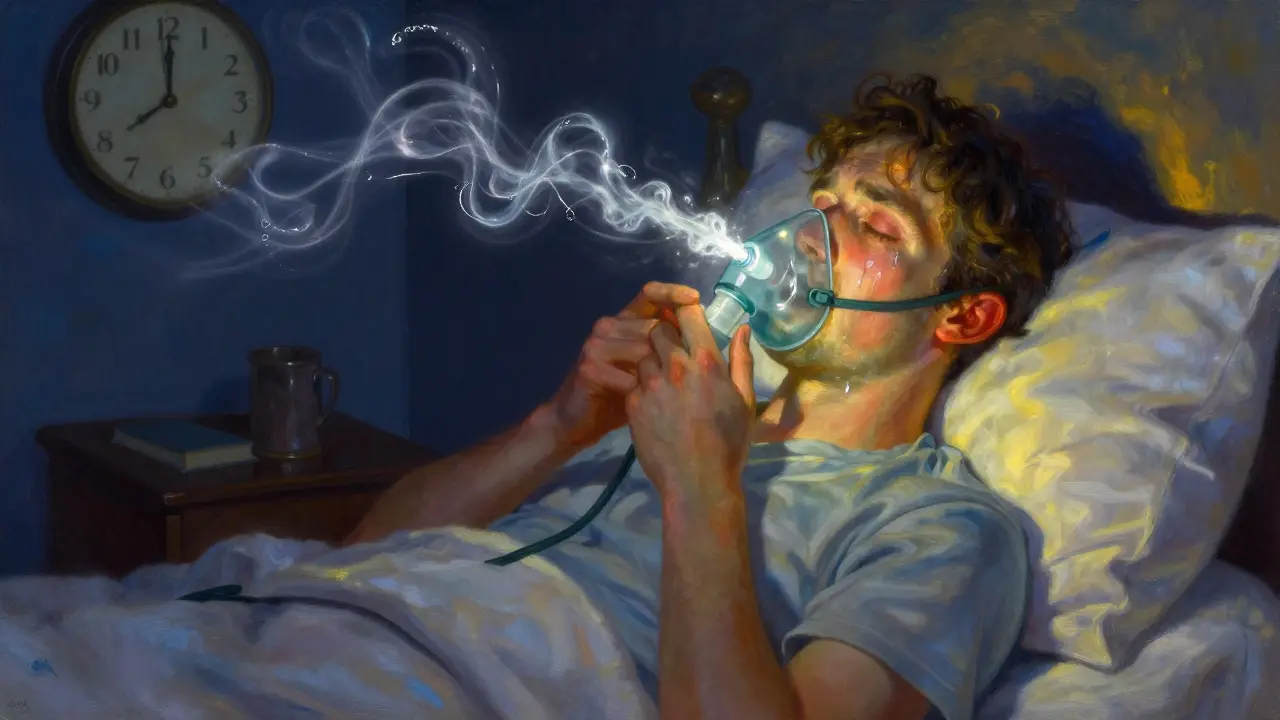
What Are Cluster Headaches?
Cluster headaches are not just bad headaches-they’re among the most painful conditions known to medicine. People who experience them describe the pain as burning, drilling, or like a hot poker shoved behind the eye. The pain is always on one side of the head, usually around the eye or temple, and hits hard and fast. Attacks last between 15 and 180 minutes, and they don’t just come once-they can strike multiple times a day, sometimes for weeks or months straight. This pattern is called a cluster period, and it often happens at the same time every day, even waking people up in the middle of the night.
Unlike migraines, cluster headaches come with clear physical signs on the same side as the pain: watery eyes, a stuffy or runny nose, drooping eyelid, or a flushed face. People often can’t sit still during an attack-they pace, rock, or bang their head against the wall. It’s why doctors sometimes call it the "suicide headache." The pain is so intense that people have described it as worse than childbirth or broken bones.
Cluster headaches affect about 1 in 1,000 people. Men are three times more likely to get them than women, and they usually start between ages 20 and 50. While the exact cause isn’t fully understood, the hypothalamus-a part of the brain that controls sleep, body temperature, and hormones-appears to be overactive during attacks. This is why many people get attacks at the same time every day, often during REM sleep.
Why Oxygen Therapy Works
Oxygen therapy is the fastest, safest, and most reliable way to stop a cluster headache attack in its tracks. Breathing 100% pure oxygen through a mask can shut down the pain in as little as 10 minutes. How? The high flow of oxygen seems to calm down the overactive nerves in the brainstem and hypothalamus that trigger the attack. It’s not a cure, but it’s the closest thing to a quick reset button.
Studies show that 78% of people get completely pain-free within 15 minutes of starting oxygen therapy. That’s better than most medications. Even better, oxygen has no side effects. Triptans, the main drug alternative, can cause chest tightness, dizziness, or even heart problems in people with high blood pressure or heart disease. Oxygen doesn’t have any of that. It’s safe for people with heart conditions, pregnant women, and older adults.
The key is getting the right setup. You need 100% medical-grade oxygen delivered at 12 to 15 liters per minute through a non-rebreather mask with a reservoir bag. This isn’t the same as the nasal cannulas used for COPD. That kind of oxygen won’t work. You need a mask that lets you breathe in pure oxygen without mixing in room air. If the flow is too low-below 10 liters per minute-the chance of relief drops sharply. One study found that at 12 liters per minute, 78% of patients were pain-free after 15 minutes. At 4 liters per minute? Only 20% felt better.
How to Use Oxygen Therapy Correctly
Timing is everything. If you wait even 10 to 15 minutes after the pain starts, the oxygen might not work as well. The goal is to start breathing it the moment you feel the first twinge. That’s why people who use oxygen regularly keep their equipment ready in multiple places: by the bed, on the couch, even in the car.
Here’s how to use it right:
- Turn on your oxygen concentrator and set the flow to 12-15 liters per minute.
- Put on the non-rebreather mask, making sure the reservoir bag fills up and stays inflated as you breathe.
- Seal the mask tightly against your face-no air leaks. A poor seal is the most common mistake.
- Breathe deeply and steadily for 15 to 20 minutes, even if the pain starts to fade.
- Don’t stop early. Stopping too soon can let the headache come back.
Most people learn the technique after one or two attacks. But 42% of new users report problems with the mask seal at first. If the mask slips or air leaks, the oxygen won’t reach your system fast enough. Some people switch to demand-valve masks, which release oxygen only when you inhale. These are lighter, quieter, and more portable-great for travel or if you’re on the go.

What Equipment You Need
You don’t need a hospital to use oxygen therapy at home. You need a few key things:
- Oxygen concentrator: A machine that pulls oxygen from the air and delivers it at high flow. Look for models rated for 15 liters per minute continuous flow, like the Invacare Perfecto2 or Inogen One G5. Portable models weigh under 5 pounds and can run on battery.
- Non-rebreather mask: Must have a reservoir bag and one-way valves to prevent breathing back in carbon dioxide. These cost $5-$10 each and should be replaced every few months.
- Tubing: Medical-grade, 10-15 feet long, compatible with your concentrator.
Costs vary. A new concentrator runs $1,200 to $2,500. Many people rent instead, paying $150-$300 a month. Insurance often covers it-but getting approved can be a battle.
Insurance and Access Problems
Even though oxygen therapy is the gold standard, many people can’t get it. In the U.S., Medicare only covers oxygen for cluster headaches if you’ve tried two different triptans first and have at least one attack per week. Even then, 41% of initial claims get denied. Private insurers are inconsistent: UnitedHealthcare approves about 68% of requests, while Aetna approves just 42%.
People in rural areas have it worse. Only 28% have immediate access to oxygen at home, compared to 63% in cities. Some patients end up buying equipment out of pocket-sometimes thousands of dollars-just to get relief. Organizations like Clusterbusters have pushed for state laws to improve coverage. As of 2023, 22 states have passed laws requiring insurers to cover oxygen therapy for cluster headaches.
Telehealth services and headache specialist directories can help you navigate the system. The American Headache Society’s "Find a Headache Doctor" tool connects patients with providers who know how to fight for coverage.
Who Doesn’t Respond to Oxygen?
Oxygen works for most-but not all. About 20% of people don’t get relief, even with perfect technique. Research shows certain factors make oxygen less likely to work:
- You’ve never smoked (odds of failure are 2.3 times higher)
- You have constant headache pain between attacks
- Your attacks last longer than 180 minutes
If oxygen doesn’t work for you, don’t give up. Other options exist: injectable sumatriptan, nasal zolmitriptan, or newer devices like gammaCore, which uses electrical stimulation to calm nerves. Some people use a combination-oxygen to stop the attack, and a triptan to prevent a second one.

Real Stories from People Who Use Oxygen
On Reddit’s r/ClusterHeadaches community, over 70% of users say oxygen changed their lives. One person wrote: "12 L/min gets me pain-free in 8 minutes if I catch it early. My pain dropped from 9/10 to 0. I finally sleep again." Another said: "I used to dread nights. Now I keep my portable unit by my bed. I breathe, I close my eyes, and it’s gone. No pills. No side effects. Just air."
But the frustration is real too. Many users report spending hours on the phone with insurance companies. One patient shared: "I got approved after 8 appeals. Took 11 months. My attacks didn’t stop while I waited. I had to buy my own machine."
There are also success stories beyond pain relief. One woman said oxygen cut her attack frequency from 8 per day to just 2 during a cluster cycle. Experts believe that by stopping attacks quickly, oxygen may help break the cycle over time.
The Future of Oxygen Therapy
New technology is making oxygen therapy easier. In January 2023, Inogen launched the G5 portable concentrator-lightweight, quiet, and approved for air travel. In May 2023, the FDA cleared the O2VERA device, designed specifically for cluster headaches, with a 15 L/min output and a 5.2-pound weight.
In Europe, a new nasal cannula system delivered 89% pain relief in clinical trials. Trials are now underway to test demand-valve masks that release oxygen only when you inhale-cutting treatment time down to under 7 minutes.
For now, oxygen remains the only non-drug treatment with Level A evidence from both the American Academy of Neurology and the European Headache Federation. It’s not perfect, but for millions of people, it’s the difference between suffering and living.
What to Do Next
If you think you have cluster headaches:
- See a headache specialist-general neurologists may not recognize the pattern.
- Keep a headache diary: note time, duration, symptoms, and what helped.
- Ask your doctor for a prescription for 100% oxygen therapy (ICD-10 code G44.0).
- Get a non-rebreather mask and a high-flow concentrator before your next attack.
- Position equipment where you spend the most time: bedroom, office, living room.
Don’t wait for the next attack to prepare. If you’re already diagnosed, check if your oxygen equipment is working properly. Clean your mask weekly. Replace tubing every 3 months. And if insurance denies your request-appeal. You’re not alone. Thousands have fought this battle and won.





Comments
Solomon Ahonsi
1 February 2026This post is basically a 5-page ad for oxygen machines. I’ve had cluster headaches for 12 years and the only thing that works is screaming into a pillow until my face bleeds. Oxygen? Yeah right. My insurance denied it three times. I’m not buying a $2k machine just so some startup can fund their Tesla.
George Firican
2 February 2026There’s a profound irony in how medicine treats cluster headaches: we have a treatment that’s non-pharmacological, non-invasive, and universally safe-yet we make patients jump through bureaucratic hell to access it. The hypothalamus isn’t just overactive; it’s been abandoned by the healthcare system. Oxygen therapy doesn’t just relieve pain-it restores dignity. The fact that insurers require two failed triptans before approving oxygen speaks less to medical protocol and more to institutional disregard for human suffering. We treat migraines like a disability and cluster headaches like a personal failure. That’s not science-it’s moral laziness.
Matt W
4 February 2026I’ve been using oxygen for 3 years now. First time I used it, I cried. Not from pain-from relief. I didn’t know it could be this simple. My wife says I look like a different person when the attacks stop. Just make sure your mask fits. I wasted two weeks thinking mine was broken-turns out I wasn’t sealing it right. Don’t overthink it. Breathe. It works.
Anthony Massirman
5 February 2026Oxygen = free. Insurance = garbage. Get the machine.
jay patel
6 February 2026lol so i just read this whole thing and now i feel like a total idiot because i thought i was just having a really bad sinus infection. i mean, i’ve been using a nasal spray and ibuprofen for 8 months. turns out i’m basically a human volcano with a bad attitude. also, i typed ‘concentrator’ as ‘concentrater’ twice. sorry. my brain is still half-asleep from last night’s attack.
Ansley Mayson
6 February 2026This is why America is broken. You need a $2000 machine to treat a condition that’s been documented since the 1800s. Meanwhile, we fund space telescopes and drone strikes. Pathetic. And don’t get me started on the ‘clusterbusters’ charity. Sounds like a marketing team’s idea of a band name.
phara don
7 February 2026Does anyone know if the O2VERA device works with standard non-rebreather masks? Or do you need their proprietary setup? Asking for a friend who’s broke and desperate.
Hannah Gliane
8 February 2026OMG I can’t believe people are still using oxygen?? 🙄 Like, it’s just air. Why not try acupuncture? Or crystals? Or crying into a bag of potato chips? I’ve had migraines since I was 14 and I just take a nap and pretend I’m in a spa. 🌸✨ Also, if you’re not rich enough to afford this, maybe you shouldn’t be having headaches? Just saying. #FirstWorldProblems
Murarikar Satishwar
9 February 2026I’ve been managing cluster headaches for over a decade, and oxygen therapy was the only thing that gave me back my life. I work in IT in Bangalore, and my employer didn’t cover it at first. I spent six months writing letters, attaching medical studies, and even translating the AAN guidelines into Hindi to show my HR. They finally approved it last year. If you’re struggling with insurance, don’t give up. The paperwork is brutal, but the relief? Worth every minute.
Bob Hynes
10 February 2026I used to think oxygen was for old people with COPD. Then I got my first cluster attack at 3 a.m., screamed so loud my dog ran out the door, and my wife grabbed the oxygen tank we got from the VA after my dad passed. I breathed for 12 minutes. Felt like I was waking up from a nightmare I didn’t know I was in. Now I keep one in the car, one in the living room, and one in my backpack. I’m not taking any chances. This ain’t medicine. This is survival.
larry keenan
11 February 2026The clinical efficacy of high-flow oxygen therapy in cluster headache management is well-documented in peer-reviewed literature, particularly in the Journal of Neurology and Headache. The mechanism involves hyperoxia-induced vasoconstriction of the trigeminal-autonomic reflex arc, with subsequent modulation of hypothalamic activity. However, logistical barriers to access-particularly in rural and underserved populations-represent a significant public health disparity. The current reimbursement paradigms, while aligned with CMS guidelines, fail to account for acute temporal patterns of attack onset, thereby undermining the therapeutic window critical to efficacy.