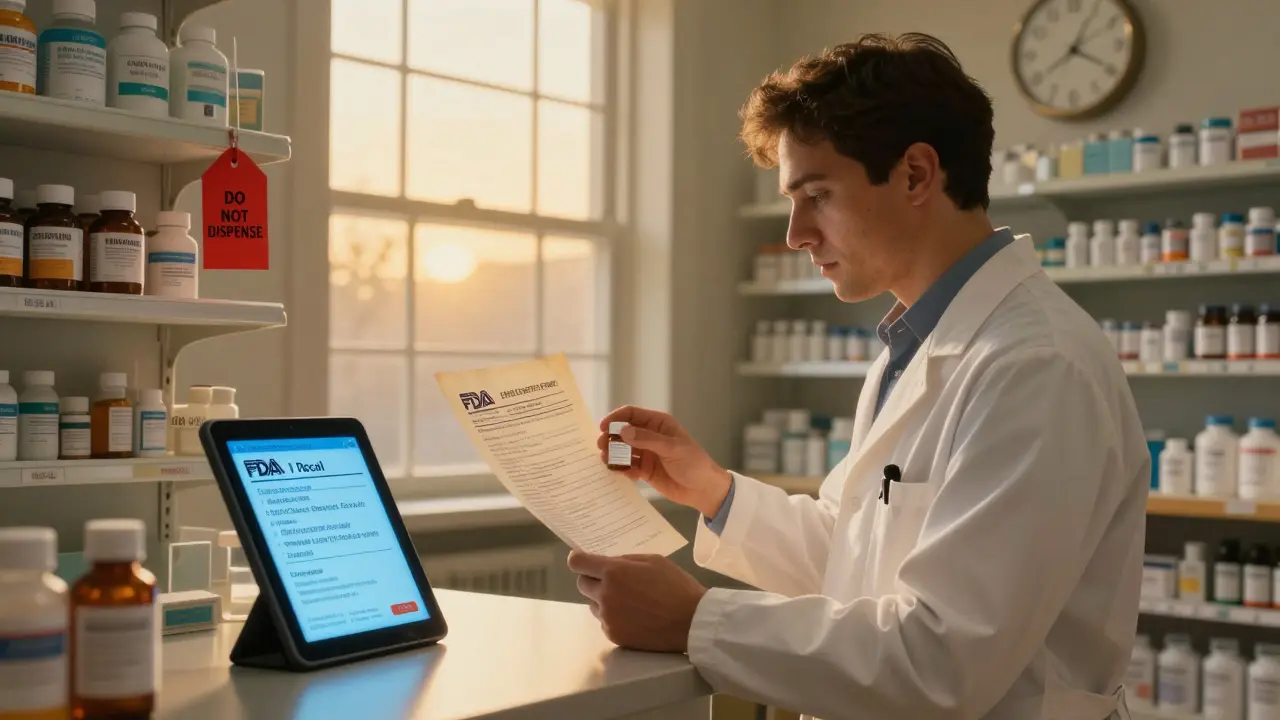
When a drug recall happens, it’s not just a notice on a website-it’s a race against time to protect patients. If your pharmacy doesn’t have a solid system for checking recall notifications, you could be putting people at risk. The FDA doesn’t just issue recalls; it expects pharmacies to act fast, especially for Class I recalls, which can cause serious harm or death. And if you miss one, you’re not just risking patient safety-you’re risking your license.
What Kinds of Drug Recalls Matter to Your Pharmacy?
Not all drug recalls are the same. The FDA classifies them into three levels, and each one demands a different response.- Class I recalls are the most urgent. These involve drugs that could cause serious injury or death. Think contaminated antibiotics, pills with the wrong dose, or medications with toxic impurities like nitrosamines. Pharmacies must verify and remove these within 24 hours.
- Class II recalls are less critical but still serious. These are drugs that might cause temporary health problems or pose a low risk of serious harm. For example, a mislabeled pill bottle or a batch with slightly off potency. You have 24 hours to respond, but patient notification isn’t always required.
- Class III recalls are mostly administrative. The drug won’t hurt you, but it violates labeling or manufacturing rules. Maybe the expiration date is smudged or the packaging is misprinted. These rarely require patient notification, but you still need to pull them from shelves.
According to the FDA’s 2023 quarterly report, 67% of all drug recalls are Class II. But if you ignore Class I, you’re playing Russian roulette with patient lives.
How Do Recall Notifications Actually Reach Your Pharmacy?
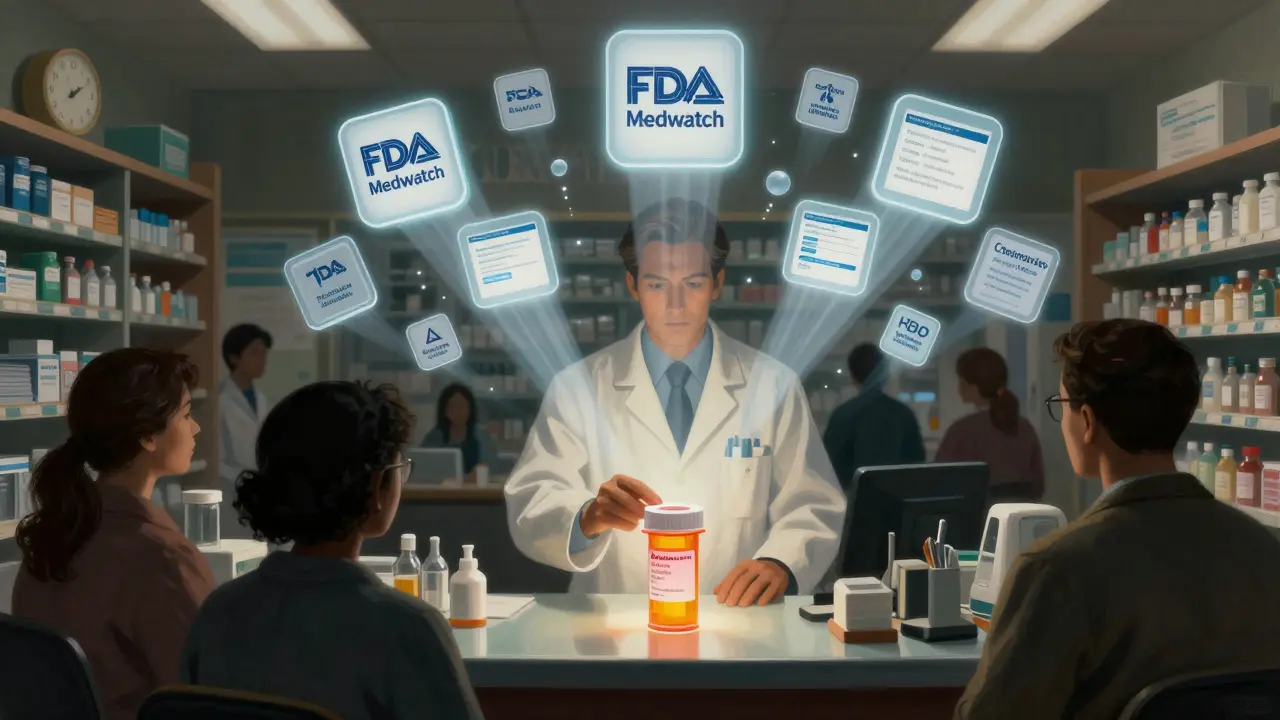
Recall notices don’t just show up in your inbox. They come through multiple channels-and if you rely on just one, you’re setting yourself up for failure.- FDA MedWatch Email Alerts: Free, official, and mandatory. You must register at www.fda.gov/safety/medwatch. These alerts go out hourly for Class I recalls and are updated weekly in the FDA Enforcement Report.
- Wholesaler Notifications: Your distributor (like McKesson, Cardinal Health, or AmerisourceBergen) sends direct alerts. Over 80% of independent pharmacies use these. But beware: 18.7% of these alerts are false positives due to mismatched lot numbers.
- Pharmacy Management Systems: This is where things get real. Systems like QS/1, PioneerRx, and FrameworkLTC pull FDA data automatically. They cross-reference your inventory with recall lists, flagging exact lot numbers and NDC codes. Hospitals using these systems cut their recall response time from 7 hours to under 2 hours.
- Mail and Fax: Still used, but dangerously slow. A certified letter can take 47 hours to arrive. The University of Florida found that 28.6% of these notices never even reached the pharmacy in time for Class I recalls.
Dr. Lucinda L. Maine of the American Association of Colleges of Pharmacy says it plainly: "Pharmacies must use at least three redundant systems to meet the 24-hour standard." Relying on just email? Not enough. Waiting for a fax? Too risky.
Step-by-Step: How to Verify a Recall Notification
When a recall hits, you need a clear process. Here’s how the best pharmacies handle it:- Confirm the recall classification within 1 hour. Is it Class I, II, or III? This determines your urgency.
- Check the FDA’s official Enforcement Report every Wednesday. Don’t just trust an email-go to the source. Look for the NDC number, lot number, and expiration date.
- Match it to your inventory. If you use a pharmacy system, it should auto-flag matching lots. If you’re manual, pull your dispensing logs and check every bottle. Look for exact lot numbers-some recalls only affect one batch out of ten.
- Verify patient records. For Class I and II recalls, you must identify patients who received the affected medication. This is where systems with patient history tracking shine. A Walgreens internal audit found that 23% of failures happened because techs couldn’t access records after hours.
- Initiate patient notification. For Class I recalls, you must contact 100% of affected patients within 8 hours. For Class II, aim for 80%. Use phone calls, not just mail. SMS and automated voicemails work too.
- Remove the product. Physically pull it from shelves, lock it, and label it "Do Not Dispense." Document the removal.
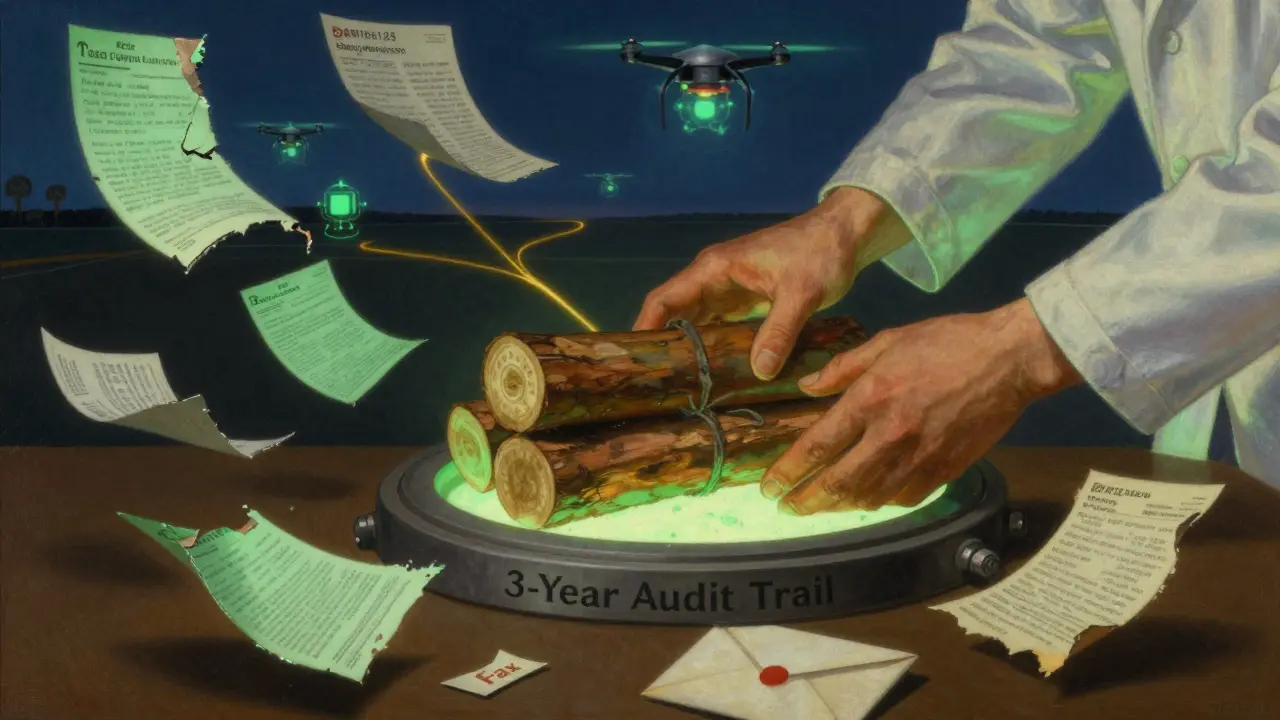
- Record everything. FDA requires you to keep verification logs for 3 years. Use electronic audit trails-92% of compliant pharmacies do.
The Cleveland Clinic’s 12-step protocol is the gold standard. Skipping even one step increases your risk of missing a dangerous recall.
Why Most Pharmacies Still Fail at This
You’d think with all the tech available, pharmacies would be flawless. But here’s what’s really happening:- Too many false alerts. Systems like RedBook send 15-20 recall notices a week-but 80% of them don’t apply to your inventory. One pharmacist on the Pharmacy Tech Forum said it takes 2-3 hours just to filter out junk.
- System costs are brutal. PioneerRx’s recall module costs $2,495 a year plus $495/month for data feeds. For a small independent pharmacy that only sees 2-3 real recalls a year, that’s not worth it.
- Staff burnout. A 2023 survey found that 73% of pharmacists had at least one "near miss" where a recall was received but not acted on because they were swamped with prescriptions.
- Outdated inventory systems. 68% of community pharmacies still can’t auto-match lot numbers. That means someone has to manually type in 15-character lot codes-on a screen that’s too small, while a patient is waiting.
And here’s the kicker: 43% of Class I recalls miss patients who got multi-month supplies through medication synchronization programs. If you don’t check your sync patients, you’re leaving them exposed.
What You Need to Do Right Now
You don’t need a $50,000 system to stay compliant. But you do need a plan.- Register for FDA MedWatch today. It’s free. Go to www.fda.gov/safety/medwatch and sign up. Set up email alerts for Class I and Class II recalls.
- Enroll in your wholesaler’s recall system. McKesson, Cardinal Health, AmerisourceBergen-they all offer free recall alerts. If you don’t know how, call your rep. Ask for "Recall Alert enrollment."
- Use your pharmacy system’s recall module if you have one. If you don’t, consider upgrading. The savings in time and risk reduction are real. A hospital pharmacy that switched to an automated system cut response time from 8 hours to 47 minutes.
- Assign a recall coordinator. Not "whoever’s free." Designate one person-pharmacist or tech-to handle all recalls. Train them. Give them 8 hours of initial training and 2 hours quarterly.
- Test your system. Once a quarter, run a mock recall. Pretend a Class I recall hit. See how long it takes to find the product, notify patients, and document everything. If it’s over 4 hours, fix your process.
What’s Coming Next
The FDA isn’t slowing down. By 2025, all Class I recalls must include patient-level risk data. By 2027, AI-powered systems will auto-verify recalls and notify patients without human input. The MediLedger blockchain pilot is already testing real-time lot tracking with 12 manufacturers.But here’s the truth: the system won’t fix itself. If you wait for automation, you’re waiting for someone else to protect your patients. Right now, you’re the last line of defense.
How often does the FDA update drug recall information?
The FDA updates its official Enforcement Report every Wednesday. However, for urgent Class I recalls, alerts are distributed hourly through email systems and pharmacy management platforms. Pharmacies should check both the weekly report and real-time alerts to avoid delays.
Can I rely on my pharmacy software to catch all recalls?
No. While modern pharmacy systems like QS/1 and PioneerRx do a great job, they depend on accurate data feeds. Some recalls still arrive with incomplete lot numbers or formatting errors. You should always cross-check with the FDA’s official website and your wholesaler’s alert system. Never rely on one source alone.
What if I miss a recall notification?
Missing a recall can lead to patient harm, regulatory fines, or even loss of your pharmacy license. The FDA requires pharmacies to demonstrate a robust recall response system during inspections. If you’ve missed one, document what happened, fix your system immediately, and train your team. Transparency and correction are better than denial.
Do I need to notify patients for every recall?
For Class I recalls, you must notify 100% of patients who received the product. For Class II, 80% is expected. Class III recalls typically don’t require patient notification. Always check the FDA’s official recall notice for specific instructions. Patient notification can be done by phone, SMS, or certified mail-never just a generic letter.
Are small independent pharmacies held to the same standards as big chains?
Yes. The FDA and CMS hold all pharmacies to the same legal standards, regardless of size. However, small pharmacies often struggle with cost and staffing. The key is to use free tools (FDA MedWatch, wholesaler alerts) and create a simple, repeatable process. You don’t need expensive software-you need a plan and discipline.
How long do I need to keep recall records?
FDA regulations require pharmacies to keep all recall verification records for at least 3 years. This includes emails, inventory logs, patient notifications, and staff training records. Electronic audit trails are preferred and are used by 92% of compliant pharmacies. Paper logs are acceptable but harder to audit.





Comments
Angel Wolfe
28 February 2026The FDA is just another puppet of Big Pharma. You think they actually care about patient safety? Nah. They’re letting dangerous drugs slip through because the lobbyists paid off the regulators years ago. I’ve seen it firsthand-my cousin died after taking a recalled med and the FDA buried the report. They don’t want you to know how many Class I recalls are quietly downgraded to Class III to avoid bad press. Wake up. This isn’t about compliance-it’s about control.
And don’t get me started on those ‘pharmacy management systems.’ They’re all owned by the same corporations that supply the drugs. You think QS/1 is helping you? It’s feeding data back to the manufacturers so they can track who’s complaining. You’re not protected-you’re being monitored.
Register for MedWatch? That’s a trap. They’ll flood you with junk alerts so you start ignoring the real ones. I stopped checking mine after the third time they flagged a batch that wasn’t even in my inventory. Now I just call my wholesaler and ask ‘Is this real?’-and if they hesitate? I know it’s a cover-up.
They want you to think this is about procedures. It’s not. It’s about making you dependent on systems they control. The real solution? Burn the computers. Go back to paper logs. At least then you’re not feeding your data into the surveillance machine.
They’ll say I’m crazy. Fine. But when your pharmacy gets shut down for missing a recall… who do you think they’ll blame? Not the FDA. Not the distributors. You. Always you.
Sophia Rafiq
1 March 2026So many people overcomplicate this. Honestly the core is simple: three sources, no exceptions. MedWatch, wholesaler, and your system. If you’re not using all three, you’re gambling. I’ve seen it happen-techs get overwhelmed, miss an email, assume the wholesaler got it, and boom-two weeks later a patient calls because they got the wrong pill. Not a big deal? Until it is.
False positives? Yeah, they suck. But the cost of missing one real recall is way higher than spending 10 minutes a day filtering. I keep a spreadsheet-just color code ‘junk’ vs ‘real’ and over time you start recognizing patterns. RedBook spam? Ignore. Wholesaler alert with matching NDC? Act.
And yeah, small pharmacies can’t afford PioneerRx. But you don’t need it. Use free tools + a checklist. Print it. Tape it to the counter. Train one person to be the recall checker. No more ‘who’s on duty?’ nonsense.
It’s not about tech. It’s about routine. Do the boring stuff consistently and you’ll be fine.
Brandie Bradshaw
2 March 2026It is, indeed, a profoundly disturbing reality that the regulatory infrastructure surrounding pharmaceutical safety is so heavily reliant on fragmented, inconsistent, and often contradictory data streams-each of which carries its own inherent vulnerabilities, from latency to misclassification to outright systemic neglect.
One must consider not merely the procedural steps outlined, but the epistemological fragility of the entire system: if recall notifications are distributed via email, fax, wholesaler feed, and automated platform, and if each of these channels possesses differing degrees of reliability, then the very notion of ‘verification’ becomes an illusion-a performative compliance ritual rather than a genuine safeguard.
Furthermore, the requirement to ‘notify 100% of patients’ within eight hours for Class I recalls is not merely logistically challenging-it is ethically dubious, given the pervasive gaps in electronic health record interoperability, the under-resourcing of community pharmacies, and the staggering turnover of patient contact information.
And yet, we continue to punish pharmacists for failures that stem from institutional abandonment-not individual negligence. The FDA’s expectation of perfect execution under conditions of structural inadequacy is not accountability-it is cruelty dressed as protocol.
Until we address the root: underfunding, understaffing, and the commodification of healthcare-we are merely rearranging deck chairs on the Titanic, while the iceberg looms larger every day.
Miranda Anderson
3 March 2026I’ve been a pharmacist for 18 years and I can tell you this-most of us aren’t lazy or negligent. We’re just drowning. You ever try to verify a recall while five people are waiting at the counter, one of them has a diabetic crisis, and your tech just quit because they got offered $2 more at the gas station?
It’s not that we don’t care. It’s that we’re stretched so thin that even the most careful person misses things. I had a near-miss last year. A Class II recall came in, I saw it, I thought I’d get to it after lunch. Lunch never happened. The bottle sat on the shelf for 14 hours before a customer asked why it looked weird.
And yeah, I felt awful. But the system didn’t help. The alerts came at 3 a.m. I didn’t check my phone. The system didn’t auto-flag it because the NDC was formatted wrong. The wholesaler sent a PDF. I had to open it on my phone, squint, type in a 15-character lot number by hand while a kid was screaming because his asthma inhaler was out.
We need more staff. We need better tech. We need less bureaucracy. And we need to stop pretending this is a ‘personal failure’ when it’s a systemic collapse.
Gigi Valdez
4 March 2026The premise of this post is fundamentally sound. The procedural framework for recall management is clearly articulated and aligns with established regulatory expectations. However, the underlying assumption-that pharmacists are the primary locus of accountability-requires critical reevaluation.
Pharmacies operate within a supply chain that is neither transparent nor equitable. Manufacturers are not held to the same standard of notification speed. Distributors prioritize profit over precision. Regulatory agencies lack the bandwidth for enforcement.
Therefore, while adherence to protocols is necessary, it is insufficient. True safety requires upstream accountability: mandatory real-time lot tracking from manufacturer to patient, standardized data formats across all channels, and legal liability for entities that fail to transmit accurate recall data.
Until then, pharmacists are being asked to act as the final, unpaid, overworked safety net for a broken system. This is not professional responsibility-it is institutional exploitation.
Sneha Mahapatra
4 March 2026As someone from India, I’ve seen how healthcare systems in developing countries handle recalls-often with no digital infrastructure at all. They rely on community pharmacists who know their patients personally. A name, a face, a child’s prescription. When a recall happens, the pharmacist calls every patient by name. No system needed.
Here in the US, we’ve automated everything so much that we’ve lost the human connection. We have alerts, logs, barcodes-but we don’t know who our patients are anymore. We don’t even remember their names.
Maybe the answer isn’t more tech. Maybe it’s less. Maybe we need to go back to trusting the person behind the counter, not the algorithm.
It’s not about compliance. It’s about care. And care can’t be coded.
bill cook
6 March 2026So you’re telling me I have to spend my entire weekend checking lot numbers because some corporate pharmacy got lazy? I’m tired of being the one who gets blamed for this mess. I work 60 hours a week. I have two kids. I don’t have time to be a FDA compliance officer.
And why are we even doing this? Who cares if a pill has the wrong label? People still take it. They don’t even notice. This whole thing is a scam to get pharmacies to buy more software.
They’re just trying to scare us into paying for upgrades. I’m not falling for it. I’ll keep doing what I’ve always done. If someone gets hurt? That’s on them. Not me.
Byron Duvall
6 March 2026Class I recalls? Please. The FDA’s entire recall system is a rigged game. They let the same companies that make the dangerous drugs also write the recall criteria. You think nitrosamines were caught because the FDA was watching? No-they were caught because a whistleblower in Germany leaked the data. The FDA didn’t do a damn thing until the media caught wind.
And those ‘pharmacy management systems’? They’re all paid for by the same corporations that produce the recalls. You think they’re helping you? They’re tracking your inventory so they can predict where the next recall will hit-and make sure you’re the one stuck with the blame.
Stop being a pawn. Stop checking emails. Stop trusting ‘official’ sources. The system is designed to fail you. The only way to survive is to ignore it all and hope for the best.
Katherine Farmer
7 March 2026While the post presents a superficially coherent framework, it reveals a fundamental misapprehension of systemic complexity. The reliance on ‘three redundant systems’ is not merely insufficient-it is epistemologically naive. Redundancy implies parity of function, yet the channels described-email, wholesaler, and software-are not equivalent; they are heterogenous, temporally asynchronous, and semantically inconsistent.
Furthermore, the notion that ‘a simple checklist’ suffices for Class I recall management ignores the cognitive load imposed upon practitioners already operating under conditions of chronic occupational stress. The FDA’s regulatory framework, in its current iteration, functions not as a safeguard, but as a liability-shifting mechanism.
The real issue is not compliance-it is the neoliberal erosion of public health infrastructure. Until we treat pharmacy as a public good rather than a profit center, all procedural advice is merely performative theater.
Full Scale Webmaster
8 March 2026Let’s be real-this whole recall thing is a circus. You think the FDA actually gives a damn? They’ve got 500 people in a basement in Silver Spring trying to keep up with 12,000 alerts a month. Half of them are spam. Half of the rest are outdated. The other half? They’re from manufacturers who forgot to update their own databases.
And don’t even get me started on the ‘wholesaler alerts.’ I’ve had McKesson send me a recall notice for a drug I stopped carrying in 2019. I’ve had three different alerts for the same batch with three different expiration dates. One said it was contaminated. Another said it was fine. The third said it was being recalled because the bottle was blue instead of green.
Pharmacy systems? They’re garbage. I use QS/1. It flagged a recall last month. I checked the FDA site. The NDC didn’t match. I called the wholesaler. They said ‘we don’t have that in our system.’ I called the manufacturer. They said ‘we don’t even make that anymore.’ So what do I do? Pull it? Leave it? I spent three hours on a bottle that didn’t even exist.
And now I’m supposed to notify patients? Who? The guy who picked it up in 2021? The woman who got it through a sync program and hasn’t been in since? I don’t have their numbers. The system doesn’t keep them. The law says I have to. So I fake it. I send an automated SMS to 200 people who never got it. I log it. I sleep.
This isn’t healthcare. It’s a haunted house with paperwork.