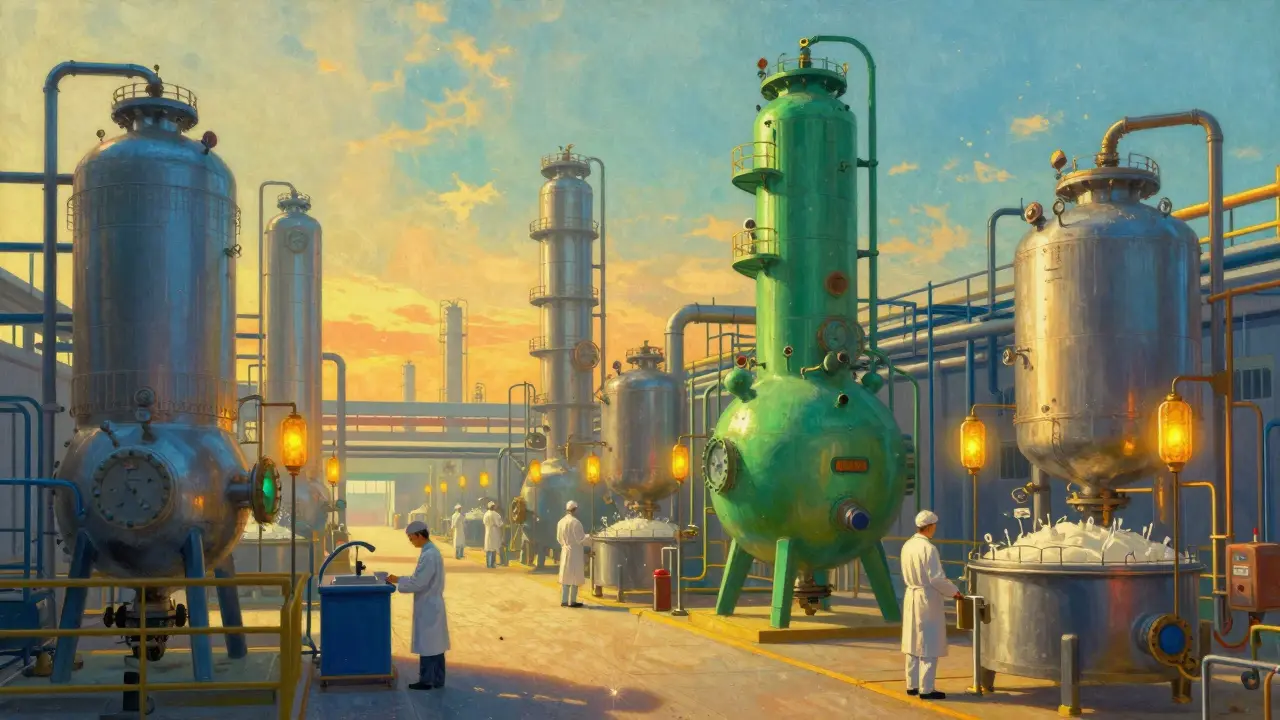
When you take a pill for high blood pressure, diabetes, or an infection, there’s a good chance the active ingredient inside came from a factory in China. About 80% of the world’s active pharmaceutical ingredients (APIs)-the raw chemical building blocks of medicines-are made in China. That’s not a small number. It’s the backbone of the global generic drug supply. But behind the low cost and massive output lies a complex, and sometimes troubling, reality: quality control is inconsistent, oversight is limited, and the system is built on a fragile foundation.
How China Dominates the Global API Market
China didn’t become the world’s top API producer by accident. After joining the World Trade Organization in 2001, the government poured billions into building chemical manufacturing hubs, especially in provinces like Jiangsu and Zhejiang. State subsidies, relaxed environmental rules, and tight control over raw material supply chains gave Chinese factories a massive cost advantage. Today, companies like Sinopharm and Shijiazhuang Pharma Group churn out 500 to 2,000 metric tons of APIs per year for drugs like metformin, amoxicillin, and losartan. Their production costs are 30-40% lower than in the U.S. or Europe.This isn’t just about volume. Chinese manufacturers specialize in the most dangerous steps of chemical synthesis-fluorination, handling toxic solvents, and multi-stage reactions that require extreme precision. Western and Indian companies have largely moved away from these steps because they’re risky and expensive. China stepped in, not because it was the safest option, but because it was the cheapest.
The Quality Gap: Numbers Don’t Lie
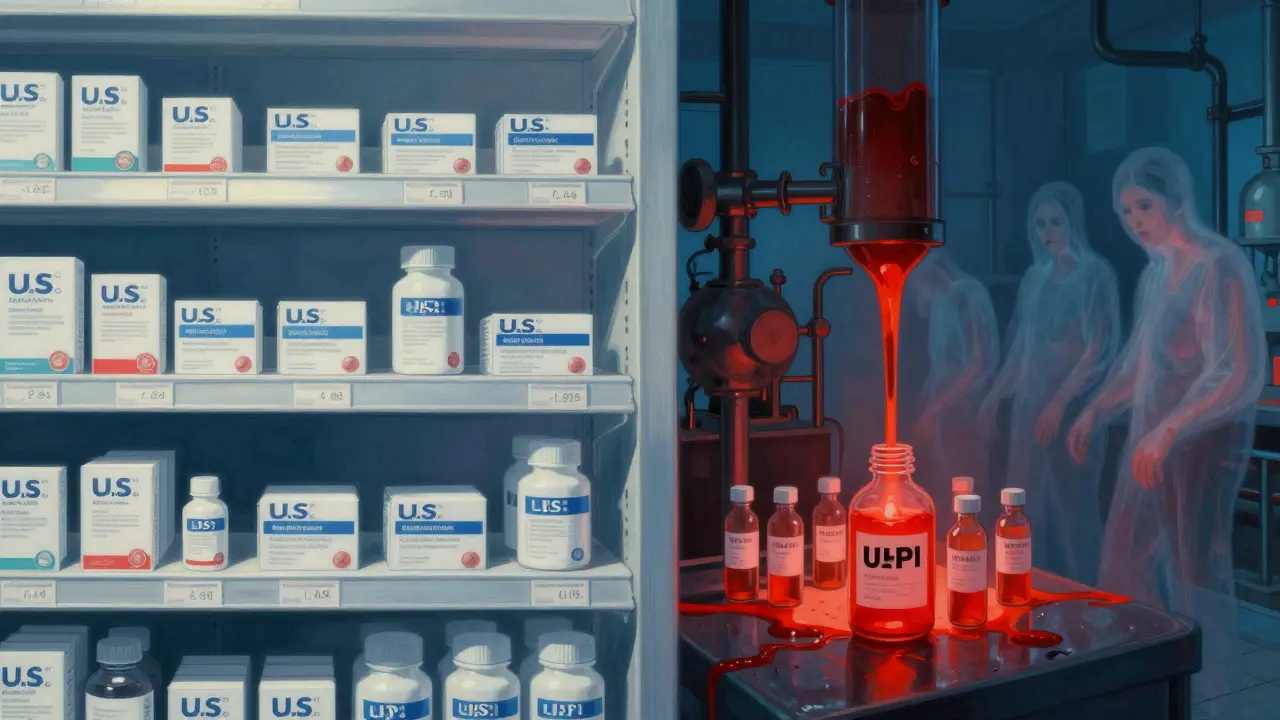
Cost doesn’t always equal quality. The U.S. Food and Drug Administration (FDA) inspects foreign drug plants, and the data is clear: Chinese facilities fail at a higher rate. Between 2022 and 2023, 78% of FDA warning letters to overseas manufacturers cited inadequate laboratory controls. Another 65% pointed to poorly validated manufacturing processes. And 52% flagged data integrity issues-like altered records or deleted test results.A 2023 FDA study found that 12.7% of API samples from China failed purity tests. Compare that to 2.3% from Europe and 1.8% from the U.S. That’s not a small difference. It’s a red flag. One U.S. generic drugmaker told a 2023 survey that they had to retest 37% of Chinese-sourced metformin batches due to out-of-spec results. For Indian-sourced metformin? Just 8%.
Even when the drugs reach the market, the risks linger. In 2023, Zydus Pharmaceuticals recalled over 1.2 million bottles of blood pressure medication because the API from Huahai Pharmaceutical in China was under-potent. Patients didn’t get the full dose. That’s not a manufacturing glitch. That’s a public health risk.
Why Quality Control Falls Short
The problem isn’t just corruption or negligence. It’s structural. Most Chinese API plants still use batches-old-school, single-vessel production lines-instead of continuous manufacturing, which is now standard in the U.S. and EU. Continuous systems reduce contamination risks and improve consistency. China lags here: 65% of its production is batch-based, while only 35% of Western facilities still use it.Another issue? Data. Quality control in China often relies on paper logs or unverified digital records. The FDA requires electronic records that can’t be edited after the fact. Many Chinese plants don’t meet that standard. One pharmaceutical executive described it as “a system built on trust, not verification.”
Even when China tries to fix things, the pace is slow. The National Medical Products Administration (NMPA) launched the Generic Consistency Evaluation program in 2016 to force Chinese generics to prove they work the same as brand-name drugs. But as of 2024, only 35% of approved generics have completed the test. That means over 60% of generics sold in China-and exported globally-haven’t been proven bioequivalent.
The Supply Chain Trap
Here’s the twist: China doesn’t make the final pills. It makes the active ingredient. India takes those APIs and turns them into tablets and capsules, then ships them to the U.S., Europe, and beyond. India imports 65% of its APIs from China. So even if you buy an Indian-made drug, the core chemical likely came from a factory in Hebei or Zhejiang.This creates a dangerous bottleneck. If China cuts exports-due to trade tensions, a factory shutdown, or a natural disaster-doctors and patients worldwide could face shortages. The U.S. FDA estimates that 90% of essential medicines rely on Chinese-made KSMs (key starting materials). That’s not just an economic issue. It’s a national security one.
Former FDA Commissioner Dr. Andrew von Eschenbach called it “a single point of failure for the global drug supply.” And it’s not hypothetical. During the early pandemic, when Chinese factories shut down temporarily, shortages of antibiotics and heart medications hit U.S. hospitals hard.
Who’s Doing Better?
India isn’t perfect, but it’s more transparent. Indian manufacturers have built reputations for reliability, even if their APIs often come from China. They’ve invested in quality systems, hired international auditors, and adopted FDA-style documentation. That’s why U.S. companies trust them more.Meanwhile, the EU and U.S. are pushing back. The European Union’s 2024 Pharmaceutical Strategy aims to cut API dependence on China from 80% to 40% by 2030. The U.S. CHIPS and Science Act allocated $500 million to rebuild domestic API production. Vietnam and Mexico are stepping in, too, offering lower costs than the U.S. with better oversight than China.
But here’s the catch: no one can match China’s scale. If you need 10 tons of a common API next month, only China can deliver it fast and cheap. That’s why most companies still use it-despite the risks.
Cost vs. Risk: The Real Trade-Off
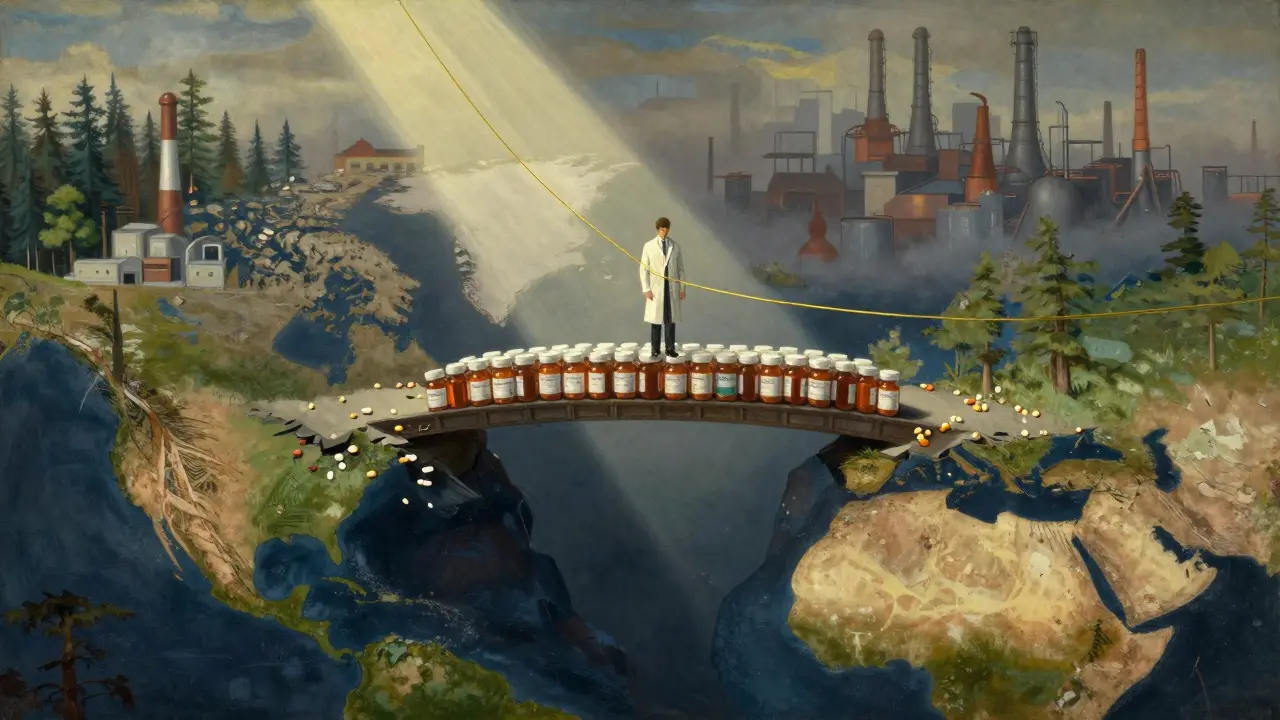
A 2024 Gartner survey of 150 pharmaceutical companies showed Chinese API suppliers scored 4.7 out of 5 for price and 4.5 out of 5 for production capacity. But for quality consistency? Only 3.2 out of 5. European suppliers? 4.1 out of 5 for quality, but 2.8 out of 5 for price.For many companies, the math is simple: pay more for quality, or save money and risk recalls. One procurement manager admitted, “Switching to Chinese API saved us $4.2 million a year-even with a 15% rejection rate.” That’s the reality. The savings are real. The consequences? Often hidden until it’s too late.
What’s Changing?
China knows the reputation is damaged. That’s why it launched “Pharma 2035,” a $22 billion plan to upgrade factories, adopt continuous manufacturing, and improve data systems. The NMPA now requires electronic submissions for all new API applications and wants 30% of high-volume products made with continuous processes by 2026.Some progress is real. Since 2015, China has shut down 80% of non-compliant factories. The number of generic drug manufacturers dropped from 7,000 to 2,500. That’s a big cleanup.
But the question remains: is it enough? Deloitte says China needs to hit 95%+ regulatory compliance across global markets within five years-or it will lose market share. That means investing $30-40 billion more in quality infrastructure. So far, the signs are mixed.
What This Means for You
If you’re a patient, you probably won’t know where your drug was made. Labels don’t say. But you should know: the cheapest option isn’t always the safest. If your medication suddenly stops working, or you experience unexpected side effects, it could be tied to an API quality issue.If you work in healthcare, pharmacy, or supply chain, you’re already facing this. You’re choosing between cost and control. You’re balancing budgets against risk. And you’re not alone.
The truth is, the global drug supply is a fragile chain. China built it on speed and scale. Now, the world is asking: can it be made safe?





Comments
Donna Zurick
3 March 2026I’ve been taking generic blood pressure meds for years and never thought twice about where they’re made. Now I’m googling my prescription like it’s a horror movie. Seriously though, if the active ingredient is from China, why does the label say 'Made in India'? That’s not transparency, that’s obfuscation.
We need to stop pretending this is just a cost issue. It’s a public health blind spot.
RacRac Rachel
5 March 2026I get that China’s cheap, but 12.7% of API samples failing purity tests? 😳 That’s not ‘borderline’-that’s a system on life support. We’re betting lives on a gamble because it’s easier than rebuilding our own supply chains. The EU’s plan to cut dependence to 40%? Long overdue. 🇪🇺💪
Jane Ryan Ryder
6 March 2026So what? You think your $3 insulin is gonna be made in Ohio? Wake up. China feeds the world’s medicine cabinet. If you want pure, safe, overpriced drugs, move to Switzerland and pay $500 a pill. Otherwise, shut up and take your metformin.
Callum Duffy
7 March 2026This is a deeply complex issue, and the framing as 'China bad, West good' is overly simplistic. While quality control gaps are documented, it is also true that Chinese manufacturers produce at a scale unmatched elsewhere. The solution lies not in vilification, but in international regulatory harmonisation and investment in mutual standards.
Betsy Silverman
7 March 2026I lived in Hangzhou for a year and visited a pharma plant there. The workers were skilled, the facilities modern. But the paperwork? A mess. No one’s denying the system’s flaws-but demonizing an entire country ignores the human beings behind the production. We need cooperation, not outrage.
Ivan Viktor
8 March 2026So let me get this straight. We’re panicking because pills come from China, but we’re fine with phones and laptops coming from China? Funny how we’re okay with tech supply chains but not medicine ones. Maybe we just don’t like the idea of our health being outsourced.
Matt Alexander
9 March 2026It’s simple: if your drug doesn’t work, it’s probably because the API was weak. You can’t tell by looking at the bottle. Always check the manufacturer. If it’s from a place like Huahai or Sinopharm, ask your pharmacist if they’ve had batch issues. Most won’t tell you.
John Cyrus
10 March 2026People who cry about China making our meds are just scared of progress. The FDA finds issues? So what? They find issues with American plants too. Stop being hysterical. If you want pure drugs, go to a clinic and pay $1000 for a brand name. Otherwise, be grateful you’re not paying $200 for blood pressure pills
Shivam Pawa
10 March 2026As someone from India, I’ve seen how our industry relies on Chinese APIs. We’re not the villains here-we’re the middlemen trying to keep things running. The real issue is global supply chain fragility. India is investing in API production too, but scale takes time. Patience and collaboration, not blame.
Diane Croft
12 March 2026I work in pharmacy. We get batches from China, India, Europe. The Chinese ones? They’re the ones we test twice. And sometimes three times. We know. We just can’t say it out loud. The system’s built on silent compromise.
tatiana verdesoto
13 March 2026I’ve talked to workers in Jiangsu. They’re proud of their work. They want to make safe medicine. But the pressure to cut costs, meet quotas, and avoid inspections? That’s what breaks the system. It’s not about culture-it’s about incentives. Fix the system, not the country.
Justin Rodriguez
14 March 2026The real tragedy isn’t that China makes most APIs. It’s that we stopped building domestic capacity because it was ‘too expensive.’ Now we’re stuck. Pharma 2035 might help, but it’s too little, too late. We need to fund U.S. and EU API production like it’s infrastructure-not a budget line item.