
When you pick up a prescription at the pharmacy, you might not think about whether the pill in your hand is exactly the same as the one your doctor prescribed. But behind every generic drug swap is a rigorous, science-backed system called therapeutic equivalence codes. This isn’t just bureaucratic jargon-it’s what lets pharmacists safely replace a brand-name drug with a cheaper generic without asking your doctor again. And if you’ve ever wondered why some generics can be swapped and others can’t, the answer lies in how the FDA rates them.
What Are Therapeutic Equivalence Codes?
Therapeutic equivalence codes are the FDA’s way of telling pharmacists and doctors which generic drugs can be swapped in for brand-name versions with full confidence. These codes appear in the Orange Book, officially titled Approved Drug Products with Therapeutic Equivalence Evaluations. First published in 1980, the Orange Book has become the go-to reference for anyone involved in prescribing or dispensing medications in the U.S.The system works because it’s not enough for a generic drug to have the same active ingredient. It has to perform the same way in your body. That means matching the brand in strength, dosage form, route of administration, and-most critically-how quickly and completely it gets absorbed. The FDA calls this bioequivalence. If a generic passes that test, it gets an ‘A’ code. If not, it gets a ‘B’.
The A and B Code System
The first letter in a therapeutic equivalence code tells you everything you need to know.- A-rated drugs are considered therapeutically equivalent. That means you can swap them freely. About 90% of all generic drugs in the U.S. fall into this category. If you see ‘AB’, ‘AB1’, ‘AB2’, or ‘AB3’, you’re looking at a drug that’s been tested and cleared for substitution.
- B-rated drugs are not rated as equivalent. That doesn’t mean they’re unsafe-it means there’s not enough evidence to say they’re interchangeable. These might be complex products like inhalers, topical creams, or extended-release pills where bioequivalence is harder to prove. A ‘B’ code could mean the FDA needs more data, or that the product has known issues with absorption.
There are even more specific codes under the ‘B’ umbrella. For example:
- BC = extended-release dosage forms with potential bioequivalence concerns
- BT = topical products (like creams or gels) where absorption is inconsistent
- BN = aerosol or nebulizer products
- BX = not enough data to make a call
These aren’t just labels-they’re legal triggers. In 49 states, pharmacists are allowed to substitute A-rated generics without asking the prescriber. But if a drug is B-rated, they usually can’t swap it unless the doctor specifically says it’s okay.
How the FDA Decides: The Three Rules
The FDA doesn’t guess. They use three strict criteria to assign a code:- Pharmaceutical equivalence: Does the generic have the same active ingredient, strength, dosage form, and route of administration as the brand? If not, it’s out.
- Bioequivalence: Does the generic absorb into your bloodstream at the same rate and to the same extent as the brand? This is tested in healthy volunteers using blood samples. The FDA requires the generic’s absorption to be within 80%-125% of the brand’s.
- Clinical effect and safety: Has the drug been shown to work the same way in real patients? This is especially important for drugs with narrow therapeutic windows-like warfarin or lithium-where even small differences can cause harm.
If a drug passes all three, it gets an ‘A’. If it fails even one, it gets a ‘B’. No exceptions.
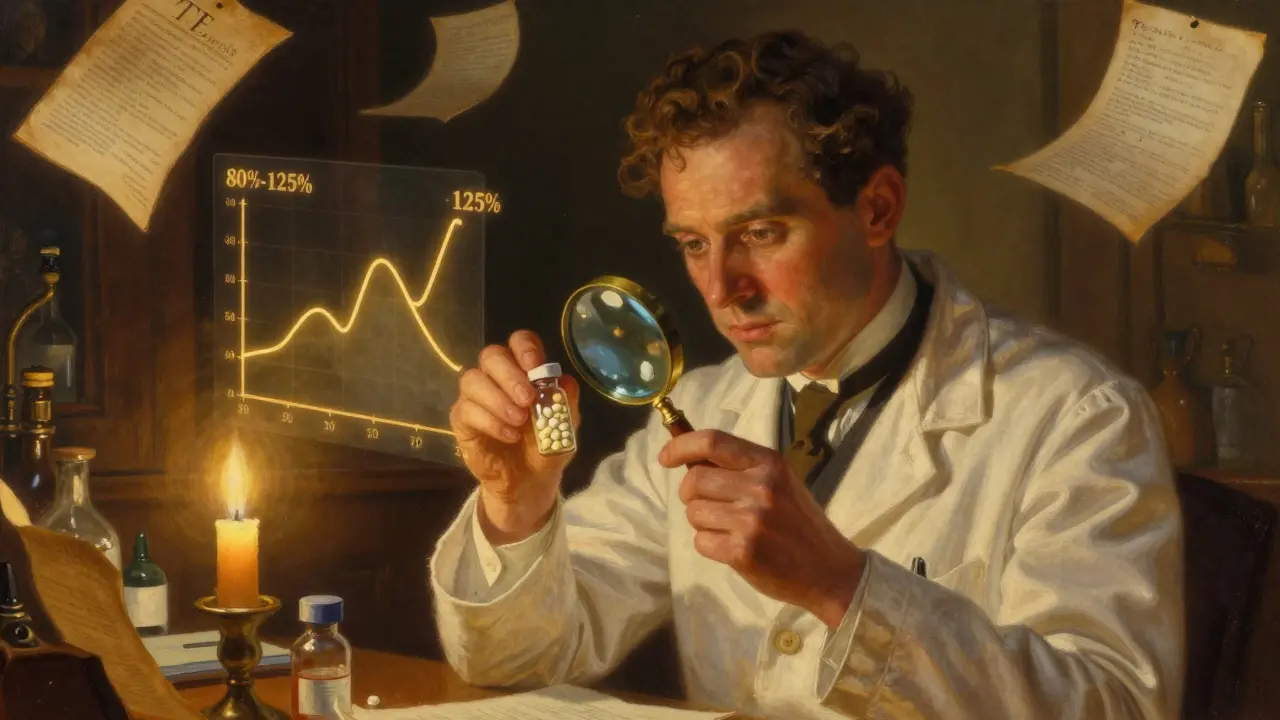
Why Some Generics Get B-Rated-Even When They Shouldn’t
Here’s where things get messy. Some B-rated drugs are just as effective as their brand-name counterparts. The problem isn’t the drug-it’s the testing method.Take topical creams. If you’re applying a steroid cream for eczema, how do you prove the generic absorbs the same amount through the skin? Blood tests don’t work well here. The FDA still relies on outdated methods for these products, so even if the cream works just as well, it gets a ‘B’ because the science can’t prove bioequivalence yet.
Same goes for inhalers. The way the drug is delivered-how fine the mist is, how much sticks in your lungs-can vary between brands and generics. But current tests can’t measure that accurately. So, despite real-world evidence showing they work the same, the FDA gives them a ‘B’.
Dr. Duxin Sun from the University of Michigan says this is a major flaw. “We’re using 1980s science to judge 2020s drugs,” he wrote in 2022. “For complex products, the current system doesn’t reflect reality.”
What Pharmacists and Doctors Actually Do
Pharmacists rely on the Orange Book every day. According to a 2022 survey by the National Community Pharmacists Association, 87% of pharmacists check the Orange Book at least once a week. They spend an average of 2.7 minutes per prescription verifying the TE code. That adds up to $1.2 billion in annual savings by avoiding unnecessary brand-name prescriptions.But confusion still happens. A 2022 American Medical Association survey found that 42% of physicians didn’t fully understand what ‘B’ codes meant. Some thought a ‘B’ meant the drug was unsafe. Others didn’t realize a ‘B’ could still be appropriate for their patient.
One real example: A patient on a B-rated extended-release pain medication was switched to a generic with the same code. The pharmacist refused, thinking it wasn’t allowed. But the doctor had prescribed it specifically because the patient had tried other generics and only this one worked. The delay caused unnecessary pain and an ER visit. It wasn’t a failure of the drug-it was a failure of understanding the code.
How the System Is Changing
The FDA knows the system has gaps. In 2022, they released a draft guidance to update how they evaluate complex drugs. They’re now working with manufacturers to develop better testing methods-like using skin patches to measure absorption for topical products, or lung deposition studies for inhalers.They’ve also expanded their Product-Specific Guidances (PSGs) to over 1,850 documents. These give manufacturers exact instructions on how to prove bioequivalence for each drug. More PSGs mean more ‘A’ ratings in the future.
The goal? Reduce B-rated products for complex generics by 30% by 2027. That’s not just a number-it’s hundreds of thousands of patients who could get cheaper, equally effective drugs.
Why This Matters to You
Generic drugs make up 90% of prescriptions filled in the U.S. But they cost only 23% of what brand-name drugs do. That’s how the system saves billions every year. The therapeutic equivalence code system is what makes that possible.If you’re prescribed a generic, and it has an ‘A’ code, you’re getting a drug that’s been proven to work just like the brand. No risk. No guesswork.
If you’re prescribed a B-rated drug, don’t assume it’s inferior. Ask your doctor or pharmacist: “Is this because the science is uncertain, or because it’s truly different?” Sometimes, the B-rated version is the only one that works for you.
The system isn’t perfect. But it’s the best we have-and it’s getting better.
What does an 'A' rating mean for a generic drug?
An 'A' rating means the generic drug is considered therapeutically equivalent to the brand-name version. It has the same active ingredient, strength, dosage form, and route of administration, and has passed bioequivalence testing showing it works the same way in the body. Pharmacists can substitute it without asking the prescriber, and it’s legally interchangeable in 49 U.S. states.
Can a 'B'-rated generic still be safe to use?
Yes. A 'B' rating doesn’t mean the drug is unsafe. It means the FDA doesn’t have enough data to confirm it’s interchangeable with the brand. Many B-rated drugs are clinically effective and used daily. The rating reflects limitations in testing methods-not necessarily differences in how the drug works in patients.
Why do some generic drugs have codes like AB1, AB2, or AB3?
These codes appear when there’s more than one brand-name drug (called a Reference Listed Drug) that the generic is being compared to. For example, if two different brands of a drug have slightly different formulations, the generic might match one better than the other. AB1, AB2, etc., tell pharmacists which specific brand the generic is equivalent to. Substitution is only allowed within the same group (e.g., AB1 can only be swapped for another AB1).
Are over-the-counter (OTC) drugs given therapeutic equivalence codes?
No. The FDA’s therapeutic equivalence system only applies to prescription drugs. OTC medications aren’t evaluated or coded in the Orange Book, even if they have generic versions. Pharmacists can still substitute OTC drugs, but they do so based on labeling and formulary guidelines-not TE codes.
How often is the Orange Book updated?
The FDA updates the Orange Book monthly. New drug approvals, code changes, and withdrawn products are added as soon as they’re reviewed. The full printed edition comes out once a year, but the online database is current as of the last update. Pharmacists are encouraged to use the online version for the most accurate information.






Comments
Michaela Jorstad
20 February 2026Wow, this is such a clear breakdown-I’ve been a pharmacist for 12 years and even I didn’t fully grasp how nuanced the AB1/AB2/AB3 codes were until now. Thanks for explaining it without jargon. Seriously, this should be required reading for every med student and pharmacy tech.
Jeremy Williams
21 February 2026It is indeed a remarkable system, one that balances regulatory rigor with practical clinical utility. The Orange Book, though seemingly archaic in format, remains an indispensable artifact of pharmaceutical science and legal interoperability in the United States.
Maddi Barnes
22 February 2026So let me get this straight… we’re using 1980s tech to judge 2020s drugs?? 😅 I mean, come ON. We have drones that deliver pizza, but we can’t figure out how to test if a cream absorbs through skin? 🤦♀️ And don’t even get me started on inhalers-like, we’ve got sensors that can detect a sneeze from three blocks away, but we’re still using ‘blood levels’ to judge a drug that’s supposed to go straight into LUNGS??
Also, why is ‘B-rated’ even a thing? It’s not like ‘B’ means ‘bad.’ It means ‘we’re too lazy to build better tests.’ And yet pharmacists are legally forced to treat it like a death sentence? I’ve seen patients cry because their pain med got switched and now they’re back in bed. This isn’t science. It’s bureaucracy with a lab coat.
Also, side note: if a drug works for you, it works. Period. The system isn’t perfect-it’s just the law. And laws are made by humans. And humans? They’re messy.
Jonathan Rutter
22 February 2026Ugh, another one of these ‘FDA is perfect’ fanboy posts. Let’s be real-this whole system is a scam. Big Pharma owns the Orange Book. They lobby to keep B-ratings on generics so they can keep charging $500 for a pill that costs $2 to make. And don’t even get me started on how they manipulate bioequivalence studies. They cherry-pick healthy volunteers, use tiny sample sizes, and then call it ‘science.’
My cousin was on a B-rated epilepsy med. Switched to an ‘A’ generic because his insurance forced it. Had a seizure in his sleep. Broke his collarbone. Now he’s on disability. The FDA says ‘it’s equivalent.’ I say: prove it to his skull.
Don’t believe the hype. This isn’t about safety. It’s about profit.
Jana Eiffel
23 February 2026The therapeutic equivalence framework, while imperfect, represents a monumental achievement in regulatory science. Its foundation in pharmacokinetic rigor ensures that patient safety remains paramount, even as market pressures incentivize cost-cutting. The distinction between pharmaceutical equivalence and bioequivalence is not merely technical-it is epistemologically significant.
One must not confuse regulatory limitation with clinical inadequacy. The ‘B’ designation is not a value judgment but a methodological boundary-a recognition of epistemic humility in the face of biological complexity.
aine power
23 February 2026A-rated = good. B-rated = bad. Stop overthinking it.
Robin bremer
23 February 2026bro this is wild 😳 i had no idea that like… the cream i use for my eczema is ‘B-rated’? and i’ve been using it for 5 years?? so like… is it safe?? or am i just lucky?? 🤔 also why does the fda even care how much goes into my blood if the cream works on my skin?? 🤯
also side note-why do they call it the ‘orange book’?? like… is it printed on orange paper?? or is it just vibes?? 🤨
Greg Scott
24 February 2026I’ve worked in community pharmacies for over a decade. The Orange Book is my bible. I check it before every generic fill. Most people don’t realize how much time and care goes into this. We’re not just handing out pills-we’re making sure someone doesn’t get sick because of a bad substitution. This system? It saves lives. Even if it’s not perfect.
Scott Dunne
25 February 2026As an Irishman, I find this entire system baffling. In Europe, we don’t need a 500-page document to tell us if a generic works. We trust the science, not the bureaucracy. The FDA’s obsession with classification feels like American overregulation at its finest. If it’s chemically identical, let pharmacists decide. Stop with the codes.
Ashley Paashuis
25 February 2026This is such an important topic, and I appreciate how thoughtfully it was presented. I’ve seen patients confused by B-ratings, and it’s heartbreaking. Many assume ‘B’ means ‘unsafe,’ when really it just means ‘we need better tools.’ The real issue is communication-between doctors, pharmacists, and patients. We need better education, not just better codes.
Davis teo
27 February 2026So you’re telling me a guy in a lab in Maryland decides whether my pain meds work based on blood samples from 12 college students?? And if they don’t match *exactly*? I’m stuck with $400 brand-name pills??
My grandpa took the same generic for 15 years. Never had a problem. Now his insurance says ‘B-rated’ so he can’t get it. He’s in tears. This isn’t science. It’s a corporate game.
And don’t even get me started on how the FDA lets manufacturers pick their own test subjects. It’s rigged.
Arshdeep Singh
27 February 2026Actually, this is just capitalism in disguise. The FDA doesn't care about patients-they care about patents. Every time they approve a new 'A' rating, it kills a monopoly. Big Pharma spends billions lobbying to keep generics out. The 'B' codes? They're not scientific-they're financial. The real problem isn't the system. It's the people who profit from its flaws.
Also, did you know? In ancient India, Ayurvedic practitioners used pulse diagnosis to assess drug efficacy. We're using blood tests. Progress?
Liam Crean
28 February 2026I really appreciate how this post acknowledged both the strengths and the flaws of the system. It’s easy to get angry at the FDA, but the truth is-they’re trying. The challenge with complex generics is real. Maybe the solution isn’t to scrap the system, but to fund better testing. I’d love to see more public-private partnerships here. Science should serve patients, not paperwork.