
Millions of people drink cranberry juice to prevent urinary tract infections. It’s a common home remedy, often recommended by doctors and pharmacies alike. But if you’re on medication-especially blood thinners like warfarin-you’ve probably heard conflicting advice. Some say it’s safe. Others warn you to avoid it completely. So what’s the truth?
The Warfarin Confusion
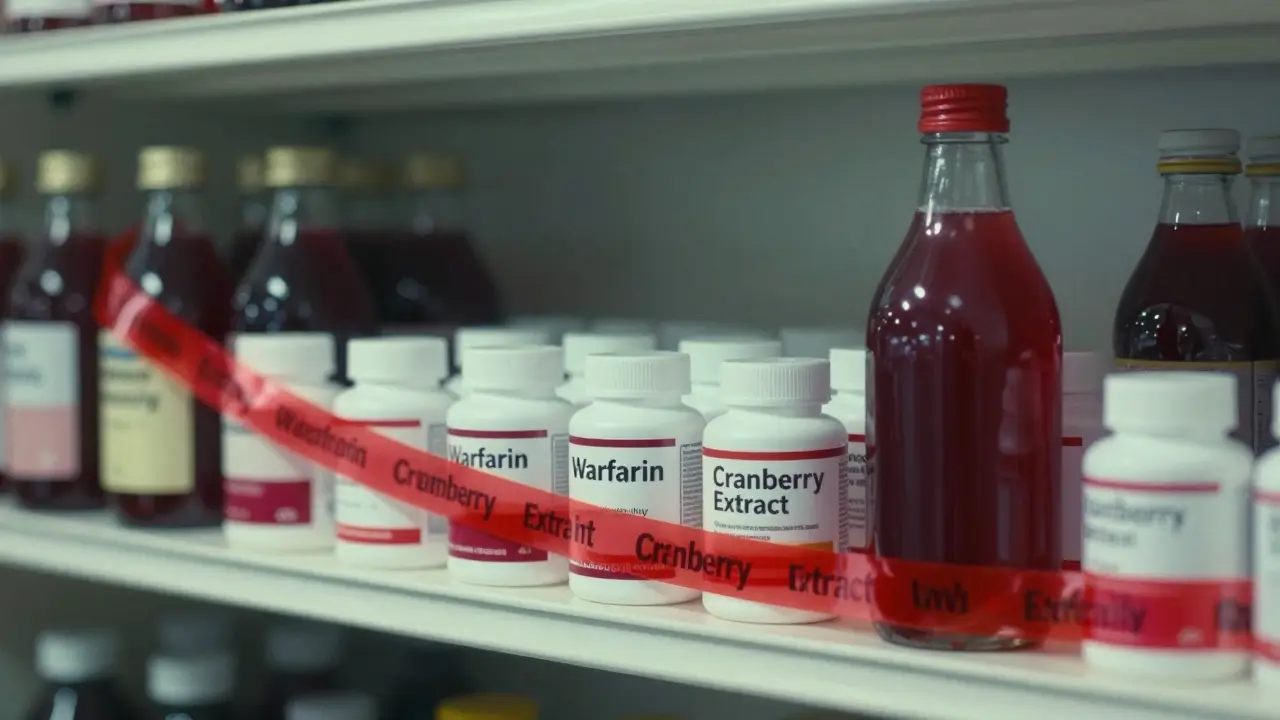
The biggest fear around cranberry juice centers on warfarin, a blood thinner used to prevent clots. Back in 2003, a single case report suggested that a man on warfarin had a dangerous spike in his INR (a measure of blood clotting time) after drinking cranberry juice. That one story sparked panic. Pharmacies started warning patients. Doctors told people to stop drinking it. But here’s the thing: after 20 years of research, the evidence is mixed.A 2010 review looked at 11 case reports and 4 controlled studies. Eight case reports claimed cranberry juice raised INR levels. But all four controlled studies found no change. One study gave 12 healthy adults 250 mL of cranberry juice three times a day for two weeks. Their INR stayed exactly the same. Another study with 18 participants found no effect on warfarin levels in the blood.
So why do some people still have problems? It’s likely because they’re not drinking regular juice. Many are taking concentrated cranberry supplements-pills or powders with way more active compounds than a glass of juice. These can contain up to 36 mg of proanthocyanidins per serving, far beyond what’s in a typical 8-ounce glass of cranberry cocktail (which is only about 27% cranberry juice). The real risk isn’t the juice you buy at the grocery store. It’s the high-dose supplements.
What About Other Medications?
Most people assume if cranberry juice affects warfarin, it probably affects other drugs too. But that’s not how it works. Drug interactions aren’t one-size-fits-all. Each medication is processed differently in the body.Take antibiotics like amoxicillin or cefaclor. In theory, cranberry might interfere with how they’re absorbed. A 2009 study tested this with 18 women. Half took the antibiotic with cranberry juice. The other half didn’t. The results? No meaningful difference in how the drug entered the bloodstream. The same was true for statins, blood pressure meds, and even antidepressants. No clinical evidence shows harm.
One drug that gets talked about a lot is alprazolam (Xanax). Since cranberry juice can inhibit an enzyme called CYP3A4 in test tubes, and that enzyme breaks down alprazolam, some assume it could make Xanax stronger. But here’s the catch: no human study has ever shown this happening. Not one. The same goes for most other medications. The theoretical risk doesn’t equal real-world danger.
Grapefruit Juice Is the Real Problem
People often confuse cranberry juice with grapefruit juice. That’s a mistake. Grapefruit juice has 17 known serious interactions with medications, including statins, blood pressure drugs, and immunosuppressants. It doesn’t just affect one enzyme-it shuts down a major drug-processing system in the liver and gut. Cranberry juice doesn’t do that.Even the FDA lists grapefruit as a known interaction risk. It doesn’t list cranberry. That’s not an accident. It’s based on decades of clinical data. If cranberry juice were as dangerous as grapefruit, we’d see hospital admissions piling up. We don’t.
What Do Experts Actually Say?
There’s disagreement among doctors, but the most experienced voices are leaning toward calm. Dr. David Ang-Lee from the University of Maryland says, “The lab data looks scary, but real patients don’t show the same effects.” Dr. Paul Watkins from the University of North Carolina calls the fear around cranberry juice “vastly overstated.”The American College of Clinical Pharmacy says: avoid cranberry products if you’re on warfarin. But they also say there’s no evidence of risk with antibiotics, statins, or most other common drugs. The American Urological Association updated its 2021 guidelines to say cranberry can be used for UTI prevention in patients not on warfarin-with no restrictions on other medications.
Meanwhile, pharmacists on Reddit report that 62% of patients ask about cranberry and warfarin every week. But 78% of those pharmacists still advise avoiding it-not because the evidence says it’s dangerous, but because they don’t want to risk a bad outcome. That’s caution, not science.
What Should You Do?
If you’re on warfarin and you drink cranberry juice regularly, don’t panic. But do this:- Stick to regular cranberry juice (8-12 oz per day). Avoid supplements unless your doctor approves them.
- Don’t suddenly start or stop drinking it. Consistency matters more than avoidance. If you’ve been drinking it for months, keep doing it. If you haven’t, don’t start.
- Get your INR checked more often for a few weeks after making any change.
- If you’re on a different medication-antibiotics, blood pressure pills, cholesterol meds-cranberry juice is almost certainly fine.
And if you’re taking a cranberry supplement? Talk to your pharmacist. These products aren’t regulated like drugs. One brand might have 10 mg of active compounds. Another might have 50 mg. That’s a big difference.

Why the Myths Keep Spreading
The fear around cranberry juice persists because it’s easy to misunderstand science. A lab study shows cranberry juice inhibits an enzyme. That sounds scary. But the human body isn’t a test tube. What happens in a petri dish doesn’t always happen in a person.Also, people remember stories. A woman on warfarin drinks cranberry juice and her INR goes up. She tells her friend. Her friend tells her doctor. The doctor warns everyone. But if 10 other people drink cranberry juice and their INR stays normal? That doesn’t make headlines. It doesn’t even get recorded.
And then there’s the supplement industry. Companies sell concentrated cranberry pills with bold claims: “99% pure cranberry!” “Triple-strength!” “Doctor-recommended!” But they don’t have to prove safety with medications. The FDA doesn’t require it. So the burden falls on you.
The Bottom Line
Cranberry juice isn’t poison. It’s not a drug killer. For most people, it’s a safe, natural way to help prevent urinary tract infections. About 20% of women get recurrent UTIs. For them, cranberry juice can be a real help.The only clear risk is with warfarin-and even then, it’s mostly tied to high-dose supplements, not the juice you pour from a bottle. If you’re on warfarin, be cautious. But don’t throw out your juice box. Just be smart about it.
For everyone else: enjoy your cranberry juice. Your body will thank you.
Can I drink cranberry juice while taking warfarin?
It’s complicated. Regular cranberry juice (8-12 oz per day) doesn’t consistently affect warfarin in clinical studies. But concentrated supplements might. If you’re on warfarin, avoid high-dose cranberry pills. Stick to standard juice, keep your intake consistent, and monitor your INR closely. Never start or stop cranberry juice without talking to your doctor.
Does cranberry juice interact with antibiotics?
No, not in any clinically meaningful way. A 2009 study tested amoxicillin and cefaclor with cranberry juice in 18 women. There was no significant change in how the antibiotics were absorbed or processed. You can safely drink cranberry juice while taking antibiotics for a UTI.
Are cranberry supplements safer than juice?
No. Supplements are often more concentrated and less regulated. A single pill might contain the equivalent of several glasses of juice. This increases the theoretical risk of interaction, especially with warfarin. Unless your doctor or pharmacist specifically recommends a supplement, stick to regular juice.
How much cranberry juice is too much?
One 8-ounce glass per day is fine for most people. Drinking more than 16 ounces daily doesn’t offer extra UTI protection and may increase sugar intake or upset your stomach. For people on warfarin, consistency matters more than quantity. Don’t go from drinking it every day to never drinking it-or vice versa.
Can I drink cranberry juice with statins or blood pressure meds?
Yes. Multiple studies have looked at statins (like atorvastatin), beta-blockers, and ACE inhibitors with cranberry juice. No clinically significant interactions were found. The same applies to most common medications. The only exception is warfarin-and even then, only with high-dose supplements.
Why do some doctors say to avoid cranberry juice entirely?
Some doctors err on the side of caution. A single case report from 2003 caused widespread fear, and not all providers have kept up with newer research. Also, if a patient has a bad reaction, the doctor could be held responsible-even if the evidence is weak. That’s why some still say “avoid it,” even though the science doesn’t support a blanket warning.
Is cranberry juice better than antibiotics for UTIs?
No. Cranberry juice helps prevent UTIs, not treat them. If you have symptoms like burning, urgency, or cloudy urine, you need antibiotics. Cranberry won’t cure an active infection. Think of it like a seatbelt-it helps prevent accidents, but doesn’t fix a crash.
What’s the difference between cranberry juice and cranberry extract?
Cranberry juice is mostly water, sugar, and a small amount of cranberry (often 27% or less). Cranberry extract is concentrated-pills, powders, or liquids with higher levels of proanthocyanidins. Extracts are more likely to interact with medications because they deliver more active compounds in a smaller volume. Always check the label for proanthocyanidin content if you’re on medication.






Write a comment