SAMe-Antidepressant Interaction Risk Calculator
Risk Assessment Tool
This tool calculates your potential risk of serotonin syndrome when combining SAMe with antidepressants based on current medical guidelines.
Risk Assessment Results
Symptoms to Watch For
- Racing heart (tachycardia)
- High blood pressure
- Muscle rigidity
- Confusion or agitation
- Tremors or shivering
- High fever (above 38°C)
- Loss of coordination
People looking for relief from depression often turn to supplements like SAMe, hoping for a gentler alternative or a boost to their prescription meds. But combining SAMe with antidepressants isn’t as simple as popping a pill with your morning coffee. The risks are real, the effects can be unpredictable, and too many people don’t know what they’re getting into.
What SAMe Actually Does in Your Brain
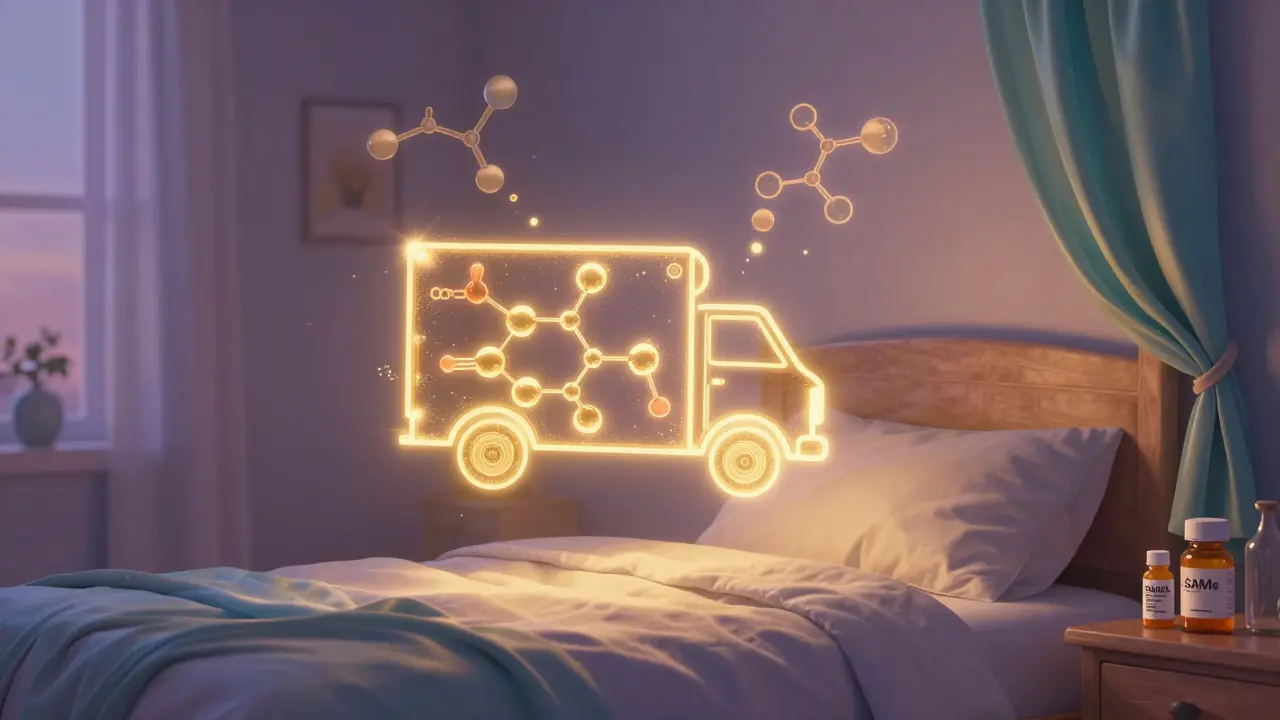
SAMe, or S-adenosylmethionine, isn’t a drug. It’s a compound your body naturally makes, involved in over 200 chemical reactions - mostly helping to move methyl groups around. Think of it like a molecular delivery truck, dropping off methyl groups to build neurotransmitters like serotonin, dopamine, and norepinephrine. That’s why it’s been studied for depression: more of these mood chemicals could mean better mood.
Studies show SAMe can start working faster than SSRIs - sometimes in 7 to 10 days instead of 3 to 4 weeks. In mild to moderate depression, about 35% to 50% of people see improvement. That’s not as strong as the 60% to 70% response rate you get with antidepressants like sertraline or escitalopram, but it’s meaningful for those who haven’t responded well to meds alone.
It also helps with pain, especially joint pain from osteoarthritis. One 2018 study found people taking SAMe with duloxetine had 30% more pain relief than those on duloxetine alone. That’s why some people use it for both depression and chronic pain - two conditions that often go hand in hand.
Why SAMe and Antidepressants Don’t Mix Easily
The biggest danger isn’t that SAMe doesn’t work - it’s that it can push your brain chemistry too far. Both SAMe and antidepressants increase serotonin. When you stack them, especially SSRIs or SNRIs, you risk serotonin syndrome.
Serotonin syndrome isn’t just feeling a little jittery. It’s dangerous. Symptoms include racing heart, high blood pressure, muscle rigidity, fever, confusion, tremors, and in severe cases, seizures or death. The Mayo Clinic, the Natural Medicines Database, and the FDA all flag this combination as a major risk. The interaction score? 7.3 out of 10 - serious.
Real cases exist. One Reddit user started 400mg of SAMe with 20mg of Prozac and ended up in the ER with muscle rigidity and confusion. Another user on Healthline said it helped - no issues after 8 months. That’s the problem: it’s unpredictable. Some people handle it fine. Others don’t.
Between 2018 and 2022, the FDA recorded 32 adverse events involving SAMe and antidepressants, with 9 classified as serious. Two of those were confirmed serotonin syndrome cases. That’s not a lot compared to millions of users, but it’s enough to warrant extreme caution.
Who Should Avoid This Combo Altogether
If you have severe depression - especially melancholic or treatment-resistant types - SAMe likely won’t help. One 2015 study found only 18% of people with severe depression went into remission on SAMe, compared to 42% on venlafaxine. It’s not a replacement.
People with bipolar disorder should never take SAMe without a psychiatrist’s supervision. It can trigger mania or rapid mood swings. And if you’re already on MAOIs (like phenelzine or tranylcypromine), SAMe is absolutely off-limits. The risk of serotonin overload is too high.
Also skip it if you’ve had serotonin syndrome before. Once is enough. Repeating it could be fatal.
What If You Still Want to Try It?
Some doctors do use SAMe as an add-on - but only under strict conditions. The American Society of Clinical Psychopharmacology recommends starting low: 200mg twice a day, taken with food to reduce stomach upset. Increase by 200mg every 5 to 7 days only if tolerated. Never jump to 800mg or 1600mg right away.
Monitor yourself closely for the first 2 to 4 weeks. That’s when 85% of adverse reactions happen. Watch for:
- Shaking or twitching (clonus)
- Unexplained sweating or fever
- Rapid heartbeat or dizziness
- Confusion, agitation, or hallucinations
- Stiff muscles or trouble moving
If you notice any of these, stop SAMe immediately and seek medical help. Use the Hunter Criteria to recognize serotonin syndrome: spontaneous clonus, or inducible clonus with agitation or sweating, or ocular clonus with agitation or sweating, or tremor with hyperreflexia and fever above 38°C.
Also, take SAMe in the morning. It can cause insomnia in 18% of users. Splitting the dose - one in the morning, one at lunch - helps some people avoid sleep problems.
Quality Matters - Most Supplements Are Inconsistent
Not all SAMe is created equal. ConsumerLab’s 2022 test found 32% of products contained 15% to 25% less active ingredient than the label claimed. Some were completely ineffective.
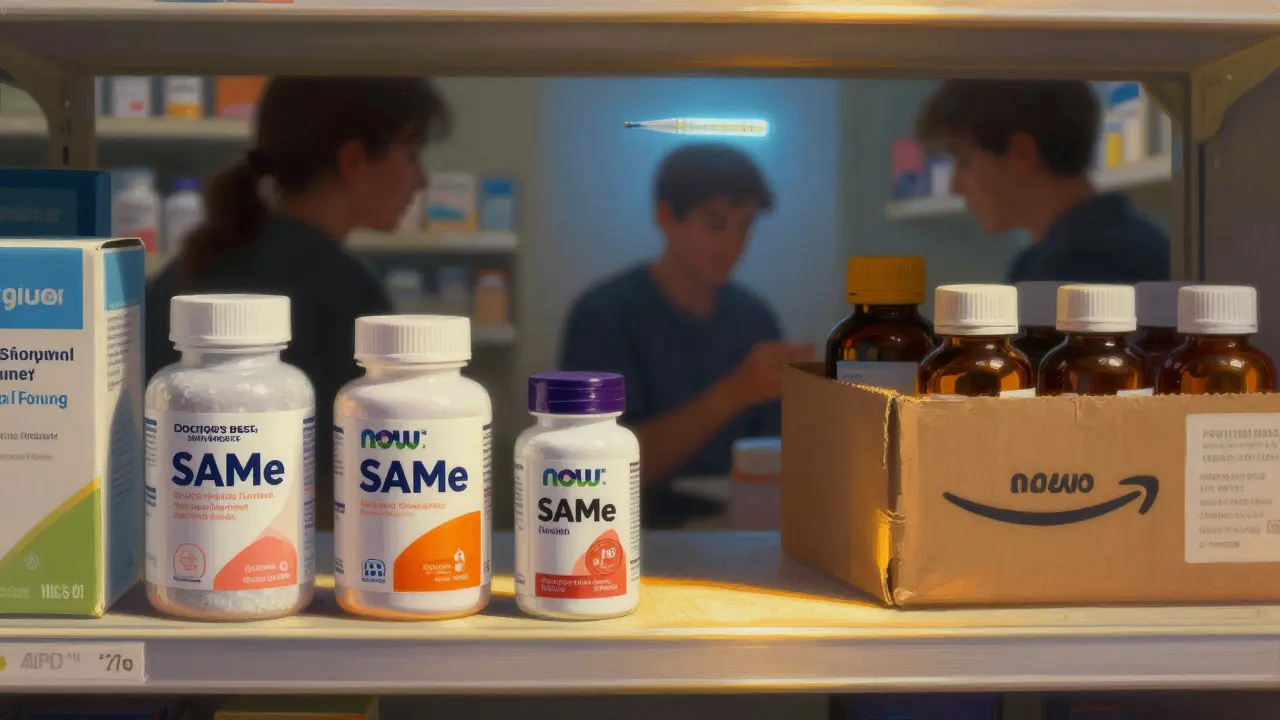
Look for brands that are third-party tested: Doctor’s Best, NOW Foods, and Thorne Research are among the more reliable. Avoid cheap Amazon brands with no transparency. And always check the expiration date - SAMe breaks down fast. Store it in the fridge (2-8°C) and use it within 18-24 months.
Even then, you’re still dealing with a supplement. The FDA doesn’t require proof of effectiveness before it hits the shelf. Manufacturers can claim it supports “mood health” without showing data. That’s why 37% of products don’t even warn about drug interactions.
The Bigger Picture: Is SAMe Worth It?
The U.S. market for SAMe is $120 million a year. Over 4.7 million Americans used it for depression in 2022, and 68% took it with antidepressants. That’s a lot of people blending supplements with prescriptions - often without telling their doctor.
But the science isn’t strong enough for major medical groups to endorse it. The American Psychiatric Association says SAMe lacks sufficient evidence for routine use. The European Food Safety Authority banned it in 2015 over safety concerns. In the U.S., it’s legal, but unregulated.
There’s hope on the horizon. Two new SAMe derivatives - SAMe-PEG and SAMe-phospholipid complexes - are in Phase II trials. Early results show they reduce serotonin interaction risk by 40% in animal models. If they work in humans, this could change everything.
Until then, SAMe remains a risky, expensive, and inconsistent option. It’s not a miracle cure. It’s not a safe shortcut. For most people, sticking with proven antidepressants and therapy is the smarter path.
But if you’re considering SAMe as an add-on - because your current treatment isn’t working, or you’re dealing with chronic pain - talk to your doctor first. Don’t guess. Don’t rely on Reddit. Get blood tests, track your symptoms, and start low. Your brain chemistry isn’t a gamble.
What Happens If You Stop SAMe Suddenly?
Unlike antidepressants, SAMe doesn’t cause withdrawal symptoms. But if you’ve been taking it for weeks or months and stop cold, you might feel a dip in mood. That’s not withdrawal - it’s your brain readjusting to lower methyl donor levels. If you’re combining it with antidepressants, stopping SAMe won’t make your meds stop working. But you might lose the extra benefit you gained.
Always taper off slowly if you’ve been on a high dose. Cut by 200mg every 3-5 days. That gives your body time to adapt.
Can SAMe replace antidepressants?
No. SAMe is not a replacement for antidepressants. It’s less effective in moderate to severe depression, with remission rates around 18% compared to 42% for venlafaxine. It’s best used as a supplement under medical supervision, not as a standalone treatment.
How long does SAMe take to work?
SAMe can start working in 7 to 10 days - faster than SSRIs, which take 2 to 4 weeks. But results vary. Some people notice improvements in mood or energy within a week. Others need 4 to 6 weeks. Consistency and proper dosing matter.
Is SAMe safe with Zoloft or Prozac?
It’s risky. Combining SAMe with SSRIs like Zoloft or Prozac increases the chance of serotonin syndrome. While some people tolerate it without issues, documented cases of serious reactions exist. Never combine them without a doctor’s guidance and close monitoring.
What’s the best dose of SAMe for depression?
Most studies use 400-1600 mg daily. But when combining with antidepressants, start with 200mg twice daily. Increase by 200mg every 5-7 days only if there are no side effects. Never exceed 1600mg without medical supervision.
Does SAMe cause weight gain?
No, SAMe doesn’t typically cause weight gain. In fact, some people report increased energy and reduced appetite. Unlike many antidepressants - which often lead to weight gain - SAMe is not linked to metabolic changes in clinical trials.
Why is SAMe so expensive?
SAMe is unstable and hard to manufacture. It requires special processing, refrigeration, and enteric coating to survive stomach acid. This drives up production costs. A month’s supply can cost $80-$120, making it one of the pricier supplements on the market.
Can I take SAMe if I have liver disease?
SAMe was originally studied for liver conditions and may help with certain types of liver damage. But if you have advanced cirrhosis or severe liver impairment, consult your doctor. While it’s generally considered safe, your body’s ability to process it may be reduced, and interactions with other medications could be unpredictable.
Final Thoughts: Proceed With Caution
SAMe isn’t evil. It’s not a scam. It’s a natural compound with real biochemical effects. But it’s not harmless. When mixed with antidepressants, it can tip your brain into a dangerous state. The fact that some people benefit doesn’t mean it’s safe for everyone.
The real issue isn’t the supplement - it’s the lack of awareness. People buy SAMe online, assume it’s safe because it’s natural, and then combine it with their prescription without telling anyone. That’s how bad outcomes happen.
If you’re struggling with depression and your current treatment isn’t working, talk to your doctor about evidence-based options: therapy adjustments, switching meds, TMS, or ketamine. SAMe might be an option - but only as a last resort, under supervision, and with full awareness of the risks.
Your mood matters. Don’t risk your health for a supplement that’s poorly regulated, expensive, and unpredictable. Better options exist - and they’re backed by science, not anecdote.




Comments
RAJAT KD
8 January 2026SAMe isn't a magic bullet. The data shows it's barely better than placebo in severe depression, and stacking it with SSRIs is playing Russian roulette with your neurochemistry.
Jacob Paterson
9 January 2026Of course people are dying from this combo - because they treat supplements like they’re vitamins and not potent biochemical modulators. If you’re dumb enough to mix SAMe with Prozac without consulting a psychopharmacologist, you deserve what you get. 🤦♂️
Meghan Hammack
10 January 2026I know someone who took SAMe with Zoloft for 6 months and felt like a new person - no side effects, just calm and clear. Not everyone reacts the same. Don’t scare people off with worst-case scenarios. Hope matters too. 💛
Johanna Baxter
12 January 2026Why do we even let this stuff be sold? It’s like selling nuclear fuel at a gas station. Natural doesn’t mean safe. And no one reads the fine print. I’m just here for the drama 😭
Angela Stanton
13 January 2026Let’s talk about the placebo effect in SAMe studies - 35-50% improvement? That’s literally the same ballpark as sugar pills in depression trials. And the 32 FDA adverse events? Probably underreported by 10x. Also - why is this $120/month? 💸
Also, the fact that 68% of users combine it with SSRIs without telling their doctor? That’s not ignorance. That’s systemic failure of medical education.
And don’t even get me started on the Amazon brands that are 80% cellulose. 😒
Maggie Noe
13 January 2026It’s not about SAMe being good or bad - it’s about the illusion of control. We want to believe we can hack our brains with a pill from the health food store because the system failed us. We’re not just taking a supplement - we’re trying to reclaim agency over our suffering. But when you don’t understand the biochemistry, you’re not healing. You’re gambling.
And yes - I’ve seen people get better on SAMe. But I’ve also seen people crash. The difference? One had a psychiatrist. The other had a YouTube video.
Maybe the real question isn’t ‘Is SAMe safe?’ - but ‘Why do we keep turning to unregulated compounds when we have evidence-based treatments?’
We need better access to therapy. Better mental health infrastructure. Not more supplements with fake clinical trial logos.
And yes - I cried reading this post. Not because I’m emotional. Because it’s true.
💔
Matthew Maxwell
15 January 2026It is morally irresponsible to promote the use of unregulated, poorly characterized biochemical agents in conjunction with FDA-approved pharmaceuticals without mandatory physician oversight. The fact that this practice is widespread among laypersons indicates a catastrophic failure of public health literacy.
Those who engage in this behavior are not ‘self-advocates’ - they are reckless actors endangering themselves and potentially others through indirect pharmacological interactions. The FDA’s 32 adverse event reports are merely the tip of the iceberg.
There is no such thing as a ‘natural’ remedy that bypasses the laws of neuropharmacology. The term ‘natural’ is a marketing ploy designed to circumvent scientific scrutiny.
If you are taking an SSRI and feel the urge to self-medicate with SAMe - stop. Call your doctor. Do not Google. Do not Reddit. Do not trust influencers. Your serotonin system is not a toy.
Chris Kauwe
16 January 2026Let’s be real - this whole ‘natural cure’ movement is just American individualism dressed up in hemp. We don’t trust institutions, so we turn to unregulated supplements that cost more than our rent. Meanwhile, the real solution - therapy, social support, structural change - is too slow, too expensive, too political.
SAMe is just a symptom of a broken system. We want a pill for everything, even when the problem isn’t biochemical - it’s existential.
And yet… I get it. When you’re drowning, you’ll grab any rope. Even if it’s frayed. Even if it’s made of glitter.
But don’t pretend it’s not a gamble. It’s not ‘holistic.’ It’s just desperation with a label.
Pooja Kumari
18 January 2026I took SAMe with Lexapro for 11 months and it was the only thing that got me out of bed. I had zero side effects. I cried when I read this because I know how hard it is to find something that works. I don’t care what the studies say - this worked for me. And I’m not going to apologize for that. I’m alive because of it. 💪
My doctor knew. We monitored my serotonin levels. We started low. We didn’t just wing it. So don’t tell me it’s all dangerous. Some of us are careful. Some of us are lucky. And some of us are just trying to survive.
Don’t take away my hope just because you’re scared.
Drew Pearlman
20 January 2026Listen - I get it. You’re tired. You’re tired of waiting 6 weeks for SSRIs to work. You’re tired of side effects. You’re tired of feeling like a broken machine. I’ve been there.
SAMe isn’t the answer - but it’s not the villain either. It’s a tool. Like therapy. Like exercise. Like sunlight. Like sleep.
The problem isn’t SAMe. The problem is that we treat mental health like a product to be bought, not a process to be nurtured.
If you’re going to use it - do it right. Start at 200mg. Track your mood. Sleep. Hydrate. Talk to your doctor. Don’t just buy the cheapest bottle on Amazon and hope for the best.
You deserve better than fear-mongering. And you deserve better than false hope.
Be smart. Be patient. Be kind to yourself.
Heather Wilson
21 January 2026Authoritative sources: FDA, Mayo Clinic, Natural Medicines Database - all flag this interaction as serious. Yet 68% of users combine SAMe with SSRIs without disclosure. That’s not ignorance - it’s negligence. And it’s fueled by supplement marketing that deliberately obscures risk.
Also - the price. $120/month for a compound that’s naturally produced in your liver? That’s price gouging disguised as ‘premium bioavailability.’
And the fact that 32% of products are underdosed? That’s not a quality control issue - it’s a regulatory failure. The FDA doesn’t regulate supplements like drugs. That’s not a bug - it’s the system.
So yes - this post is terrifying. But it’s also necessary.
Jerian Lewis
22 January 2026I stopped SAMe cold after 4 months. No withdrawal. But I felt flat for two weeks. Like my brain forgot how to be happy. It wasn’t depression. Just… emptiness. Like the lights were dimmed.
Now I stick with therapy and a low-dose SSRI. No supplements. No risks. No false hope.
Some things aren’t worth the gamble.