
When your lungs can't get enough oxygen, your heart works harder. But when that extra work becomes constant, it starts to break down. Pulmonary hypertension isn't just high blood pressure in the lungs-it's a silent, progressive disease that slowly overloads the right side of your heart. Many people ignore the early signs, thinking they're just out of shape or have asthma. By the time they get diagnosed, the heart is already strained. The good news? With the right care, survival rates have more than doubled in the last 30 years.
What Pulmonary Hypertension Really Means
Pulmonary hypertension (PH) means your pulmonary arteries-those blood vessels carrying blood from your heart to your lungs-are under too much pressure. Normal pressure is around 12 mmHg at rest. In PH, it's 20 mmHg or higher, measured directly through right heart catheterization. That’s the only way to confirm it. Echocardiograms can hint at it, but they often overestimate. A 2019 study in Circulation found echocardiography was wrong nearly half the time, especially in people with lung disease or heart failure.
PH isn’t one disease. It’s five different types, grouped by cause. Group 1 is pulmonary arterial hypertension (PAH)-the rarest, but most treatable. Group 2 comes from left heart failure. Group 3 is tied to lung diseases like COPD or pulmonary fibrosis. Group 4 is caused by blood clots in the lungs. Group 5 includes everything else-autoimmune diseases, blood disorders, metabolic issues. Each group needs a different approach. Mistaking Group 2 for Group 1 can lead to dangerous treatments. That’s why accurate diagnosis matters more than anything.
Early Symptoms Are Easy to Miss
The first sign? Shortness of breath during normal activity. Not after running a mile-after walking up a flight of stairs or carrying groceries. People often dismiss it. One Reddit user, u/PHWarrior1987, wrote: “My doctor told me I was just out of shape for 18 months. My 6-minute walk dropped from 500 meters to 220.” That’s a classic red flag.
Other early signs include fatigue, dizziness, chest pain, and swelling in the ankles or legs. A prominent second heart sound (S2), a heave felt on the chest wall, or distended neck veins aren’t obvious unless a doctor knows what to look for. Many patients see four or five doctors before getting the right diagnosis. The average delay? Nearly three years. By then, the right ventricle is already enlarged and struggling.
How Right Heart Strain Shows Up
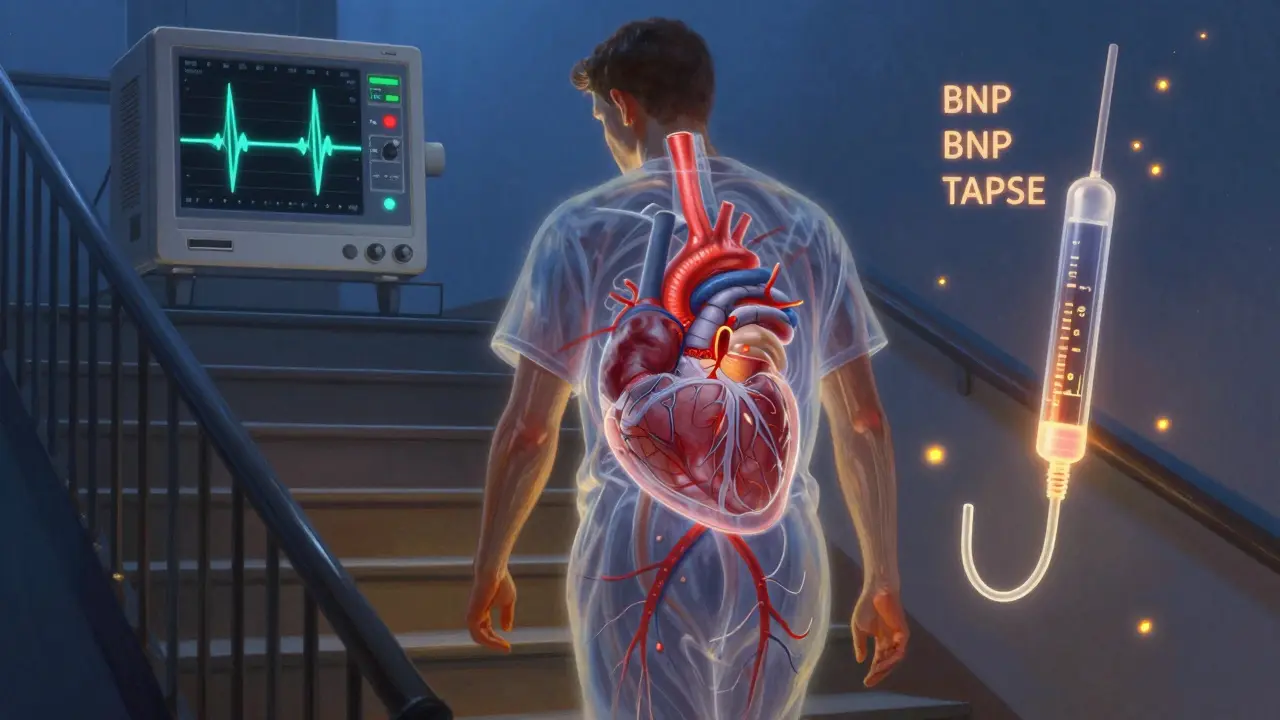
The right ventricle isn’t built for high pressure. It’s thin-walled, meant to pump blood gently into the lungs. When pulmonary pressure climbs, it thickens, stretches, and weakens. That’s right heart strain-and it’s measurable.
- Right ventricular wall thickness over 5 mm on echo
- End-diastolic area bigger than 22 cm²
- TAPSE under 17 mm (this measures how well the heart muscle pulls down)
- Right ventricular ejection fraction below 45%
These numbers don’t just describe damage-they predict survival. A TAPSE under 17 mm means your risk of death in the next year doubles. BNP levels above 180 pg/mL or NT-proBNP above 1,400 pg/mL signal severe strain. These biomarkers are now part of standard risk scoring. The REVEAL 2.0 calculator uses 19 factors-including your 6-minute walk distance, BNP, and functional class-to predict your 1-year survival with 85% accuracy.
Some patients get cardiac MRI to see the exact size and shape of the right ventricle. But only 37% of specialized centers have it. Most rely on echo, which is good enough if interpreted by someone trained in PH. The American Society of Echocardiography says you need at least 120 supervised studies to read these images well. That’s why seeing a PH specialist matters.
Therapy Has Changed Dramatically
In the 1980s, the median survival after diagnosis was just 2.8 years. Today, it’s over 5 years-and rising. Why? Because treatment isn’t one drug anymore. It’s combination therapy.
There are now 14 FDA-approved drugs for PH, grouped into five classes:
- Endothelin receptor antagonists (like bosentan, macitentan)
- Phosphodiesterase-5 inhibitors (sildenafil, tadalafil)
- Prostacyclin pathway drugs (epoprostenol, treprostinil, selexipag)
- Soluble guanylate cyclase stimulators (riociguat)
- Calcium channel blockers (only for the 10% who respond to vasoreactivity testing)
Before 2015, most patients got one drug. Now, 68% of PAH patients start with two or three together. Studies show combination therapy cuts hospitalizations and improves exercise capacity. The 2022 approval of sotatercept was a game-changer. It’s the first drug that actually reverses vessel remodeling by targeting TGF-β signaling. In the STELLAR trial, it reduced death or clinical worsening by 44%.
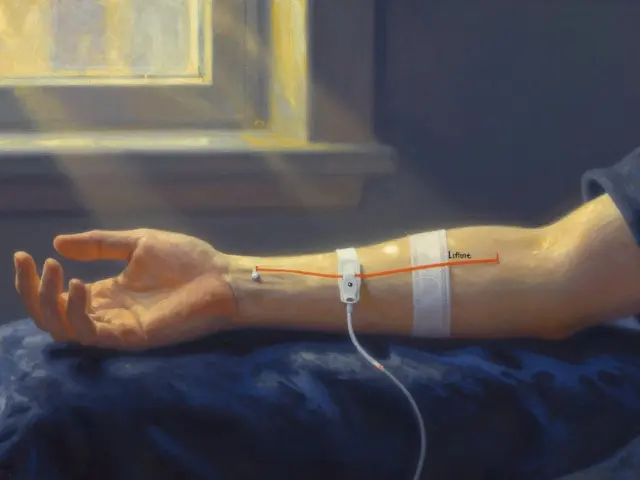
Some patients need continuous IV infusions. That means a central line and a pump running 24/7. It’s not easy. But for those with advanced disease, it’s life-saving. Prostacyclin analogs like epoprostenol can improve survival by 2-3 times compared to no treatment.
Why Diagnosis Takes So Long-and What’s Being Done
Seven out of ten patients are initially misdiagnosed. Asthma. COPD. Anxiety. Obesity. Even heart failure. That’s partly because primary care doctors don’t see PH often. It’s rare. But the signs are there if you know what to look for.
Experts now say: if you have unexplained shortness of breath, especially with normal lung function, think PH. If your EKG shows right ventricular strain, think PH. If your legs swell and your heart is normal, think PH.
There’s a new push to cut diagnostic delays to under a year. The Pulmonary Hypertension Association is training primary care providers to spot the red flags. And new biomarkers are coming. The LIBERTY trial is testing let-7 microRNA as an early warning sign of right heart damage-before symptoms get bad.
But access is still unequal. A 2023 AHRQ report found minority patients wait 47% longer for diagnosis. Mortality rates are 32% higher in underserved communities. Specialized PH centers-there are only 35 in the U.S.-are critical. They don’t just give drugs. They have nurses who coordinate care, pharmacists who manage complex regimens, and social workers who help with insurance.

What Works-and What Doesn’t
Don’t rely on home pulse oximeters or fitness trackers. They won’t catch PH. Don’t skip right heart catheterization just because an echo looks “close.” It’s the only way to know for sure.
And don’t wait for symptoms to get worse. The goal isn’t to feel better next month-it’s to stop the heart from failing. Regular follow-ups every 3 to 6 months are non-negotiable. Blood tests. Echoes. Walk tests. Adjustments to meds. That’s how people survive long-term.
One patient, u/O2intheveins on Reddit, shared: “After my cath confirmed 58 mmHg, my specialist added a third drug. Three months later, my BNP dropped from 850 to 190. I’m walking again.” That’s the power of timely, expert care.
Living With Pulmonary Hypertension
It’s not a cure. But it’s manageable. Many patients live for 10, 15, even 20 years with PH. They exercise within limits. They avoid high altitudes. They get flu shots. They carry emergency meds. They have a care team that knows their history.
The biggest mistake? Thinking it’s just a lung problem. It’s a heart problem too. And the heart can recover-if the pressure is lowered early enough.
Can pulmonary hypertension be cured?
There is no cure for pulmonary hypertension, but it can be effectively managed. With modern combination therapies, many patients live for decades with stable symptoms. In rare cases, lung or heart-lung transplant may be an option for advanced disease, but this is not a cure-it’s a last-resort treatment.
Is pulmonary hypertension the same as regular high blood pressure?
No. Regular high blood pressure (systemic hypertension) affects arteries throughout the body. Pulmonary hypertension only affects the arteries between the heart and lungs. They’re measured differently, treated differently, and have different causes. You can have one without the other.
Can I exercise with pulmonary hypertension?
Yes-carefully. Supervised pulmonary rehabilitation programs are recommended. Walking, light cycling, and stretching can improve endurance and quality of life. But avoid heavy lifting, high altitudes, and intense bursts of activity. Always check with your PH specialist before starting any new routine.
Why do I need a right heart catheterization if my echo looks fine?
Echocardiograms estimate pressure, but they’re not accurate enough for diagnosis. Up to 44% of echo results overestimate pulmonary pressure. Only right heart catheterization gives the true, direct measurement. It also helps classify your PH type, which determines your treatment. Skipping it can lead to wrong therapy.
Are there new treatments on the horizon?
Yes. Sotatercept, approved in 2022, is the first drug that reverses lung vessel damage. Trials are now testing metabolic drugs like dichloroacetate to improve right heart energy use. A new microRNA biomarker (let-7) could detect early heart strain before symptoms appear. These advances are shifting PH from symptom control to disease modification.
How do I find a pulmonary hypertension specialist?
Look for a center certified by the Pulmonary Hypertension Care Center (PHCC) program. These centers have doctors who perform at least 10 right heart catheterizations per year and work with multidisciplinary teams. The Pulmonary Hypertension Association has a directory on their website. Insurance often requires referral to a specialist for advanced therapies.



Comments
Edith Brederode
18 January 2026Just read this after my mom’s PH diagnosis last year. I had no idea how much has changed since the 90s. The fact that survival rates doubled? That’s hope right there. 🙏❤️
clifford hoang
19 January 2026They say 'modern therapy' but who’s really benefiting? Big Pharma’s profit margins are skyrocketing while patients still wait 3 years for diagnosis. This is a system designed to keep you sick and paying. 💸👁️
Arlene Mathison
21 January 2026YES. This is exactly what I told my doctor when I kept saying 'I’m not just out of shape.' Took 2 years, 4 ER visits, and a panic attack before someone listened. Now I’m on triple therapy and I can walk to the mailbox without gasping. You’re not crazy if you feel it-you’re just not being heard. Keep pushing. 💪
Emily Leigh
21 January 2026Wow. So much… information. I’m just here wondering why no one ever told me this before. Also, why does every medical article sound like a TED Talk? Can we just say 'it’s serious' instead of 12 paragraphs about TAPSE? 😴
Carolyn Rose Meszaros
21 January 2026My sister’s on epoprostenol. The pump is a nightmare, but she’s alive. And she laughs again. That’s worth every IV line and midnight alarm. 🌸
Greg Robertson
22 January 2026Great breakdown. I’ve been reading up since my cousin got diagnosed. I didn’t realize how much the right ventricle gets wrecked before symptoms show. Thanks for making this so clear.
Renee Stringer
23 January 2026People need to stop blaming the system. If you’re out of breath walking up stairs, maybe you should’ve exercised more. This isn’t a tragedy-it’s a consequence.
Courtney Carra
24 January 2026It’s fascinating how medicine treats PH as a 'lung issue' when it’s clearly a systemic failure of pressure regulation-almost like the body’s hydraulic system is corrupted. We’re not just treating vessels-we’re negotiating with the architecture of survival.
thomas wall
24 January 2026It is lamentable that, in the United Kingdom, access to specialized PH centres remains grossly inequitable. The disparity in diagnostic latency between socioeconomic strata is not merely a clinical failure-it is a moral indictment of the healthcare paradigm.
Manoj Kumar Billigunta
24 January 2026From India, I want to say: this info is gold. My uncle had PH, but here, doctors think it’s just asthma or heart failure. No one talks about TAPSE or BNP. If this helps even one person get tested early, it’s worth it. Thank you.
Thomas Varner
26 January 2026Wait-so echo is wrong almost half the time?? Then why do they even do it? Why not just go straight to cath? Is it just cost? Or laziness? Because if you’re gonna misdiagnose half the time… why bother?
Art Gar
26 January 2026While the data presented is statistically robust, one must question the underlying assumption that pharmacological intervention constitutes progress. The emphasis on drug regimens obscures the deeper question: why is this disease increasing in prevalence at all? The answer lies not in medical journals, but in environmental degradation and systemic neglect.
Crystal August
27 January 2026So you’re telling me people wait YEARS for diagnosis? And you think this is acceptable? This isn’t rare-it’s negligence. Someone should be fired. Or sued. Or both.
Nadia Watson
28 January 2026thank you for sharing this… i read it three times. i work in a rural clinic and we dont have echo machines that are calibrated for PH. we see patients with swollen legs and no other explanation. now i know to ask for cath. i hope this reaches more providers.
Shane McGriff
29 January 2026I’ve been a PH caregiver for 7 years. The hardest part isn’t the meds or the pumps-it’s the loneliness. No one gets it until they live it. But reading posts like this? It reminds me I’m not alone. Keep talking. We’re listening.