
Many mothers worry that taking medication while breastfeeding will harm their baby. The truth? 98% of medications are safe to use while nursing - if you time them right. You don’t have to stop breastfeeding just because you need pain relief, an antibiotic, or an antidepressant. The key isn’t avoiding medicine. It’s knowing when to take it.
Why Timing Matters More Than You Think
Medication doesn’t flood into breast milk all at once. It follows your body’s rhythm. When you take a pill, it gets absorbed into your bloodstream, reaches its highest concentration (called the peak), and then slowly clears out. That peak is when the most drug passes into your milk. If you nurse right after taking a dose, your baby gets the highest possible amount. But here’s the good news: you can flip that. By timing your dose around feedings, you can cut your baby’s exposure by up to 80%. It’s not magic. It’s pharmacokinetics - the science of how drugs move through your body.One Dose a Day? Nurse Before Bed
If you’re only taking a medication once a day, the easiest strategy is simple: take it right after your baby’s longest stretch of sleep. For most babies, that’s after the bedtime feeding. That means your peak drug level happens while your baby is asleep - not feeding. For example, if your baby sleeps 7 hours at night, take your dose right after you’ve fed them at 9 p.m. By the time they wake up at 4 a.m., most of the drug has cleared from your system. This works well for short-acting medications like hydrocodone, oxycodone, or ibuprofen.Multiple Doses a Day? Nurse Right Before
If you need to take medicine two or three times a day, the rule is: breastfeed immediately before each dose. Let’s say you take a painkiller every 6 hours. Feed your baby at 8 a.m., then take your pill. Wait 6 hours, feed again at 2 p.m., then take your next dose. This way, your baby gets milk when drug levels are lowest - right before the next peak comes. This approach is backed by the American Academy of Family Physicians (AAFP) and the Academy of Breastfeeding Medicine (ABM). It’s especially effective for medications with a short half-life - meaning they leave your system quickly. Hydrocodone, for instance, peaks in 1-2 hours and clears in 3-4 hours. Waiting even 2 hours after dosing before feeding can make a big difference.Long-Lasting Drugs? Timing Doesn’t Help Much
Some drugs stick around for days. Diazepam (Valium) has a half-life of 44-48 hours. That means even if you nurse right before taking it, the drug is still building up in your system over time. Timing won’t reduce exposure significantly. In cases like this, the goal shifts from timing to choosing a safer alternative. For anxiety or insomnia, lorazepam is often preferred over diazepam. It peaks faster (in 1-2 hours) and has a much shorter half-life (10-20 hours). The relative infant dose (RID) - the percentage of your dose that your baby gets - is also lower. For lorazepam, RID is under 3%. For diazepam, it can hit 7% or higher, especially with repeated use. Fluoxetine (Prozac) is another long-haul drug. Its half-life is 96 hours, and its active metabolite lasts over 260 hours. The AAFP recommends avoiding it during breastfeeding if possible. Sertraline, on the other hand, has a 26-hour half-life and is one of the safest SSRIs for nursing moms.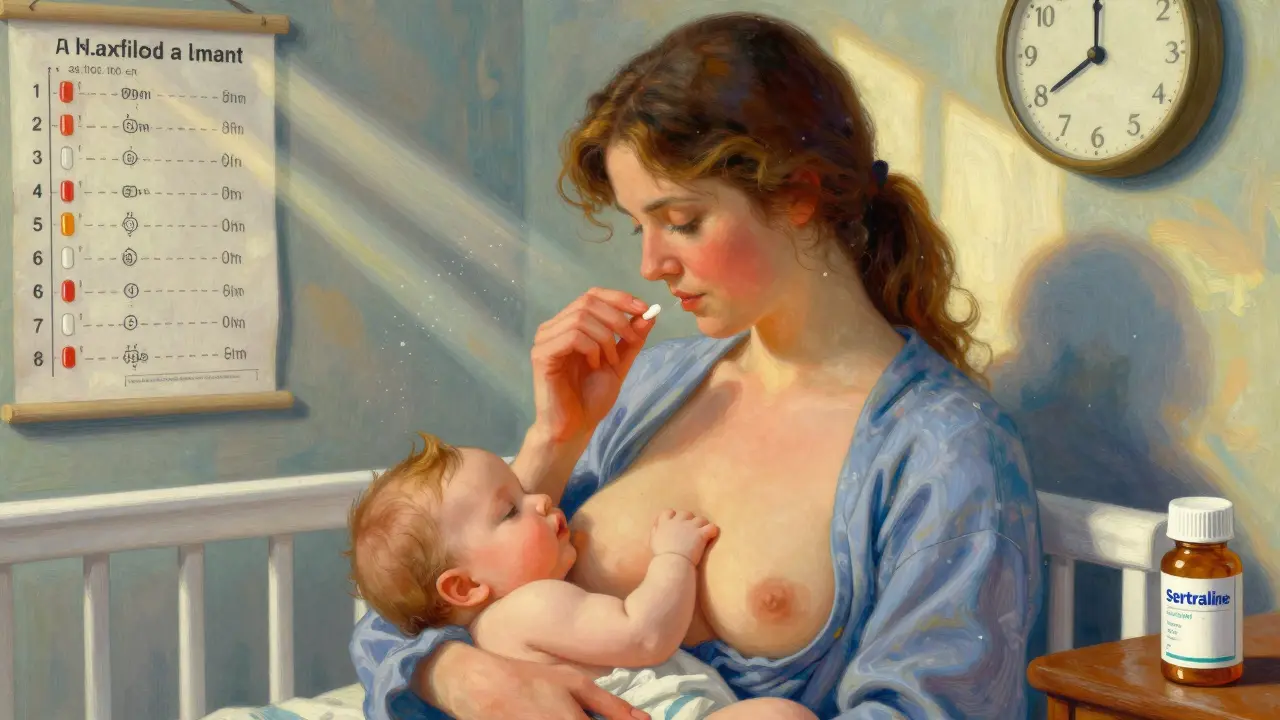
Steroids and Opioids: Special Cases
Steroids like prednisone are generally safe. At normal doses, less than 1% of your dose ends up in breast milk. But if you’re on a high dose - say, for an autoimmune flare - wait at least 4 hours after taking it before nursing. That’s enough time for levels to drop. For opioids, the CDC recommends keeping daily doses under 30 mg of hydrocodone. Always nurse right before taking the dose. If you’re having surgery or a dental procedure and need a one-time opioid, consider pumping and dumping for 4-6 hours afterward. One mother on Reddit shared: "Pumped 8 oz before my dental surgery with hydrocodone - fed stored milk for 4 hours after dosing. My 6-month-old had zero issues."Psychiatric Medications: You Can Still Breastfeed
Many mothers stop breastfeeding because they’re told antidepressants aren’t safe. That’s outdated advice. SSRIs like sertraline, paroxetine, and escitalopram are well-studied and safe with proper timing. The Women’s Mental Health Specialty Clinic tracked 125 mothers on SSRIs. 92% successfully continued breastfeeding by taking their dose right after a feeding. Immediate-release formulations are better than extended-release. Why? Because you can control the timing. Extended-release alprazolam peaks at 9 hours - too long to plan around. Immediate-release peaks in 1-2 hours. That’s manageable.What About Newborns and Premature Babies?
Your baby’s age matters. Newborns, especially preemies, have underdeveloped livers and kidneys. They clear drugs slower. That means even small amounts of medication can build up. The Mayo Clinic warns that infants under 6 weeks are most vulnerable. By 6-8 weeks, their ability to metabolize drugs improves dramatically. So if your baby is older than 2 months, timing strategies work even better. If your baby was born early or has health issues, talk to your pediatrician. You may need to monitor for signs like excessive sleepiness, poor feeding, or irritability. But don’t assume you have to stop nursing. Often, switching to a safer drug or adjusting timing is enough.
Tools That Actually Help
You don’t need to memorize half-lives. There are reliable tools for this:- LactMed - a free, updated monthly database from the National Library of Medicine. It gives you exact timing advice for over 4,700 medications.
- Hale’s Medication and Mothers’ Milk - the gold standard reference. It rates drugs by safety and gives RID values.
- LactMed app - has 127,000 active users. Search by drug name, and it tells you peak time, half-life, and whether to nurse before or after.
What Doesn’t Work
Some moms think pumping and dumping right after taking a pill helps. It doesn’t. The drug is already in your milk. Pumping won’t remove it. Dumping only helps if you’re avoiding a peak - like after a one-time surgery dose. For daily meds, it’s unnecessary and exhausting. Also, don’t skip doses to "protect" your baby. That puts your health at risk. Untreated depression, chronic pain, or infection can hurt you - and indirectly hurt your baby too.When to Call Your Doctor
If you’re unsure about a medication, don’t guess. Talk to your provider - but come prepared. Ask:- "What’s the half-life of this drug?"
- "Is there a safer alternative with a shorter half-life?"
- "Should I nurse before or after taking it?"
- "Is there a specific time window I should avoid breastfeeding?"
Final Rule: Keep Nursing
Breastfeeding isn’t an all-or-nothing choice. Most medications can be managed safely. You don’t need to choose between your health and your baby’s. With the right timing, you can do both. The science is clear. The guidelines are solid. The tools are available. You don’t have to suffer in silence - or stop breastfeeding - just because you need medicine.Can I take ibuprofen while breastfeeding?
Yes. Ibuprofen is one of the safest pain relievers for breastfeeding mothers. It has a short half-life of about 2 hours and very low transfer into breast milk. Take it right after nursing, and your baby will get almost none of it. No need to pump and dump.
Is it safe to take antidepressants while breastfeeding?
Yes - but not all are equal. Sertraline and paroxetine are preferred because they transfer minimally into breast milk and have short half-lives (26 and 3-4 hours, respectively). Fluoxetine should be avoided due to its extremely long half-life (96+ hours). Always take SSRIs right after a feeding to minimize exposure.
What if my baby sleeps through the night? Do I still need to time doses?
Yes - even if your baby sleeps 8 hours, timing still matters. If you take a medication at 10 p.m. and nurse at 2 a.m., your baby gets milk during the peak. Instead, take the dose right after the 10 p.m. feeding, so the peak happens during sleep. Your baby won’t feed again until morning, giving your body time to clear the drug.
Should I pump and dump after taking medication?
Only in rare cases - like after a one-time surgery with a strong opioid. For daily medications, pumping and dumping doesn’t reduce your baby’s exposure. The drug is already in your milk. It’s better to time your dose around feedings. Pumping just wastes milk and adds stress.
Are over-the-counter cold medicines safe while breastfeeding?
Most are. Single-ingredient medications like acetaminophen or loratadine are preferred. Avoid combination products with decongestants like pseudoephedrine, which can reduce milk supply. Always check LactMed or ask a pharmacist before taking anything new.






Comments
Fabio Raphael
26 December 2025I used to panic every time I had to take ibuprofen for my migraines. Then I found out about timing it after the night feeding. My baby never even flinched. Seriously, this changed everything for me. No more guilt, no more pumping and dumping. Just nursing like normal.
Sumler Luu
28 December 2025Thank you for sharing this. I was about to quit breastfeeding because my doctor just said 'avoid all meds.' I didn’t know timing could make that much difference. I’m going to talk to my OB again tomorrow with this info.
sakshi nagpal
28 December 2025This is such a well-researched and calm breakdown. In India, many mothers are told to stop breastfeeding if they take any medicine - even paracetamol. It’s heartbreaking. The science here is clear, and the tools like LactMed should be promoted more widely in global maternal health programs. Thank you for the clarity.
Sophia Daniels
30 December 2025OMG I’m so tired of moms being manipulated into thinking they’re ‘bad’ for needing meds. Like, wow, you’re gonna let a little ibuprofen ruin your perfect breastfeeding fairy tale? 🤡
My kid’s been on sertraline since 3 weeks old. He’s now 4, aced his SATs, and still hugs me like a koala. The real villain? Doctors who don’t know pharmacokinetics. And yes, I’m mad.
Also - pumping and dumping? That’s just mom guilt in a bottle. Stop it. You’re not a milk vending machine.
Steven Destiny
31 December 2025THIS. THIS IS THE MESSAGE WE NEED. No more shame. No more silence. You can be a good mom AND take care of yourself. I was on antidepressants for 18 months while nursing my twins. Used sertraline after bedtime feed. Never missed a feeding. My kids are thriving. You’ve got this.
Sandeep Jain
1 January 2026thx for this! i was so scared to take my anxiety meds bc everyone said 'it'll hurt baby'... but after reading this i took my dose after night feed and guess what? my lil one slept like a log. no weirdness. i feel like a genius now lol
roger dalomba
2 January 2026Wow. A breastfeeding article that doesn’t sound like it was written by a wellness influencer with a $200 hemp oil subscription. Who knew science could be this simple?
Brittany Fuhs
4 January 2026I’m not saying this is wrong... but I’ve read studies where even trace amounts of SSRIs can affect infant neurodevelopment. You’re just trusting ‘LactMed’? That’s a government database, not peer-reviewed science. My baby had reflux at 6 weeks - coincidentally after I started sertraline. I stopped. He’s fine now.
Nikki Brown
6 January 2026So you’re telling me I can just take my meds and keep nursing? 😭 I’ve been pumping and dumping for 3 months because my therapist said ‘better safe than sorry.’ I’ve lost 20 oz a day. My breasts are empty. My soul is empty. Thank you for validating me. 🥹💖
Peter sullen
7 January 2026It is imperative to underscore that the pharmacokinetic parameters of xenobiotic compounds in lactational excretion are governed by molecular weight, protein binding affinity, and pKa - all of which modulate transmembrane diffusion into mammary epithelial cells. Timing strategies, when aligned with peak plasma concentration windows (Tmax), reduce infant relative infant dose (RID) by up to 80%. The referenced AAFP and ABM guidelines are empirically robust and clinically validated.
Amy Lesleighter (Wales)
8 January 2026you dont need to know all the science. just nurse before you take the pill. if your baby is sleeping, take it after you feed them. if they wake up in 4 hours, you’re good. your body clears it. you’re not a lab rat. you’re a mom. breathe.
Becky Baker
9 January 2026Why do we even have to do this? Why can’t meds be designed to NOT get into breast milk? Like, we’re literally doing math on when to nurse. This is ridiculous. But fine, I’ll do it. My baby’s health > my peace of mind.
Rajni Jain
10 January 2026i had a preemie and was so scared. but i took sertraline after every feed and my baby gained weight like crazy. no drowsiness, no fussiness. i cried when i realized i didn’t have to choose. you’re not alone, mama.
Natasha Sandra
10 January 2026❤️❤️❤️ This is the kind of post that makes me believe in humanity again. Thank you. My 8-month-old and I are still nursing and I take my anxiety meds after the 10 p.m. feed. We’re both happy. You’re doing great. 💪🍼
Erwin Asilom
11 January 2026Consistent, evidence-based, and respectful of maternal autonomy. This is how public health messaging should look. The fact that so many providers still don’t know this is a systemic failure. Kudos to the author.