
Statins and Grapefruit Interaction Checker
Check Your Statin Safety
Important Safety Information
Grapefruit and Seville oranges contain furanocoumarins that can dangerously increase statin levels in your blood. Never stop your statin without consulting your doctor.
Quick Reference
- High risk Simvastatin, Lovastatin
- Caution Atorvastatin
- No risk Pravastatin, Rosuvastatin, Fluvastatin, Pitavastatin
If you take a statin to lower your cholesterol, eating a grapefruit for breakfast might seem harmless - even healthy. But for some statins, that single fruit could be putting you at risk for serious muscle damage, kidney failure, or worse. This isn’t a myth. It’s a well-documented, potentially deadly interaction backed by decades of research and real-world cases.
Why Grapefruit Changes How Your Statin Works
Grapefruit doesn’t just taste different from other citrus fruits - it acts differently in your body. Inside grapefruit are chemicals called furanocoumarins. These aren’t sugar or vitamin C. They’re powerful compounds that shut down an enzyme in your gut called CYP3A4. This enzyme is responsible for breaking down many medications before they enter your bloodstream, including certain statins. When CYP3A4 is blocked, your body can’t process the statin the way it should. Instead of being broken down and filtered out, the drug builds up in your blood. One study found that drinking grapefruit juice with simvastatin raised the drug’s concentration in the blood by up to 16 times. That’s not a small increase. That’s the equivalent of taking a much higher dose than prescribed - without your doctor knowing.Which Statins Are Dangerous With Grapefruit?
Not all statins react the same way. The risk depends entirely on how your body metabolizes the drug.- High risk: Simvastatin (Zocor), lovastatin (Mevacor), and atorvastatin (Lipitor) are heavily broken down by CYP3A4. Grapefruit can push their levels into dangerous territory.
- Low to no risk: Pravastatin (Pravachol), rosuvastatin (Crestor), fluvastatin (Lescol), and pitavastatin (Livalo) use different pathways. They’re generally safe to take with grapefruit.
What Happens When Statin Levels Get Too High?
The most common problem is muscle pain. About 5-10% of people who mix grapefruit with high-risk statins report sore, achy muscles - a sign called myalgia. Many brush it off as just aging or overdoing it at the gym. But this is often the first warning sign of something worse. The real danger is rhabdomyolysis. This is when muscle tissue breaks down rapidly, spilling a protein called myoglobin into your bloodstream. Your kidneys can’t handle it. The result? Kidney damage, kidney failure, or even death. A documented case involved a 40-year-old woman who ate grapefruit daily for 10 days while taking simvastatin. She developed severe muscle pain and dark, tea-colored urine - classic signs of rhabdomyolysis. She was hospitalized. She survived, but only because it was caught early. Rhabdomyolysis is rare - less than 1 in 10,000 statin users get it each year. But that risk jumps dramatically if you’re drinking grapefruit juice regularly while on simvastatin or lovastatin. The FDA’s own data shows that when grapefruit and high-dose statins combine, the chance of muscle breakdown increases by up to 10 times.
How Much Grapefruit Is Too Much?
You might think, “I only have half a grapefruit once a week - is that okay?” The answer isn’t simple. The 1998 study that first revealed this interaction used 200 mL (about 7 ounces) of double-strength grapefruit juice - roughly one small glass - taken three times a day. That’s not a lot. And even a single glass can cause enzyme inhibition that lasts up to 72 hours. That means if you drink grapefruit juice on Monday, your body is still unable to properly process simvastatin on Wednesday. Separating the timing - say, taking your pill in the evening and drinking juice in the morning - doesn’t help. The enzyme stays shut down. For people on atorvastatin, some guidelines allow one small grapefruit or 8 ounces of juice per week. But for simvastatin and lovastatin? The recommendation is clear: avoid it completely.What Should You Do If You Like Grapefruit?
If you’ve been eating grapefruit and taking a statin, don’t panic. But do act. First, check your prescription. Look up the name of your statin. If it’s simvastatin, lovastatin, or atorvastatin, stop consuming grapefruit, Seville oranges, or pomelos immediately. These are the only citrus fruits with enough furanocoumarins to cause the problem. Regular oranges, lemons, and limes are safe. Second, talk to your doctor. Don’t stop your statin. Stopping your medication raises your risk of heart attack and stroke far more than grapefruit does. Instead, ask: “Is there a safer statin I can switch to?” Pravastatin or rosuvastatin are excellent alternatives with no known grapefruit interaction. Third, tell your pharmacist. Pharmacists are trained to catch these interactions. A 2021 study showed that when pharmacists actively reviewed prescriptions and counseled patients, inappropriate grapefruit-statin combinations dropped by 78%.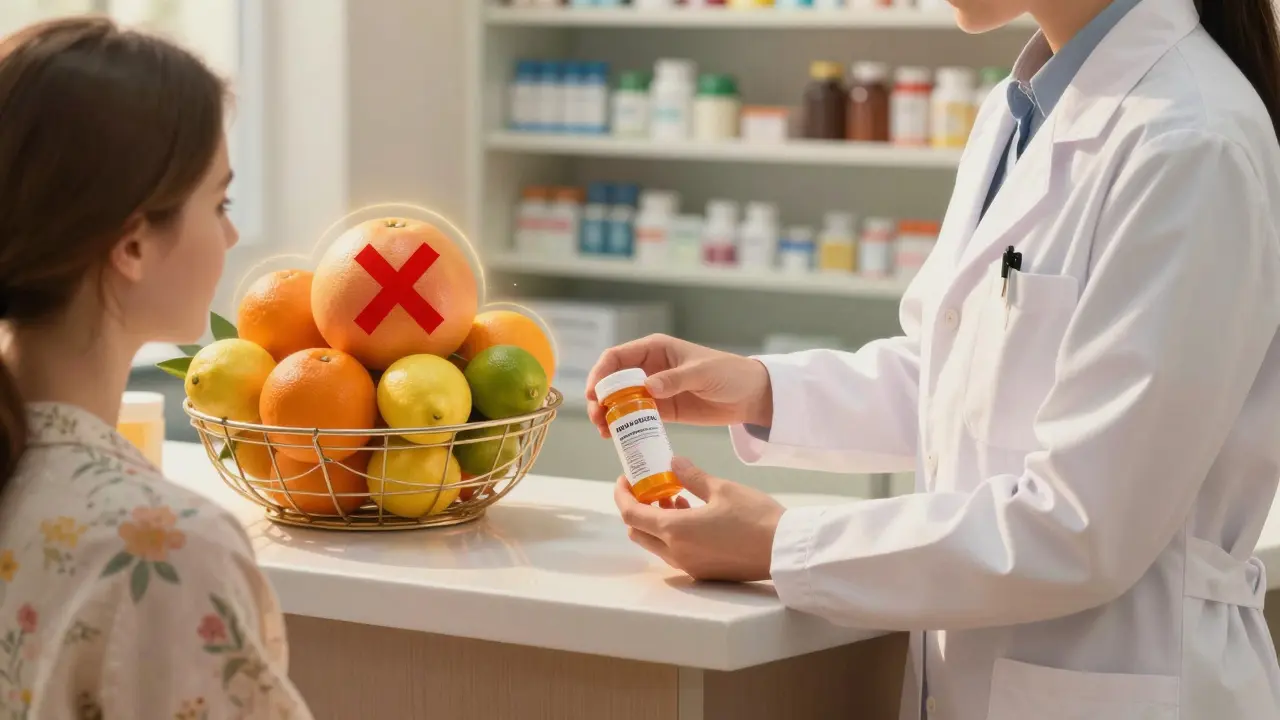
Why Do So Many People Still Get This Wrong?
Despite clear warnings, the problem persists. A 2021 survey found that only 42% of doctors routinely ask patients about grapefruit use when prescribing statins. And only 28% of patients said they’d ever been told to avoid it. Part of the problem is confusion. Many people think “all citrus is the same.” Others assume that because grapefruit is healthy, it can’t be dangerous. Some even believe that if they haven’t had side effects yet, they’re safe. But this interaction doesn’t always cause immediate symptoms. It builds up. One person might drink grapefruit juice for months without issues - then, after a minor illness or a new medication, their body can’t handle the extra drug load. That’s when things go wrong.What’s Being Done to Fix This?
Scientists aren’t giving up. Researchers at the University of Florida are working on breeding new varieties of grapefruit with significantly lower levels of furanocoumarins. Early results show it’s possible to keep the sweet taste and nutritional benefits while removing the dangerous compounds. If successful, these “safe grapefruit” varieties could be available within the next 10 years. Until then, the safest choice is clear: if you’re on simvastatin or lovastatin, leave grapefruit on the shelf. If you’re on atorvastatin, be extremely cautious. And if you’re on pravastatin or rosuvastatin, enjoy your fruit without worry.Bottom Line: Know Your Statin, Know Your Fruit
Statins save lives. Grapefruit is nutritious. But when they mix the wrong way, the result can be catastrophic. You don’t need to give up fruit. You just need to know which one to avoid.- STOP: Grapefruit, Seville oranges, and pomelos if you take simvastatin or lovastatin.
- USE CAUTION: Limit grapefruit to once a week if you take atorvastatin.
- SAFE: Oranges, lemons, limes, and tangerines - even with any statin.
- ALWAYS: Tell your doctor and pharmacist what you eat and drink regularly.
Can I drink grapefruit juice if I take rosuvastatin (Crestor)?
Yes. Rosuvastatin is not broken down by the CYP3A4 enzyme in your gut, so grapefruit juice does not interfere with it. You can safely consume grapefruit, oranges, or other citrus fruits while taking rosuvastatin. Other safe options include pravastatin, fluvastatin, and pitavastatin.
If I eat grapefruit in the morning and take my statin at night, is that safe?
No. The chemicals in grapefruit - furanocoumarins - permanently disable the CYP3A4 enzyme in your intestines. This effect lasts up to 72 hours. Even if you take your statin 12 hours after eating grapefruit, your body still can’t break it down properly. Timing doesn’t prevent the interaction.
Are all citrus fruits dangerous with statins?
No. Only grapefruit, Seville oranges (used in marmalade), and pomelos contain enough furanocoumarins to cause the interaction. Regular oranges, lemons, limes, and tangerines are safe. Don’t confuse grapefruit with other citrus - they’re not the same.
What are the signs of muscle damage from statins and grapefruit?
Watch for unexplained muscle pain, weakness, or tenderness - especially in your shoulders, thighs, or lower back. Dark, tea-colored urine is a red flag. These could be signs of rhabdomyolysis. If you notice these symptoms and you’ve been eating grapefruit, contact your doctor immediately.
Can I switch to a different statin if I love grapefruit?
Yes. If you regularly eat grapefruit and are on simvastatin or lovastatin, ask your doctor about switching to pravastatin, rosuvastatin, fluvastatin, or pitavastatin. These statins don’t interact with grapefruit and are just as effective at lowering cholesterol. Many patients make this switch without losing any benefit.






Comments
Martin Spedding
16 December 2025so i ate grapefruit with my lipitor for 3 years and im fine???
Raven C
17 December 2025One must consider the pharmacokinetic implications of furanocoumarin-mediated CYP3A4 inhibition-particularly in the context of first-pass metabolism-before casually dismissing clinical guidelines as anecdotal. The data is unequivocal.
Patrick A. Ck. Trip
17 December 2025Just wanted to say thanks for laying this out so clearly. I’ve been on pravastatin since last year and switched because of this exact issue. My doctor didn’t mention it, but my pharmacist did. Glad I listened.
Small things like this save lives. Thanks again.
Chris Van Horn
18 December 2025Of course you’re fine-you’re one of those people who think ‘I’ve never had a problem’ means it’s not dangerous. You’re not special. You’re just lucky. And statistically, your luck will run out the moment you get a cold, start a new med, or turn 50. Wake up.
amanda s
19 December 2025AMERICA NEEDS TO STOP LETTING FOREIGN FRUITS KILL ITS PEOPLE. THIS IS WHY WE NEED BORDER CONTROL FOR CITRUS. GRAPEFRUIT IS A TRAITOR.
Anu radha
19 December 2025my uncle had muscle pain and dark pee. he went to hospital. now he dont eat grapefruit. i tell everyone. its not worth it.
Sachin Bhorde
20 December 2025For those on atorvastatin: even though the interaction is dose-dependent, the 72-hr CYP3A4 inhibition window means chronic low-dose exposure still poses a non-linear risk. Avoidance > mitigation. Also, pomelo = worse than grapefruit. FYI.
Victoria Rogers
21 December 2025Wow. So the solution is to not eat fruit? What’s next? Are we gonna ban sugar because some people get diabetes? This is just fearmongering dressed up as science.
Jane Wei
22 December 2025i take rosuvastatin and still eat grapefruit. no drama. life’s too short to fear fruit.
Radhika M
22 December 2025my sister took simvastatin. she ate grapefruit. she got very weak. doctor said stop both. now she feels better. so i tell people: check your medicine name.
Pawan Chaudhary
23 December 2025Hey everyone, if you’re on statins and love citrus, just ask your doc about pravastatin or rosuvastatin-they’re just as good and you can enjoy your smoothie without worry. 😊
CAROL MUTISO
24 December 2025It’s funny how we treat food like a villain when the real villain is the healthcare system that doesn’t educate patients before prescribing. Grapefruit didn’t betray us-we let the system fail us. Now we’re blaming the fruit instead of the silence.
Erik J
24 December 2025Is there any data on whether the effect is cumulative over years of occasional consumption? Or is it strictly acute?
BETH VON KAUFFMANN
26 December 2025Let’s be clear: the FDA’s warning label is a liability shield, not a medical recommendation. The 16x plasma concentration spike was measured in healthy volunteers under controlled conditions-real-world adherence is far messier. This is overblown.
Brooks Beveridge
28 December 2025Hey, just want to say-you’re not alone if you didn’t know this. I didn’t either until my pharmacist flagged it. Now I check every med I take. Keep asking questions. You got this. 💪