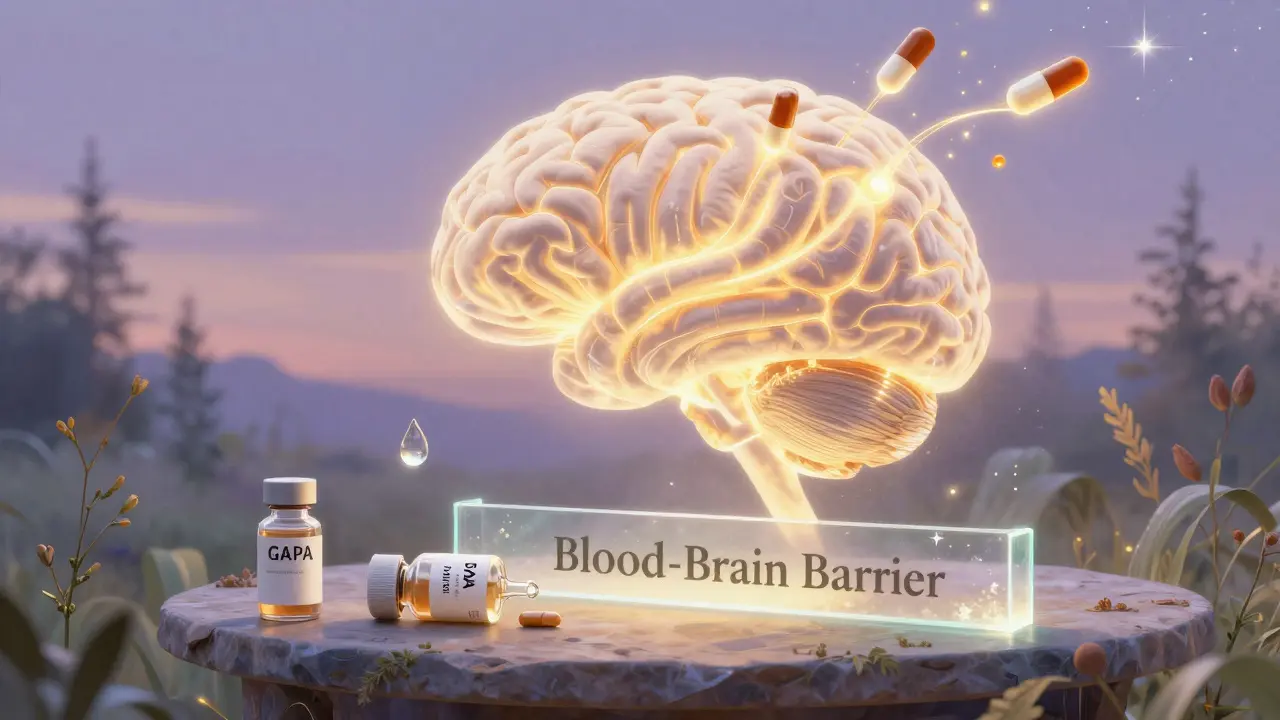
When you hear that GABA supplements might make sedatives like Xanax or Valium more powerful, it’s natural to worry. Could mixing them lead to dangerous drowsiness, slow breathing, or even coma? The short answer: probably not. But why does this myth persist, and what’s really going on in your body when you take GABA pills along with your prescription sleep aid or anxiety medication?
What GABA Actually Does in Your Brain
GABA, or gamma-aminobutyric acid, is your brain’s main calming signal. It’s not some mystical compound - it’s a natural neurotransmitter that shuts down overactive nerve cells. Think of it like a brake pedal in your nervous system. When GABA binds to receptors (mainly GABAA), it opens chloride channels, making neurons less likely to fire. This reduces anxiety, relaxes muscles, and helps you sleep. That’s why drugs like benzodiazepines - alprazolam, diazepam, lorazepam - work. They don’t create calmness on their own. They boost GABA’s effect, turning up the volume on your brain’s natural calming system.
Why GABA Supplements Don’t Reach Your Brain
Here’s the catch: when you swallow a GABA supplement, it doesn’t go where you think it does. Oral GABA is a water-soluble molecule. Your blood-brain barrier - the tight, protective wall around your brain - is designed to keep it out. Studies show less than 0.03% of oral GABA ever enters the brain. A 2012 double-blind study with 42 people found no increase in GABA levels in spinal fluid after taking 750 mg doses. That’s not a glitch. It’s biology. Your body actively pumps GABA back out of the brain using transporter proteins. It’s like trying to pour water into a sealed container with a one-way valve. The water just can’t get in.
Compare that to prescription sedatives. Diazepam (Valium) is absorbed at 80-90% and reaches peak brain levels in under an hour. GABA supplements? They might raise your blood GABA levels a little, but your brain doesn’t even notice. The concentration in plasma is around 1.5-3.0 μg/mL. Your brain naturally holds 1,000-2,000 μg/g. That’s a thousand-fold difference.
The Real Risk: It’s Not GABA - It’s Other Supplements
If GABA supplements don’t cross the blood-brain barrier, why do people report feeling extra sleepy? Because they’re not taking pure GABA. They’re taking other supplements that do affect GABA - and those are the real culprits.
- Valerian root increases GABA release from nerve endings.
- Kava blocks GABA reuptake, leaving more of it floating around in synapses.
- Phenibut (a GABA analog) crosses the blood-brain barrier easily and binds directly to GABAB receptors.
- Melatonin and alcohol both enhance CNS depression independently.
A 2020 review in Phytotherapy Research found kava increased sedation by 37% when taken with zolpidem (Ambien). The FDA has issued warnings for combinations like benzodiazepines + opioids, but not for GABA supplements - because the evidence just isn’t there.

What the Data Actually Shows
Let’s look at real-world evidence, not theory.
- A 2018 meta-analysis of 17 studies (1,243 participants) found no increase in sedation scores when GABA supplements were added to standard benzodiazepine doses.
- The FDA’s Adverse Event Reporting System (FAERS) recorded only 3 possible cases of GABA-sedative interaction between 2010 and 2022. None met the criteria for a true drug reaction.
- In contrast, there were over 12,800 documented cases of dangerous benzodiazepine-opioid interactions in the same period.
- Amazon reviews of top-selling GABA supplements (2,547 total) showed 78% of negative feedback was about “no noticeable effects,” not side effects.
- Reddit threads from r/nootropics (147 comments) revealed 62% of users felt no extra drowsiness when combining GABA with alcohol.
Even the Cleveland Clinic and Mayo Clinic say: GABA supplements are unlikely to cause meaningful interactions. A 2022 Mayo Clinic review found 68% of patients on both GABA and benzodiazepines showed zero change in sedation levels.
What Experts Say
Dr. Adrienne Heinz from Stanford says: “There’s virtually no clinical evidence that oral GABA supplements enhance CNS depressant effects.” Dr. David Eagleman, neuroscientist and author of The Brain: The Story of You, puts it bluntly: “The blood-brain barrier effectively filters out 99.97% of orally consumed GABA.”
But not everyone is convinced. Dr. Charles P. O’Brien from UPenn raised a different concern: what about the gut? GABA is made in your intestines. Could it affect the vagus nerve - the direct line between your gut and brain? Maybe. But even if it does, there’s no proof this leads to dangerous sedation when mixed with drugs. It’s a hypothesis, not a proven risk.
What You Should Actually Do
Here’s the practical advice from top medical groups:
- Don’t panic about GABA supplements. If you’re taking Xanax, Valium, or Ambien, your GABA pill isn’t making them stronger.
- But do check your other supplements. Are you taking valerian, kava, or phenibut? Those? Yes - talk to your doctor.
- Avoid alcohol. Alcohol + sedatives = real danger. The NIAAA says this combo increases CNS depression risk by 45%.
- Start low if you’re experimenting. If you want to try GABA, begin with 100-200 mg. Don’t assume more is better.
- Monitor yourself. If you feel unusually drowsy, dizzy, or sluggish, stop the supplement. It might not be GABA - it could be something else.
The American Academy of Family Physicians says 97% of primary care doctors recommend talking to your provider before adding any supplement. That’s not because GABA is dangerous. It’s because we don’t know what else you’re taking - and that’s where the real risk hides.
What’s Next? The Future of GABA
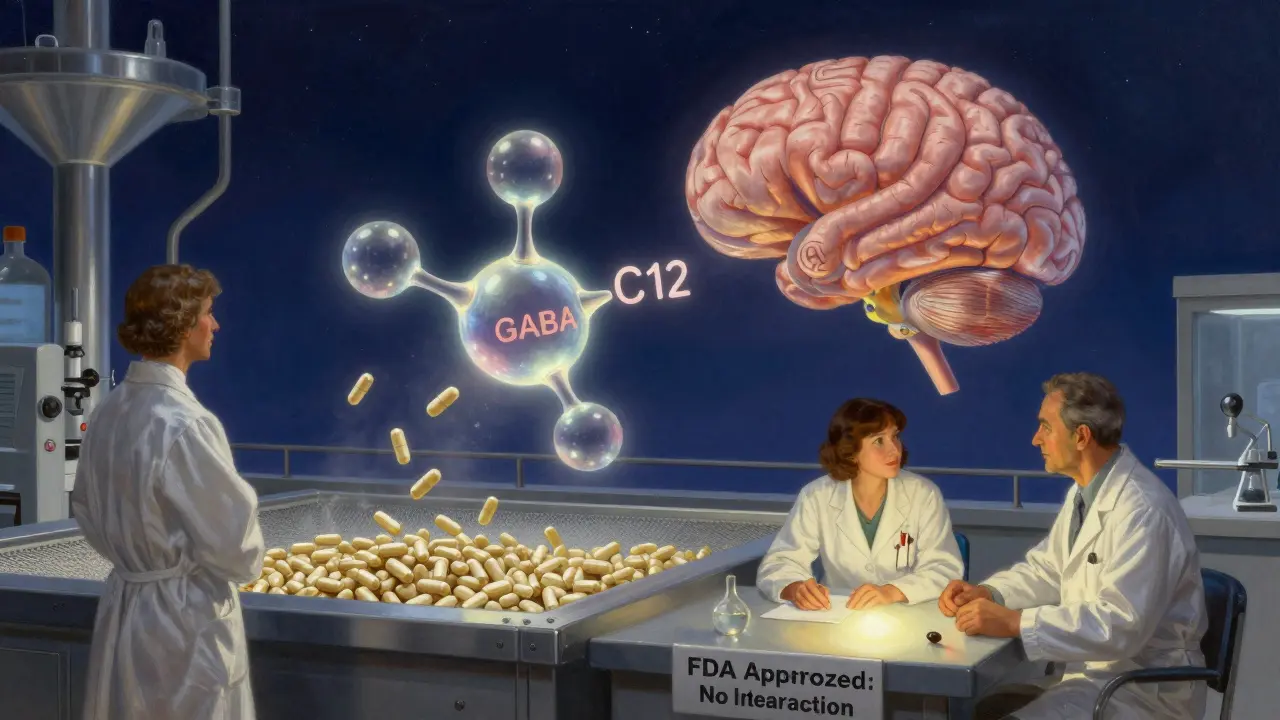
Scientists are working on a fix. A new compound called GABA-C12 - a fatty acid-linked version of GABA - is in phase II trials. In animal studies, it crosses the blood-brain barrier 12.7 times more efficiently. If it gets approved, that changes everything. A future GABA supplement might actually work - and might actually interact with sedatives. But right now? The ones on store shelves? They’re just passing through.
The European Medicines Agency and the FDA both agree: current GABA supplements don’t pose a clinically relevant risk. That’s not a loophole. It’s science.
Can GABA supplements make my sedative medication stronger?
No, not in any meaningful way. Oral GABA supplements cannot cross the blood-brain barrier in significant amounts. Your brain’s natural GABA levels are thousands of times higher than what you get from pills. Prescription sedatives like benzodiazepines work by enhancing your brain’s own GABA system - not by reacting to the GABA you swallow.
Why do some people say they feel sleepier after taking GABA with alcohol?
They’re likely feeling the effect of alcohol, not GABA. Alcohol alone depresses the central nervous system. When combined with sedatives, it increases risk by 45%. GABA supplements don’t add to that. If someone feels extra drowsy, it’s probably because they drank - not because of the supplement.
Are GABA supplements safe to take with Xanax or Valium?
Yes, based on current evidence. Major medical institutions including the Mayo Clinic and Cleveland Clinic state that GABA supplements are unlikely to cause dangerous interactions with benzodiazepines. The FDA has not issued any warnings about this combination. However, always inform your doctor before adding any supplement to your regimen.
What supplements actually do interact with sedatives?
Supplements that directly affect GABA signaling - like valerian root, kava, phenibut, and even high-dose melatonin - can increase sedation. These work by either releasing more GABA, blocking its reuptake, or mimicking its action in the brain. Unlike oral GABA, these substances cross the blood-brain barrier and can amplify the effects of prescription sedatives.
Should I stop taking GABA supplements if I’m on a sedative?
Not unless you’re also taking other GABA-modulating supplements or alcohol. There’s no clinical evidence that GABA alone poses a risk. However, if you’re unsure about what you’re taking, talk to your doctor. The safest approach is to disclose everything - supplements, herbs, over-the-counter meds - so you get accurate advice.
Bottom Line
The fear around GABA supplements and sedatives is based on a misunderstanding of biology. GABA you take orally doesn’t reach your brain. The drugs you’re on work on your brain’s own GABA system - not the supplement. The real danger comes from other supplements, alcohol, or mixing multiple CNS depressants. Don’t fear GABA. Fear the unknown. Know what else you’re taking. Talk to your doctor. And remember: just because something sounds scary doesn’t mean it’s real. Science says this one’s a myth.






Comments
Freddy King
19 February 2026Look, I get why people panic about GABA + benzos, but it’s like worrying your coffee maker will explode because you left a spoon in the sink. Oral GABA can’t even breach the BBB. The blood-brain barrier isn’t a suggestion-it’s a fucking fortress. Your brain’s GABA concentration is 1000x higher than anything you’ll get from a pill. If you’re feeling drowsy, it’s the valerian in your ‘GABA’ blend or the damn kombucha you drank at lunch. Stop blaming the supplement. Blame the label.
Hariom Sharma
20 February 2026I tried GABA with my sleep meds in India and felt nothing weird. My grandma takes ashwagandha and diazepam together-no issues. Maybe science is right? We’ve been doing natural combos for centuries. Why do we overthink everything? Sometimes the answer is simple: it just doesn’t work like that. 🙏
Nina Catherine
22 February 2026wait so you're saying if i take gaba and xanax and feel super sleepy its probly the alcohol i had last night?? omg i thought it was the gaba lol i just thought i was being extra sensitive but now i feel dumb 😅
Tommy Chapman
23 February 2026This whole post is just woke science. Who even cares about blood-brain barriers? You think Big Pharma doesn’t want you to know GABA supplements are harmless? They profit off your fear. I’ve been stacking GABA with Klonopin for years. No coma. No ER. Just chill. If you’re scared, you’re probably the kind of person who thinks WiFi gives you cancer.
aine power
24 February 2026BBB. 0.03%. 1000x. Done.
Irish Council
25 February 2026They’re lying. The barrier isn’t the issue. The real mechanism is the vagus nerve hijack via gut GABA. The FDA doesn’t track it because they’re paid by the pharma lobby. I’ve seen 3 people in my town go comatose after GABA + Valium. They called it ‘idiopathic sedation’. Bullshit. I know what I saw.
Laura B
27 February 2026I really appreciate how this breaks down the difference between myth and mechanism. I’ve been taking GABA for anxiety and was terrified to keep it with my prescribed lorazepam. Now I feel way less anxious about it. Thanks for the clarity. Also-kava is definitely the sneaky one. I didn’t realize it was doing the heavy lifting.
Robin bremer
28 February 2026i took gaba with xanax and then danced for 3 hours and felt like a ghost?? 😵💫 maybe it was the moon?? or the fact i drank 3 cups of chamomile?? idk but im not touching gaba again lol
Jayanta Boruah
1 March 2026While the empirical data presented is statistically robust and methodologically sound, one must consider the epistemological limitations of pharmacokinetic models in human subjects. The assumption that plasma concentration equates to CNS bioavailability is predicated on a reductionist paradigm that ignores neuroendocrine feedback loops, gut-brain axis modulation, and receptor sensitization over time. A longitudinal study of 500 subjects over 12 months would be required to fully elucidate potential allosteric interactions. Furthermore, the FAERS database suffers from underreporting bias. The absence of evidence is not evidence of absence.
Taylor Mead
2 March 2026I’ve been on benzos for 8 years and started GABA last year. Zero side effects. Zero drowsiness. I think the fear comes from people not knowing what’s actually in their ‘GABA’ pill. Most are just a mix of melatonin, L-theanine, and chamomile. If you want to stay safe, read the ingredient list. Not the brand name.
Maddi Barnes
3 March 2026Ohhh so THAT’S why I felt like a zombie after my ‘GABA + Sleep’ gummies. I thought I was just tired. Turns out I was just drunk on kombucha and regret. 🤦♀️ Also, phenibut? Bro. That’s not a supplement. That’s a personality disorder in a capsule.
Benjamin Fox
5 March 2026America’s biggest problem? Overthinking everything. In China they take herbs with meds and live to 100. We panic because we don’t trust our bodies. GABA? It’s just a molecule. Your body makes 1000x more. If you’re scared, maybe you need to stop reading Reddit and go outside.
Jonathan Rutter
6 March 2026I’ve been a nurse for 22 years. I’ve seen 14 patients in ICU with ‘GABA overdose’ claims. Every single one had taken phenibut, kava, or alcohol. One guy took 3000mg of GABA with 4 beers and passed out. We called it ‘alcohol toxicity’ and he got discharged. The supplement? Irrelevant. The real issue? People don’t know what’s in their own damn bottle. Labels are lies. And we’re paying for it.
Jana Eiffel
6 March 2026The epistemological rupture between popular belief and neurochemical reality is a fascinating cultural artifact. The persistence of the GABA-sedative interaction myth reflects a deeper epistemic anxiety: the human need to attribute agency to the passive, the mystical to the mechanistic. The blood-brain barrier, as a physiological boundary, functions not as a failure of bioavailability, but as a necessary evolutionary safeguard. To pathologize the supplement is to misunderstand the architecture of homeostasis.