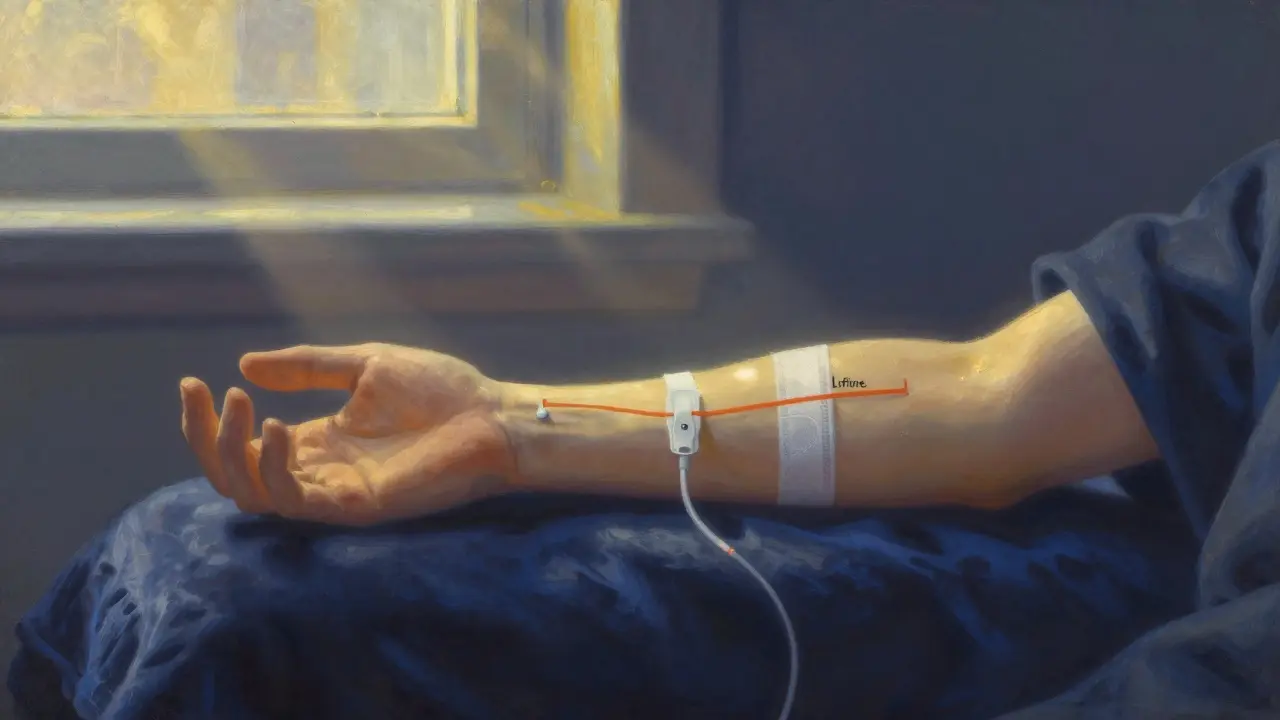
Imagine needing a lifeline that allows your blood to be cleaned three times a week, but the natural veins in your arm aren't strong enough to handle the pressure. That is the reality for thousands of people starting hemodialysis. The way your blood enters and leaves the dialysis machine-your dialysis access-isn't just a medical detail; it's a decision that affects your daily energy, your risk of infection, and your long-term survival.
Getting the right access is often a race against time. While some patients can plan for months, others need treatment immediately, forcing a choice between a temporary fix and a permanent solution. Understanding the trade-offs between the "gold standard" and the quick-fix options is the first step in taking control of your renal health.
Key Takeaways for Your Access Journey
- AV Fistulas are the top choice due to lower infection rates and long-term durability.
- AV Grafts are a reliable alternative when natural veins are too small or weak.
- Catheters provide immediate access but carry the highest risk of bloodstream infections.
- Vein Mapping is a critical first step to determine which option fits your anatomy.
- Daily Monitoring (like feeling for the "thrill") is essential to prevent access failure.
The Gold Standard: AV Fistulas
When doctors talk about the best possible setup, they are talking about the AV Fistula is a surgically created connection between an artery and a vein, typically in the non-dominant arm, that allows blood to flow more robustly for dialysis. . By joining these two vessels, the vein becomes thicker and stronger over time, which allows it to handle the repeated needle insertions required for hemodialysis.
The biggest catch with a fistula is the waiting game. After the surgery, the access must "mature," a process that usually takes 6 to 8 weeks. You can't use it for dialysis until the vein is strong enough. Because of this, some people have to use a temporary catheter while their fistula gets ready. However, the payoff is huge: fistulas can last for decades and have the lowest rates of clotting and infection.
If you are considering a fistula, you'll likely start with vein mapping. This is a simple ultrasound that checks if your veins are a good fit. Interestingly, some patients use preoperative exercise programs to help their veins grow, which can increase the success rate of the fistula maturing by 15-20%.
The Synthetic Alternative: AV Grafts
Not everyone has veins strong enough for a fistula. In those cases, surgeons turn to an AV Graft is a synthetic tube made of biocompatible materials, like polytetrafluoroethylene, that connects an artery to a vein. . Think of it as a man-made bridge that bypasses the need for a strong natural vein.
The main advantage here is speed. Grafts only need 2 to 3 weeks to heal before they can be used. If you need access quickly but can't use a catheter long-term, a graft is a great middle ground. However, they don't last as long as fistulas. Because they are synthetic, the body is more likely to reject them or form clots. About 30-50% of grafts require some kind of medical intervention within the first year to keep blood flowing smoothly.
The Immediate Fix: Central Venous Catheters
When dialysis is an emergency, there is no time for a 6-week maturation period. This is where the Central Venous Catheter (or CVC) comes in. This is a soft plastic tube inserted into a large vein in the neck, chest, or groin to provide immediate access to the bloodstream. .
Catheters are incredibly convenient for the medical team because they work the moment they are placed. For the patient, however, they are the most challenging option. They carry a significant risk of bloodstream infections, and the maintenance is strict. You have to keep the site completely dry, which means no soaking in a tub or swimming. The data is stark: using a catheter instead of a fistula is linked to a 1.53 times higher risk of mortality, largely due to these infection risks.
Comparing Your Access Options
| Feature | AV Fistula | AV Graft | CVC (Catheter) |
|---|---|---|---|
| Wait Time | 6-8 Weeks | 2-3 Weeks | Immediate |
| Lifespan | Years to Decades | 2-3 Years (avg) | Short-term/Temporary |
| Infection Risk | Lowest | Moderate | Highest |
| Maintenance | Low (Daily check) | Moderate | High (Sterile care) |

How to Protect Your Lifeline: Daily Care
Once you have your access, you are the first line of defense in keeping it working. The most important thing to do with a fistula or graft is to check for the "thrill." This is a buzzing or vibrating feeling you get when you touch the access site. It tells you that the blood is flowing correctly. If the thrill disappears, it's a medical emergency-your access may have clotted, and you need to call your surgeon immediately.
For those with catheters, the focus is on sterile technique. Changing the dressing with clean hands and keeping the area dry isn't just a suggestion; it's how you avoid a hospital stay. Many patients find that taking 2-3 training sessions with a dialysis nurse helps them feel confident in these tasks, reducing the risk of complications by up to 25%.
Be mindful of your arm. If you have a fistula, avoid wearing tight clothing, jewelry, or carrying heavy bags on that arm. Even a blood pressure cuff on the same arm as your fistula can put too much pressure on the vein and cause issues.
The Future of Vascular Access
Medicine isn't standing still. We are seeing a shift toward high-tech monitoring and bioengineering. For instance, wireless sensors like the Vasc-Alert now allow patients to monitor fistula blood flow at home, which has helped reduce clotting events by about 20%.
Even more exciting is the work being done with bioengineered blood vessels. Researchers are testing human acellular vessels that mimic real veins, which could provide the durability of a fistula for people who currently only qualify for a graft. As the dialysis population ages and deals with more diabetes-which can make veins brittle-these innovations will be the key to better survival rates.
Why is a fistula better than a catheter?
Fistulas are generally better because they use your own natural tissue, which the body accepts more easily. They have a much lower risk of infection and clotting compared to synthetic grafts or plastic catheters, and they typically last much longer, often for decades of use.
What happens if my fistula doesn't mature?
Unfortunately, some fistulas fail to mature, especially in patients with diabetes or advanced vascular disease. If this happens, your medical team will likely suggest an AV graft as the next best option, or they may keep a catheter in place until a new surgical plan is developed.
Can I shower with a dialysis catheter?
You must be extremely careful. Most catheters require the site to be kept completely dry to prevent bacteria from entering the bloodstream. You should use waterproof covers or follow the specific bathing instructions provided by your clinic to avoid serious infections.
How often do AV grafts need to be replaced?
While it varies, many AV grafts need to be replaced or "cleaned out" every 2 to 3 years. This is because synthetic materials are more prone to narrowing (stenosis) and clotting than natural veins.
What is the "thrill" and why does it matter?
The thrill is the vibration you feel when touching a working fistula or graft. It's caused by the high-pressure arterial blood rushing into the low-pressure vein. If you stop feeling this vibration, it usually means the access has clotted (thrombosis) and requires immediate medical attention.
Next Steps for Patients
If you are just starting your journey, ask your nephrologist for a referral for vein mapping. Don't wait until your kidney function reaches a critical point; planning your access months in advance can save you from the risks of a temporary catheter. If you already have an access, create a daily checklist: feel for the thrill, check the skin for redness, and keep a log of any changes in the site's appearance. If you feel a sudden loss of vibration or see new swelling, contact your vascular surgeon immediately.





Comments
dwight koyner
6 April 2026The emphasis on vein mapping is absolutely correct. Many patients are often rushed into catheter placement without a proper ultrasound assessment, which can lead to suboptimal long-term outcomes. It is imperative to coordinate with a vascular surgeon as early as possible to ensure the most viable site is preserved.
Ethan Davis
6 April 2026Funny how they push these "gold standard" surgeries but never mention how the pharmaceutical companies profit from the complications of the catheters they force on people in the ER
Brady Davis
8 April 2026Oh sure, just "feel for the thrill" like you're checking a pulse on a 1950s radio set. Truly a peak medical experience right here
Kathleen Painter
10 April 2026It's so important to remember that every single person's body reacts differently to these procedures, and while the statistics give us a general map of what to expect, the emotional toll of waiting those six to eight weeks for a fistula to mature can be incredibly taxing, so please be gentle with yourselves and lean on your support systems because navigating the healthcare system while feeling physically depleted is a mountain of a task that nobody should have to climb alone, and I've found that keeping a journal of the small wins-like the first time that thrill is felt-can actually help maintain a sense of agency when it feels like the doctors are the only ones in the driver's seat.
Jamar Taylor
11 April 2026You've got this! Keep pushing for that fistula if you can. The patience now pays off in the long run!
jack hunter
12 April 2026statisitcs are just numbers man. who even cares about a 20% reduction if the system is riged anyway lol. laif is just a series of tubes until we stop breathing
Windy Phillips
13 April 2026It is simply tragic... how some people ignore the basic hygiene protocols for catheters... despite the warnings!!! One must wonder if basic common sense has completely vanished from the modern patient... truly disappointing...
Srikanth Makineni
13 April 2026grafts are a gamble. high failure rate. avoid if possible
Timothy Burroughs
13 April 2026imagine thinking you can just "exercise" your veins to make them grow lol americans and their magic fitness pills and gym routines thinking they can outrun biology it's a joke
shelley wales
14 April 2026I'm so glad the future of bioengineered vessels is being mentioned. It gives so much hope to those of us who don't have the traditional options!
Dhriti Chhabra
15 April 2026I believe it is most prudent to follow the guidance of the medical professionals while maintaining a peaceful disposition throughout the maturation process.
Jay Vernon
16 April 2026Keep it safe! 👍 Always check that buzz! ❤️
Ruth Swansburg
17 April 2026Stay strong! You can do it!
Stephen Luce
18 April 2026I remember how scary that first catheter was, the feeling of it just being there in your chest. It's a lot to process, but once you get the fistula working, the freedom is just night and day. Hang in there everyone.