
Managing diabetes isn’t just about taking pills or injecting insulin. It’s about surviving the side effects that come with them. For millions of people, the real battle isn’t high blood sugar-it’s the nausea, the dizzy spells, the infections, and the fear of crashing too low. And too often, these side effects are ignored until they force someone to quit their medication entirely. About half of all people with Type 2 diabetes stop taking their drugs within the first year, not because the treatment isn’t working, but because it’s making them feel worse.
Metformin: The First-Line Drug With a Rough Start
Metformin is the most prescribed diabetes medication in the world. It’s cheap, effective, and doesn’t cause low blood sugar. But for 20 to 30% of users, it feels like a gut punch. Heartburn, bloating, diarrhea, vomiting-these aren’t rare side effects. They’re common. And they’re why so many people give up on it before it even has a chance to work.
The fix isn’t always quitting. Many people find relief by switching to the extended-release version (Glucophage XR, Fortamet). It releases the drug slowly, which cuts down on stomach upset by nearly half. Starting low-500 mg once a day with food-and slowly increasing over weeks helps too. Most side effects fade after a month or two. But if they don’t, it’s not weakness. It’s biology.
There’s another hidden risk: vitamin B12 deficiency. After four or more years on metformin, 5 to 10% of people develop a serious drop in B12. Symptoms? Constant fatigue, shortness of breath, dizziness. It’s easily missed because it looks like aging or stress. The fix is simple: get tested. If your B12 is low, take 1,500 mcg daily. No prescription needed. Just a supplement.
Sulfonylureas: The Hypoglycemia Trap
Drugs like glipizide (Glucotrol) and glimepiride (Amaryl) force your pancreas to pump out more insulin. They work fast. They’re cheap. But they’re dangerous if you miss a meal, exercise too hard, or drink alcohol. About 15 to 20% of users have at least one episode of hypoglycemia-blood sugar dropping below 70 mg/dL-in a year.
Shaking, sweating, confusion, fast heartbeat-these aren’t just discomforts. They’re warning signs. Severe lows can lead to seizures, falls, car crashes. One study found that people on sulfonylureas are 3 times more likely to end up in the ER for low blood sugar than those on metformin.
The 15-15 rule works: eat 15 grams of fast-acting sugar (glucose tabs, juice, candy), wait 15 minutes, check your blood sugar. If it’s still low, repeat. But prevention is better than rescue. Continuous glucose monitors (CGMs) cut severe lows by 40%. If you’re on a sulfonylurea and don’t have a CGM, ask your doctor. It’s not luxury-it’s safety.
SGLT2 Inhibitors: Weight Loss With a Price
Jardiance, Farxiga, Invokana-these drugs make your kidneys flush out sugar through urine. The result? Lower blood sugar, weight loss (2-3 kg in six months), and better heart and kidney protection. But they come with a dark side: infections.
Women get yeast infections 4 to 6% of the time. Men get them 1 to 2%. Urinary tract infections happen in 5 to 10%. It’s not just inconvenient-it’s painful. One patient on Reddit wrote: “Jardiance dropped my A1c from 8.2 to 6.8, but I got three UTIs in six months. I switched out.”
There are rarer, deadlier risks. Fournier’s gangrene-a rare, fast-spreading genital infection-has killed people. The FDA issued a warning after 55 cases between 2013 and 2018. Lower limb amputations are more common with canagliflozin (Invokana), especially in people with prior foot ulcers or poor circulation.
How to reduce risk? Drink water. Keep clean. Don’t ignore burning or itching. If you’re on an SGLT2 inhibitor, your doctor should warn you about these risks upfront. If they didn’t, ask. And if you have kidney problems (eGFR under 30), skip these drugs. They’re not safe for you.

TZDs: The Heart Risk That Was Ignored
Actos and Avandia were once popular for improving insulin sensitivity. But Avandia (rosiglitazone) was pulled from many markets after studies showed it increased heart attack risk by 33%. Even today, it’s only available under strict controls. Actos (pioglitazone) is safer for the heart, but it still causes fluid retention.
Swollen ankles, sudden weight gain, trouble breathing-these are signs your body is holding too much water. For someone with heart failure, this can be deadly. The American Association of Clinical Endocrinologists says: don’t use TZDs if you have Class III or IV heart failure. Period.
Weight gain is another problem. People gain 2 to 5 kg on these drugs. For someone trying to lose weight to reverse diabetes, that’s a huge setback. And unlike SGLT2 inhibitors, TZDs don’t help the heart or kidneys. They’re a relic. Most doctors avoid them now unless nothing else works.
Alpha-Glucosidase Inhibitors: The Gas Problem
Precose and Glyset slow down how fast your body digests carbs. That means sugar enters your blood more slowly. But the undigested carbs don’t disappear-they go straight to your colon. And that’s where the trouble starts.
Up to 30% of users get bloating, gas, and diarrhea. It’s embarrassing. It’s disruptive. It’s why these drugs are rarely used today. They’re not dangerous, but they’re hard to live with. If you’re considering them, ask yourself: is a 0.5% drop in A1c worth daily flatulence?
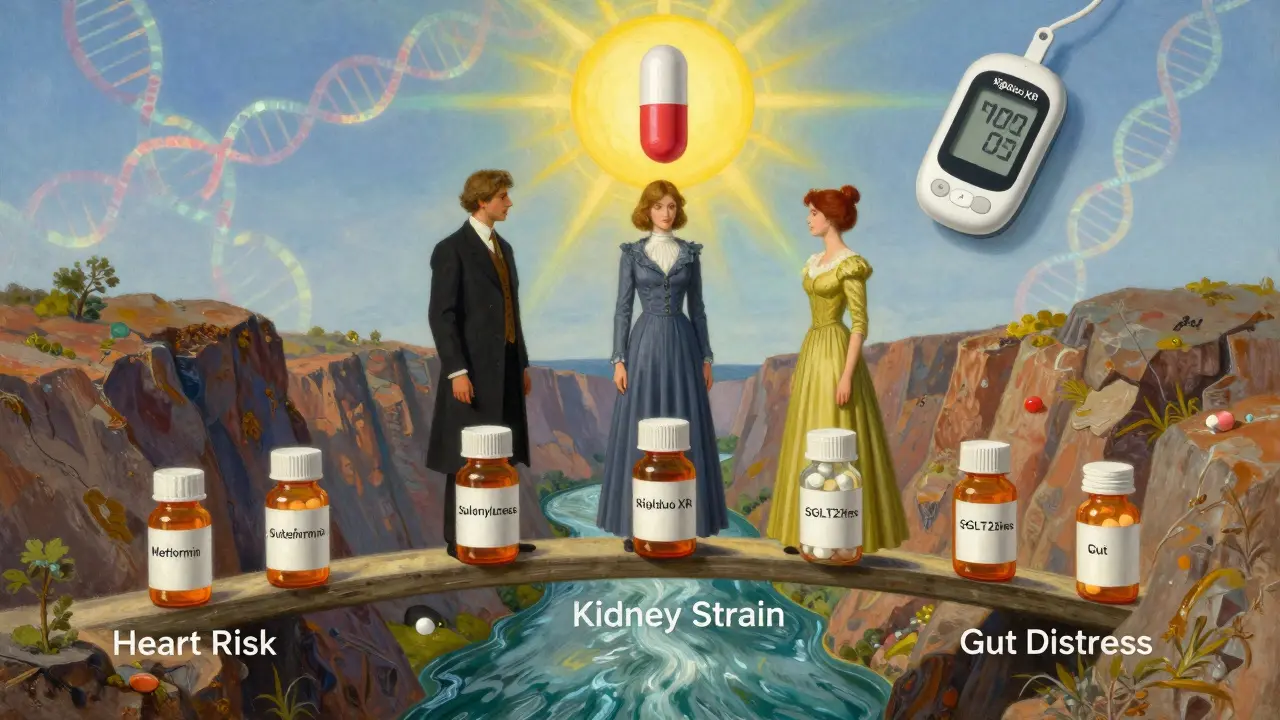
Which Drug Is Right for You?
There’s no one-size-fits-all. Your best drug depends on your body, your life, and your risks.
- If you’re overweight and have no heart or kidney disease: metformin is still the best start.
- If you have heart failure or kidney disease: SGLT2 inhibitors are now first-choice for many doctors.
- If you’re older and prone to lows: avoid sulfonylureas. They’re too risky.
- If you have a history of foot ulcers or amputations: avoid Invokana.
- If you have heart failure: avoid TZDs.
And don’t forget: combination pills are getting better. Xigduo XR combines dapagliflozin and metformin in one pill-and cuts metformin’s stomach issues by 25%. Fewer pills. Fewer side effects. That’s progress.
What No One Tells You
Most people think side effects are just part of the deal. They’re not. They’re signals. Your body is telling you something. If you’re nauseous on metformin, it’s not “just how it is.” It’s a sign you need to adjust the dose or switch formulations. If you’re getting yeast infections on an SGLT2 inhibitor, it’s not bad hygiene-it’s a drug effect.
Studies show 68% of patients feel their doctor didn’t warn them about side effects before starting treatment. That’s a failure. You deserve to know what you’re signing up for.
Ask your doctor: “What are the most likely side effects for me? How do I recognize them? What do I do if they happen?” Write it down. Keep a journal. Track your symptoms. Bring it to your next visit.
And if you’ve quit a drug because of side effects? Don’t feel guilty. You didn’t fail. The system did. There’s always another option. Maybe it’s a different pill. Maybe it’s a GLP-1 agonist like Victoza or Ozempic. Maybe it’s lifestyle. But don’t give up on managing your diabetes. Just don’t give up on finding the right fit.
The Future Is Personalized
By 2025, doctors may test your genes before prescribing metformin or sulfonylureas. If you carry the ADL-1 variant, you’re 3.2 times more likely to get bad stomach issues on metformin. If you have the CYP2C9*3 variant, you’re 2.8 times more likely to crash on sulfonylureas. Genetic testing won’t be routine yet-but it’s coming.
And soon, we may not need pills at all. Glucose-responsive insulin, closed-loop systems, and implantable devices are in development. By 2030, these could replace most daily medications. But until then, the best tool you have is knowledge.
Know your drug. Know your risks. Know your body. And don’t let side effects silence your voice. You’re not just a patient. You’re the one who has to live with the consequences. Make sure your treatment fits your life-not the other way around.
Can diabetes medications cause low blood sugar?
Yes, but not all of them. Sulfonylureas (like glipizide) and insulin are the biggest culprits, causing low blood sugar in 15-20% of users. Metformin, SGLT2 inhibitors, and GLP-1 agonists rarely cause hypoglycemia unless taken with insulin or sulfonylureas. If you’re on a drug that can cause lows, always carry fast-acting sugar and use a continuous glucose monitor if possible.
Why does metformin cause stomach problems?
Metformin affects the gut microbiome and slows digestion, which causes undigested food to ferment in the intestines. This leads to gas, bloating, nausea, and diarrhea. Extended-release versions release the drug slowly, reducing this effect. Taking it with food and starting at a low dose helps most people adjust within a few weeks.
Are SGLT2 inhibitors safe for older adults?
They’re risky if kidney function is low (eGFR under 30). These drugs work by flushing sugar through the kidneys. If kidneys are weak, they can’t do their job, which raises the risk of dehydration and acute kidney injury. For older adults with reduced kidney function, metformin is often safer. Always check your eGFR before starting an SGLT2 inhibitor.
Can I stop my diabetes medication if side effects are too bad?
Never stop without talking to your doctor. But if side effects are unbearable, don’t suffer in silence. There are dozens of alternatives. Maybe you need a different drug, a lower dose, or a combination pill. Stopping cold turkey can cause dangerous blood sugar spikes. Work with your provider to find a safer option.
Do diabetes drugs cause weight gain?
Some do, some don’t. Sulfonylureas and TZDs (Actos, Avandia) cause weight gain-2 to 5 kg on average. Insulin can too. But metformin is weight-neutral, and SGLT2 inhibitors (Jardiance, Farxiga) and GLP-1 drugs (Ozempic, Victoza) often cause weight loss. If weight is a concern, choose drugs that help you lose or maintain weight, not gain it.
How do I know if my side effects are normal or dangerous?
Mild nausea, gas, or frequent urination are common and usually harmless. But if you have pain in your genitals, swelling in your legs, trouble breathing, confusion, or fever with a rash, seek help immediately. These could signal serious issues like ketoacidosis, Fournier’s gangrene, or heart failure. When in doubt, call your doctor. Better safe than sorry.






Comments
Lexi Karuzis
26 January 2026This is all just Big Pharma's way to keep you hooked. They don't care if you're nauseous, dizzy, or getting yeast infections-what matters is that you keep buying. They even hide the B12 deficiency risk because if you knew, you'd stop. And then they'd lose billions. They're not doctors. They're accountants in lab coats.
Brittany Fiddes
28 January 2026Honestly, I find it absurd that Americans are so quick to blame medication side effects instead of their own diets. We’ve got a national addiction to processed carbs, and now everyone wants a magic pill that doesn’t make them feel like garbage? Please. If you can’t handle metformin’s side effects, maybe you should’ve skipped the donuts in the first place.
Robert Cardoso
29 January 2026The data on sulfonylureas and hypoglycemia is statistically significant, but the emotional framing here is manipulative. You’re conflating correlation with causation by implying that all ER visits are preventable. The real issue is patient education, not drug design. And the CGM recommendation? It’s cost-prohibitive for 70% of the population. This reads like a marketing brochure disguised as medical advice.
James Dwyer
29 January 2026I was on metformin for three years and thought I was broken because I couldn't tolerate it. Then I switched to XR and started at 500mg with dinner. Within six weeks, my stomach calmed down and my A1c dropped to 6.1. It’s not that the drug doesn’t work-it’s that we rush it. Give your body time. You’re not failing. Your system just needs to adjust.
jonathan soba
30 January 2026The mention of Fournier’s gangrene is a necessary but disproportionate scare tactic. There were 55 cases over five years. That’s less than 11 per year globally. Meanwhile, over 400,000 people die annually from uncontrolled diabetes. The risk exists, yes-but it’s not a reason to avoid a class of drugs that reduce cardiovascular mortality by 30%. Context matters.
matthew martin
1 February 2026I’ve been on Jardiance for two years. Yeah, I got a UTI once. Yeah, my pee tastes like syrup sometimes. But I lost 12 pounds, my blood pressure dropped, and I finally stopped feeling like a zombie after lunch. It’s not perfect. Nothing is. But it’s the first thing that made me feel like I could actually live with this disease-not just survive it. Don’t let fear silence the good stuff.
Mindee Coulter
2 February 2026I stopped metformin because I couldn’t stop crying. My doctor said it was ‘just stress.’ Turns out my B12 was 180. I started supplements and I’m back on metformin XR. No more crying. No more brain fog. Just me, my coffee, and my glucose meter. You’re not alone if this happened to you.
Rhiannon Bosse
4 February 2026So let me get this straight. You’re telling me that the same drugs that are supposed to save my life are also giving me yeast infections, making me dizzy, and possibly killing me via gangrene? And the solution is… to drink more water? Wow. I’m not diabetic. I’m a lab rat in a poorly designed experiment. Someone get me a hazmat suit.
Sue Latham
5 February 2026I mean, if you’re going to take a drug that makes you feel like you’re digesting rocks, why not just eat less sugar? I’ve been off meds for 18 months. Keto + walking 8k steps a day. A1c 5.6. No side effects. Just discipline. And maybe a little bit of self-respect.
Mel MJPS
6 February 2026I was terrified to start anything after reading all this. But my endo sat me down and said, 'Let’s try the lowest dose of metformin XR with your biggest meal. If it’s too much, we’ll try something else.' That’s the kind of care you deserve. Don’t let fear make you feel like you have to suffer in silence. Your voice matters.
Katie Mccreary
6 February 2026Metformin made me vomit. I quit. My A1c went to 9.5. Now I’m on Ozempic. No nausea. No crashes. Just me, my pen, and my life back. Sometimes the side effects aren’t the problem-the silence is.