Most people think skin cancer is just a bad sunburn or a mole that got bigger. But melanoma isn’t like other skin cancers. It’s aggressive, fast-moving, and if it spreads, it can kill. Yet here’s the truth: melanoma is one of the most preventable and treatable cancers-if you catch it early. In 2025, over 100,000 new invasive cases were diagnosed in the U.S. alone. But here’s the good news: if it’s caught before it spreads, your five-year survival rate is over 99%. That’s not a guess. That’s data from the National Cancer Institute’s SEER program. The difference between living and dying often comes down to one thing: whether you checked your skin and got it looked at before it became dangerous.
What Exactly Is Melanoma?
Melanoma starts in melanocytes-the cells that give your skin its color. When these cells go rogue, they multiply uncontrollably and can spread to lymph nodes and organs like the lungs, liver, or brain. Unlike basal or squamous cell cancers, which grow slowly and stay local, melanoma can metastasize quickly. It’s responsible for nearly 8,000 deaths in the U.S. each year, even though it makes up less than 1% of all skin cancers. Why? Because it’s sneaky. It doesn’t always look like a classic dark mole. Sometimes it’s pink. Sometimes it’s barely raised. Sometimes it’s on your sole, under your nail, or inside your mouth.
There are four main types:
- Superficial spreading melanoma (70% of cases)-the most common. It spreads sideways across the skin before going deeper.
- Nodular melanoma (15-30%)-grows fast and sticks up like a bump. Often dark, but can be flesh-colored or red.
- Lentigo maligna melanoma (10-15%)-usually on older skin, often on the face. Starts as a flat, irregular patch.
- Acral lentiginous melanoma (2-8%)-appears on palms, soles, or under nails. More common in people with darker skin tones, and often missed because it’s not where people expect skin cancer.
That last one is critical. Black, Latino, and Asian patients are more likely to get melanoma in hidden places. And they’re more likely to be diagnosed late-because doctors and patients alike assume skin cancer only happens to fair-skinned people. A 2023 study found Black patients with melanoma on their feet were misdiagnosed as bruises or fungal infections up to three times before getting the right diagnosis.
How to Spot It: The ABCDE Rule (And What Comes After)
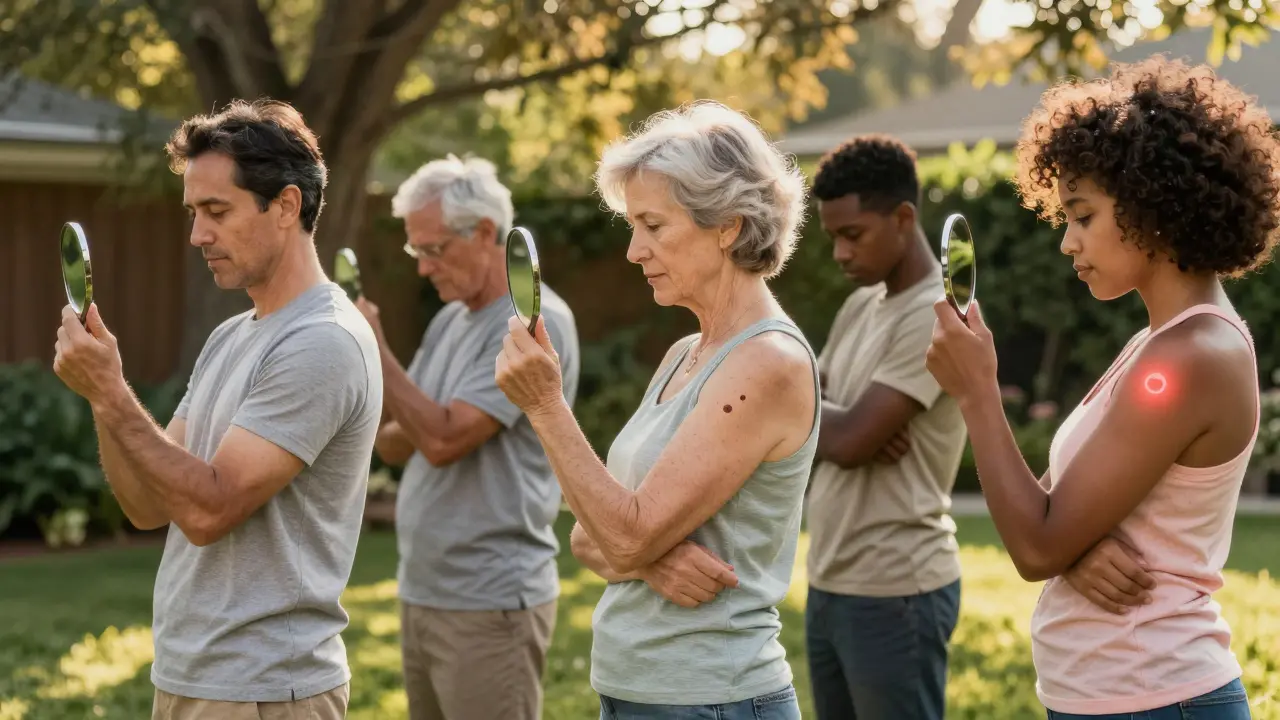
The ABCDE rule is still the gold standard for self-checks. You don’t need a fancy app or a dermatologist to use it. Just stand in front of a mirror, after a shower, when your skin is clean and lit well.
- Asymmetry: One half doesn’t match the other.
- Border: Edges are ragged, blurred, or notched.
- Color: More than one color-black, brown, tan, red, white, or blue.
- Diameter: Larger than a pencil eraser (6mm). But don’t wait for that-some melanomas start tiny.
- Evolving: It’s changing in size, shape, color, or texture. Or it starts itching, bleeding, or crusting.
But here’s what most people miss: evolving is the most important letter. A mole that’s been the same for 10 years? Probably fine. A mole that changed last month? Get it checked. A 2024 study in JAMA Dermatology found that 87% of patients who caught their melanoma early noticed it changed-not because it was big, but because it felt different.
Some people use apps like UV Index by QSun or SkinVision. These can help remind you to check, but they’re not replacements for a doctor. One Reddit user, ‘SkinCheckSavedMe,’ caught a 0.4mm melanoma after the app flagged a spot that looked normal to her. She got it biopsied. It was early. Her survival odds? 99.6%.
Who’s at Risk-and Why You Can’t Rely on Skin Tone
Yes, fair skin, blue eyes, red hair, and a history of sunburns raise your risk. But melanoma doesn’t care about your skin tone. People of color get it too-just in different places. And they’re more likely to die from it because it’s found later.
Other risk factors:
- More than 50 moles on your body
- A family history of melanoma
- Having had a melanoma before
- Using tanning beds-even once before age 35 increases risk by 58%
- Living in sunny places or at high altitudes
- Immune system suppression
Here’s something shocking: indoor tanning is still a major problem. A 2023 meta-analysis found tanning bed users have nearly double the risk of melanoma. And it’s not just teens. Women over 50 are the fastest-growing group using tanning beds, according to the Skin Cancer Foundation. That’s why melanoma rates in older women are rising 3% a year-even as younger people use sunscreen more.
Prevention: It’s Not Just Sunscreen
You’ve heard it a million times: wear sunscreen. But sunscreen alone won’t save you. Here’s what actually works:
- Seek shade between 10 a.m. and 4 p.m., when UV rays are strongest.
- Wear UPF 50+ clothing-hats, long sleeves, UV-blocking sunglasses. A regular cotton T-shirt only blocks UV 5-7. UPF 50+ blocks 98%.
- Use broad-spectrum SPF 30+ daily, even on cloudy days. Reapply every two hours or after sweating or swimming.
- Avoid tanning beds completely. There’s no safe level.
- Check your skin monthly. Take 10 minutes. Use a mirror. Take photos if you want to track changes.
And here’s a tip most people don’t know: UV radiation doesn’t just come from the sun. It reflects off snow, water, sand, and even concrete. You can get burned in winter, on a boat, or sitting by a window. A 2024 CDC study found that 67% of low-income families say sunscreen is too expensive. But you don’t need the fancy brand. Walmart’s Equate SPF 50 works just as well as Neutrogena. And a bottle lasts months if you’re smart about it.
Detection: When to See a Dermatologist
If you’re high-risk-fair skin, lots of moles, family history-you should get a professional skin exam every 3 to 6 months. But the average wait for a dermatologist appointment is almost 30 days. In rural areas, it’s over two months.
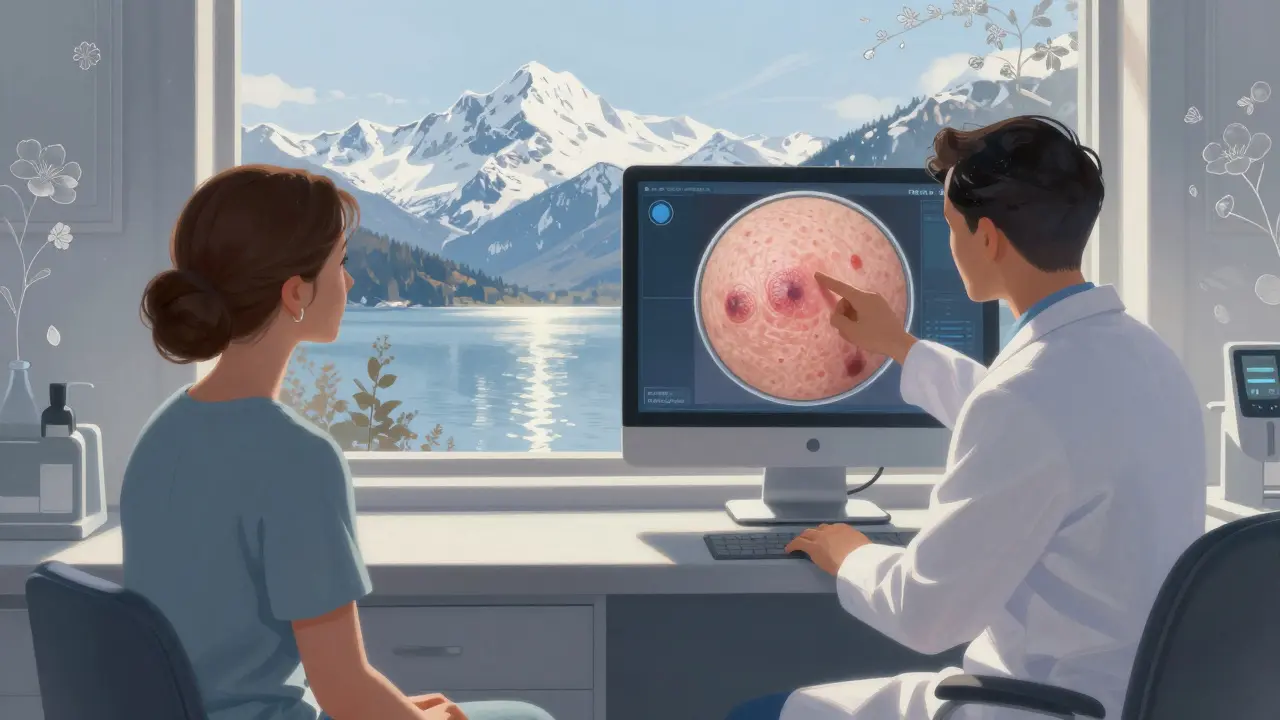
That’s where teledermatology helps. More than 60% of dermatology practices now offer virtual visits. A 2023 study found they’re 87% accurate-close to in-person. You take a clear photo, send it, and get feedback within 48 hours. Some Walmart clinics now have kiosks with built-in cameras that connect to dermatologists. They cost $25 and take 10 minutes.
But here’s the catch: Medicare pays less for virtual visits than in-person ones. So some clinics won’t offer them unless you pay out of pocket. If you’re on Medicare, ask if they offer a discounted cash rate.
Treatment: What Happens After Diagnosis
If a biopsy confirms melanoma, the next step is staging. That means figuring out how deep it went and whether it spread.
- Stage 0 (in situ): Only in the top layer of skin. Surgery with a small margin (0.5-1 cm) is usually enough. Cure rate: nearly 100%.
- Stage I-II: Deeper, but still localized. Surgery with wider margins (1-2 cm) and possibly a sentinel lymph node biopsy (SLNB). SLNB checks if cancer reached nearby lymph nodes. If it didn’t, you’re likely done with treatment. Five-year survival: 90-99%.
- Stage III: Cancer reached lymph nodes. Surgery plus immunotherapy or targeted therapy. Drugs like pembrolizumab (Keytruda) or nivolumab (Opdivo) help your immune system fight it. Side effects? Fatigue, rash, diarrhea. But better than chemo.
- Stage IV: Spread to distant organs. This is serious, but not hopeless. Immunotherapy combinations (like nivolumab + ipilimumab) now give over 50% of patients five-year survival. That’s a huge jump from 10% a decade ago.
Genetic testing is now standard for Stage IIB and above. About half of melanomas have a BRAF mutation. If you have it, drugs like dabrafenib and trametinib can work fast-often shrinking tumors in weeks. But they only last 1-2 years on average before resistance develops. Immunotherapy works slower but lasts longer. Many patients now get both, one after the other.
Cost is a brutal reality. A single infusion of nivolumab can cost $15,000. Even with insurance, out-of-pocket costs hit $28,000 for some patients. That’s why so many people on Reddit talk about financial toxicity. Some clinics offer patient assistance programs. Ask your oncology social worker. Don’t assume you can’t afford it.
The Future: AI, Vaccines, and Better Access
2025 brought big wins. The FDA approved DermEngine’s VisualizeAI, an AI tool that analyzes mole images with 93% accuracy. It’s now used in some clinics to help doctors decide which moles to biopsy. Less guesswork. Fewer missed cancers.
And then there’s the mRNA melanoma vaccine. In a 2024 trial, patients with Stage IIB-IV melanoma who got the vaccine along with pembrolizumab had a 44% lower chance of recurrence. It’s not a cure yet-but it’s a game-changer for preventing return.
Meanwhile, the CDC is pushing UV index alerts into weather apps. By 2026, over 120 million Americans will get daily alerts when UV levels are dangerous. That’s prevention at scale.
But progress won’t help everyone equally. Rural areas still lack dermatologists. Low-income families still can’t afford sunscreen. People of color still get misdiagnosed. Until we fix those gaps, melanoma will keep killing people who never had a fair shot.
What You Can Do Right Now
Don’t wait for symptoms. Don’t wait for a doctor’s appointment. Don’t wait for a reminder.
- Look at your skin. All of it. Use a mirror. Check your back, scalp, between toes, under nails.
- Take a photo of any new or changing spot. Compare in 3 months.
- If anything looks off-get it checked. Even if you think it’s nothing.
- Buy a $10 broad-spectrum sunscreen. Use it every day.
- Tell someone you care about to check their skin too.
Melanoma doesn’t care if you’re busy, scared, or broke. But you can care. And that one action-checking your skin-might be the thing that saves your life.




Comments
swati Thounaojam
8 January 2026my aunt got melanoma under her toenail no one thought it was cancer till she couldnt walk
christy lianto
8 January 2026I used to think sunscreen was for beach days. Then I got a biopsy after noticing a spot on my neck that kept flaking. Turned out it was stage 1. I don't skip a day anymore. Not even when it's raining. Not even when I'm lazy. Not even when I'm broke. That $8 bottle of Equate saved my life. If you're reading this and you've never checked your back-do it today. Don't wait for the itch. Don't wait for the bleed. Just look.
Annette Robinson
9 January 2026This post is incredibly important. I work with elderly patients in rural Ohio, and so many of them still believe melanoma only happens to people with freckles. One woman came in with a lesion on her sole she’d been treating as athlete’s foot for two years. By the time she got to us, it was stage III. We saved her with immunotherapy, but she lost her foot. We need more outreach-not just in cities, but in places where the nearest dermatologist is 120 miles away. And yes, Medicare reimbursement needs to change. These aren’t luxury screenings. They’re lifesaving.
Manish Kumar
10 January 2026Let me ask you something-why do we treat cancer like a personal failure? Like if you get melanoma, you didn’t sunscreen hard enough? We live in a world where the sun is a weapon, the skin is a battlefield, and the body is a failing machine. But what if melanoma isn’t about negligence? What if it’s about biology? About luck? About the fact that your melanocytes just decided to rebel one Tuesday morning? You can wear SPF 100, cover every inch, avoid the sun like it’s a vampire-but still get it. And that’s terrifying. Not because you didn’t try. But because sometimes, no amount of caution matters. The universe just doesn’t care if you’re good. It only cares if it’s time.
Dave Old-Wolf
11 January 2026I didn’t know melanoma could be under your nails. My cousin had one there. We all thought it was a bruise from her ballet shoes. Took three doctors to figure it out. She’s fine now, but she had to get her whole toe cut off. I started checking my own feet every week. I never thought about that before. Now I look at my toes like they’re little warning signs. And yeah-I bought the Walmart sunscreen. It works. I don’t need the fancy stuff.
Prakash Sharma
11 January 2026Why do Americans always act like they invented skin checks? In India, we’ve been watching our moles since childhood. Our grandmas knew the ABCDE rule before it had a name. And we don’t pay $15,000 for treatment-we use Ayurveda, turmeric, sunlight in moderation. You think your tech and apps are saving lives? We’ve been saving lives with wisdom, not algorithms.
Donny Airlangga
12 January 2026My dad died of melanoma in 2018. He was 62. He thought it was just a pimple on his back. He didn’t go to the doctor for six months because he didn’t have insurance. He worked construction. He didn’t want to miss a day. By the time he got diagnosed, it was stage IV. I’m not mad at him. I’m mad at the system. If you can’t afford care, you shouldn’t have to die for it. This isn’t just about checking your skin. It’s about fixing healthcare.
Kristina Felixita
13 January 2026Okay, so I started taking monthly photos of my moles after reading this-and I swear, one of them changed in 2 weeks. I went to the dermatologist, and it was a benign nevus, but they said I caught it before it could turn. I cried. I didn’t even know I was that scared. I’m not gonna stop checking now. I even bought a mirror for my back. It’s ugly, but it’s worth it. Also, I started telling my sister to check her scalp. She has long hair and never looks. Now she does. Small wins.
Evan Smith
14 January 2026So the FDA approved an AI that reads moles... but we still can’t get people to wear sunscreen? I mean, we have self-driving cars and AI that writes poetry, but we still need to beg people to put on SPF? What is wrong with us? I’m not even mad. I’m just disappointed. Like, we’re smarter than this. We know the science. We have the tools. We just don’t care enough until it’s too late. Sad.
Lois Li
14 January 2026I’m a Black woman who’s had three skin biopsies in the last five years. All were benign, but two were on my palms. Doctors always asked if I’d stubbed my toe or gotten a rash. I stopped trusting them. Now I go to a dermatologist who specializes in pigmented skin. I pay out of pocket. It’s expensive, but I’d rather pay than die. If you’re a person of color and you’ve ever been told your mole is "just a bruise"-find a new doctor. Your life matters more than their assumptions.
Ken Porter
16 January 2026Another fear-mongering article. Sunscreen is a scam. You get cancer because you’re weak. Stop blaming the sun. Go outside. Get strong. America’s too soft.
Luke Crump
16 January 2026What if melanoma isn’t the enemy? What if it’s the body’s last cry for attention? We live in a world of chemicals, stress, and screens-our skin is screaming. Maybe the mole isn’t a flaw. Maybe it’s a message. Maybe we’re supposed to slow down. To feel. To stop running from the sun and start listening to our bodies. The cure isn’t in a biopsy or a drug-it’s in surrender. In stillness. In letting go. We treat cancer like an invader. But what if it’s a teacher? A dark, painful, beautiful teacher?
Aubrey Mallory
18 January 2026I’m a nurse who works in oncology. I’ve seen people come in with melanoma that’s spread to their liver, and they tell me they "didn’t think it was serious." I’ve held the hands of mothers who didn’t get to see their kids graduate. I’ve watched men cry because they didn’t check their backs. This isn’t a "maybe". It’s a "do it now". If you’re reading this and you’ve put off a skin check because you’re scared-do it anyway. You’re not alone. We’re all scared. But the cost of waiting? It’s not worth it.
Molly Silvernale
19 January 2026The sun doesn’t hate you-but the system does. It profits off your ignorance. It sells you $40 sunscreens while letting Walmart’s Equate sit on the shelf like a forgotten hero. It charges $15,000 for a single shot of hope while pretending it’s "market-driven." It lets a woman in rural Alabama wait six months for a dermatologist while a tech bro in Silicon Valley gets his mole scanned by AI before breakfast. Melanoma doesn’t discriminate-but capitalism does. And if we don’t fix that-no app, no vaccine, no ABCDE rule will save us. We’re not fighting cancer. We’re fighting a machine that thinks your life is a line item.