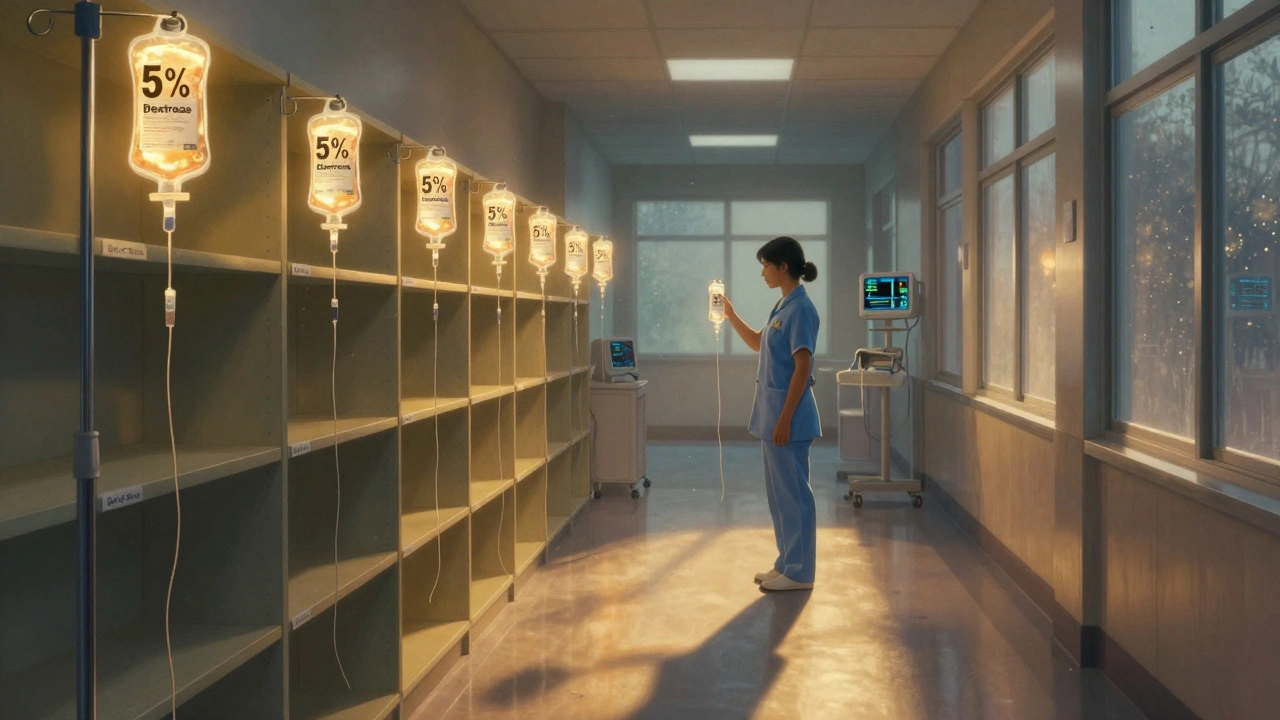
As of December 2025, over 270 drugs are still in short supply across the United States - a number that may seem lower than the peak of 323 in early 2024, but still represents a deep, ongoing crisis. For patients, nurses, and pharmacists, this isn’t just a statistic. It’s daily reality: waiting days for a cancer treatment, mixing saline solutions from larger bags to stretch supply, or being told a life-saving antibiotic isn’t available anywhere nearby. These aren’t temporary hiccups. Many of these shortages began in 2022 or earlier and show no sign of ending soon.
Which Drugs Are in Short Supply Right Now?
The most critical shortages are concentrated in a few key categories - and they’re not random. They’re tied to how these drugs are made, where they’re made, and how little profit manufacturers make from them.
- IV Fluids: 5% Dextrose Injection (small bags) and 50% Dextrose Injection remain on shortage lists since 2021 and 2022 respectively. These aren’t just IV bags - they’re the backbone of emergency care, surgery, and treating dehydration. Hospitals are rationing them. Some are turning to oral rehydration when possible, but that’s not an option for critically ill patients.
- Chemotherapy Drugs: Cisplatin, a key drug for testicular, ovarian, and lung cancers, has been in short supply for over three years. One Indian manufacturing plant, which supplied half of the U.S. market, failed an FDA inspection in 2022 and hasn’t resumed full production. Hospitals now prioritize patients with the best chance of survival, leaving others to wait or switch to less effective alternatives.
- Antibiotics: Vancomycin, cefazolin, and ampicillin are frequently out of stock. In rural clinics and small hospitals, doctors are delaying treatments or prescribing broader-spectrum drugs that increase the risk of antibiotic resistance.
- ADHD Medications: Methylphenidate (Ritalin, Concerta) and amphetamine-based drugs (Adderall) are still hard to find. Demand has climbed 35% since 2020, but manufacturers haven’t scaled up production fast enough. Many patients report going weeks without medication, affecting school performance and workplace productivity.
- GLP-1 Weight Loss Drugs: Semaglutide (Wegovy, Ozempic) and tirzepatide (Mounjaro) are in high demand for both diabetes and weight loss. While brand-name versions are often available through specialty pharmacies, generic alternatives are nearly impossible to find. This has led to black-market sales and dangerous substitutions.
- Electrolyte Solutions: Sodium chloride (saline) and potassium chloride injections remain scarce. These are essential for patients on dialysis, in intensive care, or recovering from surgery.
Why Are These Shortages Happening?
It’s not one problem - it’s a broken system.
Over 80% of the active ingredients in U.S. drugs come from just two countries: India (45%) and China (25%). These facilities often operate on razor-thin margins. A single FDA inspection failure - like the one that shut down the cisplatin plant - can ripple across the entire country. Quality control issues are common because manufacturers cut corners to meet low price demands from U.S. buyers.
Generic drugs make up 90% of prescriptions but only 20% of pharmaceutical revenue. That means manufacturers earn just 5-8% profit per generic drug, compared to 30-40% for brand-name drugs. Why would a company invest in building new facilities or upgrading equipment for a product that barely pays for itself? The answer: they won’t.
And when demand spikes - like the sudden surge in GLP-1 drugs - there’s no backup plan. No stockpile. No emergency production line. The system was built to run on steady, predictable demand. It’s not built for surprises.
Who’s Affected the Most?
It’s not just patients. Healthcare workers are drowning in the fallout.
According to a 2024 survey by the American Medical Association, 78% of doctors have delayed treatments because of drug shortages. Nearly half have had to switch patients to less effective or more toxic alternatives. In one Ohio hospital, pharmacists had to ration cisplatin - giving it only to patients with testicular cancer, where it’s most effective, and holding off on other cancers until supply improved.
Pharmacists are spending over 10 hours a week just tracking down drugs. Sixty-seven percent report medication errors directly linked to substitutions. One nurse in Texas told a reporter she once gave a patient the wrong IV fluid because the labeled bags were mixed up after switching brands due to shortage.
For cancer patients, the delays are deadly. Patients for Affordable Drugs found that 31% of cancer patients experienced treatment interruptions in 2024, with an average delay of nearly 15 days per interruption. That’s not just inconvenience - it’s a risk to survival.
What’s Being Done - And Why It’s Not Enough
The FDA says it prevents about 200 potential shortages every year by stepping in early. But they can’t force a factory to produce more. They can’t demand transparency. They can’t require manufacturers to keep backup supplies.
In January 2025, the FDA launched a new public reporting portal. Within three months, it received over 1,200 reports from providers - 87% of which led to FDA action. That’s progress. But it’s reactive, not preventative.
Some states are trying their own fixes. New York is developing an online map showing which pharmacies still have drugs in stock. Hawaii’s Medicaid program now allows imported drugs approved in Canada or the EU when U.S. versions aren’t available. These are smart, but patchwork solutions. They don’t fix the root problem.
Meanwhile, proposed tariffs of 50-200% on pharmaceutical ingredients from China and India could make things worse. If raw materials become more expensive, manufacturers may stop making low-margin drugs altogether. The Congressional Budget Office warns that without major policy changes, shortages will stay above 250 through 2027 - and could spike to 350+ if tariffs go through.
What Can You Do?
If you’re a patient:
- Call your pharmacy before your prescription runs out. Don’t wait until the last day.
- Ask if there’s a therapeutically equivalent alternative. In 47 states, pharmacists can swap in a similar drug without a new prescription.
- Check the ASHP Drug Shortages Database - it’s updated daily and lists current shortages, expected resolution dates, and alternatives.
- If you’re on a critical medication like chemotherapy or insulin, talk to your doctor about a backup plan - even if it’s just a temporary alternative.
If you’re a caregiver or family member:
- Keep a written list of all medications, dosages, and prescribing doctors.
- Don’t assume your pharmacy has the same stock as the one down the street. Call multiple locations.
- Reach out to patient advocacy groups. Organizations like Patients for Affordable Drugs can help connect you with resources or financial aid for hard-to-find drugs.
The Bigger Picture
This isn’t going to get better unless we change how we make and pay for drugs. The U.S. relies on a global supply chain that’s fragile, opaque, and profit-driven. We need financial incentives for domestic manufacturing. We need mandatory stockpiles of critical drugs. We need a national early warning system that connects manufacturers, distributors, and hospitals in real time.
Until then, the burden falls on patients, nurses, and pharmacists - the people on the front lines. They’re doing their best with broken tools. But they shouldn’t have to.
What are the most common drugs currently in short supply in 2025?
As of late 2025, the most common shortages include IV fluids like 5% and 50% Dextrose, chemotherapy drugs such as cisplatin, antibiotics like vancomycin and cefazolin, ADHD medications including methylphenidate and amphetamine formulations, and GLP-1 weight loss drugs like semaglutide. These shortages are persistent due to manufacturing issues, supply chain vulnerabilities, and high demand.
Why are generic drugs more likely to be in short supply than brand-name drugs?
Generic drugs make up 90% of prescriptions but only generate about 20% of pharmaceutical revenue. Manufacturers earn just 5-8% profit on generics, compared to 30-40% on brand-name drugs. This low margin means companies have little incentive to invest in production capacity, quality upgrades, or backup suppliers. When a plant fails an inspection or faces a supply disruption, there’s often no one else ready to step in.
Can pharmacists substitute drugs during a shortage?
Yes, in 47 states, pharmacists can substitute a therapeutically equivalent generic or brand alternative during a shortage without a new prescription. However, only 19 states allow substitutions without notifying the prescribing doctor first. Always ask your pharmacist if a substitution is available and safe for your condition.
How can I find out if my medication is in short supply?
Check the American Society of Health-System Pharmacists (ASHP) Drug Shortages Database at ashp.org/drug-shortages. It’s updated daily and lists current shortages, expected resolution dates, and approved alternatives. You can also call your pharmacy directly - they often know inventory status before it’s publicly listed.
Are there any safe alternatives if my drug is unavailable?
For many drugs, there are therapeutically equivalent alternatives - meaning they work the same way in the body. For example, if cisplatin is unavailable, carboplatin may be used for some cancers. If saline is scarce, oral rehydration may be an option for mild dehydration. Never switch medications on your own. Always consult your doctor or pharmacist to ensure the alternative is safe and appropriate for your specific condition.
What’s being done to fix the drug shortage crisis long-term?
Proposed solutions include financial incentives to bring active pharmaceutical ingredient (API) manufacturing back to the U.S., mandatory strategic stockpiles of critical drugs, and a national early warning system that shares real-time data between manufacturers, distributors, and hospitals. The FDA has improved its response time, but lacks legal authority to force production. Legislative efforts like the End Drug Shortages Act aim to improve transparency and early reporting, but progress has been slow.



Comments
Ignacio Pacheco
2 December 2025So let me get this straight - we’re paying top dollar for drugs made in countries where the FDA can’t even inspect the factories properly, and the only people getting screwed are the ones who actually need the meds? Brilliant. Absolute genius. We outsource the most critical part of healthcare to the lowest bidder and then act surprised when it all falls apart. At this point, I’d rather just brew my own cisplatin in the garage.
At least my toaster doesn’t require a waiting list.
James Kerr
4 December 2025Man, I feel for all the nurses and pharmacists out there. I had a cousin on chemo last year and they had to wait 11 days for her next dose because cisplatin was out. She cried in the parking lot after the call. It’s not just ‘inconvenient’ - it’s soul-crushing.
Also, if you’re on Adderall and can’t find it, try calling smaller independent pharmacies. Big chains are always sold out, but local ones sometimes have hidden stock. Just ask nicely 😊
parth pandya
5 December 2025as a pharma worker in india, i can tell u the real issue - factories are under so much pressure to cut costs that they skip quality checks. one plant i worked at, they reused solvent 5 times because it saved $2k per batch. no one gets fired for this - only when the fda catches them.
also, the indian govt gives tax breaks to big pharma but no incentives to make generics. so why bother?
we make the drugs but we dont control the prices. its a broken system on both sides.
sagar bhute
5 December 2025You people are pathetic. It’s not a ‘crisis’ - it’s capitalism. You want cheap drugs? Then accept that you’re getting cheap quality. You want reliable supply? Pay more. Stop pretending this is a moral issue when it’s just economics. If you can’t afford your meds, don’t take them. Or better yet - die quietly and stop clogging the system.
Also, India and China are doing just fine. Blaming them is the last resort of the lazy American.
Cindy Lopez
5 December 2025The article is well-researched, but it ignores the fact that the FDA has been aware of these manufacturing vulnerabilities since 2015. They’ve issued over 120 warning letters to Indian facilities. Yet nothing changed. So this isn’t a supply chain problem - it’s a regulatory failure.
Also, why is no one talking about the fact that 70% of IV fluid production is concentrated in just three plants? That’s not diversification. That’s a single point of failure waiting to happen.
Francine Phillips
5 December 2025My pharmacy told me Wegovy is back in stock but it’s $1200 a month. I asked if they had the generic. They laughed. Then hung up.
Also, I’ve been waiting 6 weeks for my saline bags. I’m not even sick. I just need them for my mom’s dialysis. But yeah, I guess I should just be grateful it’s not 2024.
Gene Linetsky
6 December 2025Did you know the WHO and the CDC have been secretly stockpiling these drugs since 2021? And that the real shortages are manufactured by Big Pharma to drive up prices? They’re hoarding cisplatin and ampicillin to force people into buying the expensive branded versions.
Also, the FDA’s new portal? That’s a distraction. They’re using it to track who’s complaining - so they can label you a ‘drug hoarder’ if you call too often.
Check your water. It’s probably being used to dilute the drugs.
shalini vaishnav
7 December 2025Of course America has drug shortages. You outsource everything. You don’t make anything anymore. India and China produce 90% of your medicine because you’re too lazy to build factories. You want cheap? Fine. But don’t cry when the cheap stuff breaks.
Meanwhile, India produces 40% of the world’s generics - and we do it with better quality than your so-called ‘FDA-approved’ labs. You should be thanking us, not blaming us.
Myson Jones
8 December 2025Thank you for writing this. I’m a nurse in rural Ohio, and I see this every day. We’ve had to use oral rehydration for dehydrated elderly patients because we ran out of IV fluids. We’ve had to delay chemo because cisplatin was out. We’ve had to guess at doses because we’re mixing bags from different manufacturers with different concentrations.
It’s not just about money. It’s about dignity. Patients deserve to know their meds will be there. Nurses deserve to do their jobs without playing pharmacy detective. And we all deserve a system that doesn’t treat life-saving drugs like commodities.
If you’re reading this - please call your rep. Tell them to support the End Drug Shortages Act. This isn’t partisan. It’s human.