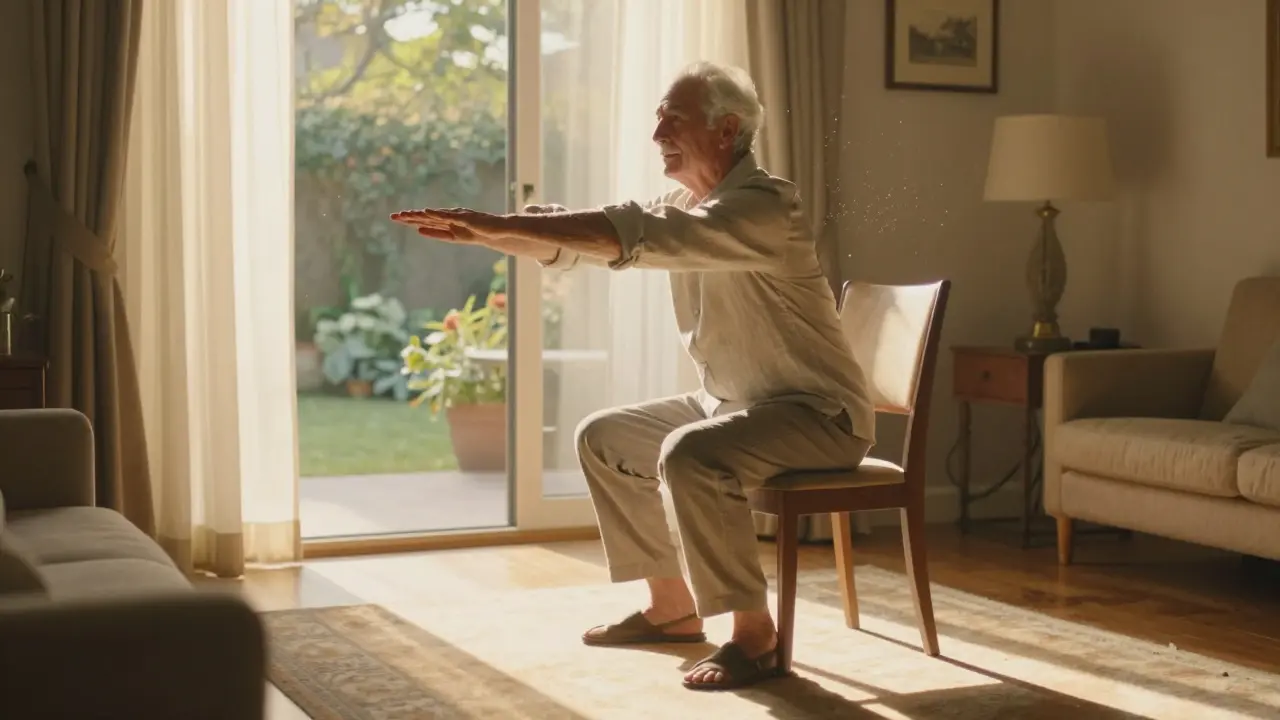
By the time you hit 40, your body is already losing muscle-slowly at first, then faster after 65. This isn’t just about getting weaker. It’s about losing the ability to stand up from a chair, climb stairs, or carry groceries. This is sarcopenia: the progressive, age-related loss of muscle mass, strength, and function. It’s not normal aging-it’s a medical condition that affects 1 in 10 adults over 60, and nearly half of those over 80. The good news? You can fight it. And the most powerful tool you have isn’t a pill-it’s strength training.
What Exactly Is Sarcopenia?
Sarcopenia isn’t just feeling tired or slower. It’s a measurable decline in muscle tissue that starts in your 30s and accelerates after 65. By age 80, you could have lost 30-40% of your fast-twitch muscle fibers-the ones that give you power to move quickly or recover from a stumble. Your body also loses motor neurons, the signals that tell muscles to contract. By 70, your ability to repair muscle drops by 50-60%. That’s why recovery takes longer, and why muscle doesn’t bounce back like it used to.
Doctors diagnose sarcopenia using three things: muscle mass (measured by DXA scan), strength (handgrip test), and function (how fast you walk). If you’re a man and your handgrip is below 27kg, or a woman below 16kg, that’s a red flag. If your walking speed drops below 0.8 meters per second, you’re at higher risk for falls and hospitalization.
This isn’t the same as being inactive. Someone who’s bedridden for weeks loses muscle fast-but that’s disuse atrophy. Sarcopenia happens even if you’re moving around. It’s also not cachexia, which comes with cancer or severe illness and causes weight loss beyond muscle. And it’s not just weakness without muscle loss-that’s called dynapenia. Sarcopenia means you’re losing both mass and function.
Why Your Muscles Fade With Age
Your muscles don’t just wear out-they get ignored by your body’s repair systems. As you age, your cells stop responding as well to signals that tell them to build protein. The mTOR pathway, which kicks off muscle growth, becomes 30-40% less active. Your mitochondria-the energy factories inside muscle cells-produce 15-20% less ATP, leaving you fatigued faster. Chronic low-grade inflammation creeps in, with IL-6 and TNF-alpha levels rising by 30-50%, which directly breaks down muscle tissue.
At the same time, your satellite cells-tiny muscle stem cells that repair damage-drop by half by age 70. Your neuromuscular junctions, where nerves connect to muscles, lose 25-30% of their efficiency between 50 and 80. That means your brain sends the signal to lift your leg, but the muscle doesn’t respond as strongly. It’s like an old phone losing signal: the message is there, but the connection is weak.
This isn’t just about looking weaker. It’s about losing independence. A 2022 survey of over 3,000 older adults found that those who didn’t train their muscles were 17% more likely to need help with daily tasks like bathing, dressing, or getting out of bed.
Strength Training Is the Only Proven Fix
There are no magic pills for sarcopenia. Supplements like creatine or protein shakes help-but only if you’re also lifting. The most powerful, evidence-backed solution is strength training. Multiple studies confirm: two sessions a week can reverse muscle loss in older adults.
In just 12-16 weeks, people over 65 who did resistance training gained 1-2kg of muscle and increased strength by 25-30%. That’s not theoretical. Real people report being able to open jars again, carry laundry baskets, or stand up from the couch without using their hands. One 68-year-old man on a fitness forum saw his handgrip strength jump from 18kg to 24kg after six months of training. That’s the difference between needing help and doing it yourself.
Strength training also improves balance and walking speed. A 2023 study in Circulation found that older adults who trained twice a week improved their gait speed by 0.1-0.2 meters per second. That might sound small, but it cuts fall risk by 30-40%. Falls are the leading cause of injury-related hospitalizations in seniors. Preventing just one fall can save tens of thousands in medical costs.

How to Start-No Gym Required
You don’t need heavy weights or a personal trainer. You just need consistency. The American College of Sports Medicine recommends 2-3 sessions per week, targeting all major muscle groups: legs, back, chest, arms, and core.
Start with bodyweight moves:
- Chair squats: Sit in a sturdy chair, stand up slowly, then sit back down. Do 10 reps.
- Wall push-ups: Stand a foot from a wall, place hands on it, and push your body away.
- Seated leg extensions: Sit tall, straighten one leg, hold for 2 seconds, lower slowly.
- Heel raises: Hold onto a counter, rise onto your toes, lower slowly.
Once you can do 15 reps easily, add resistance. Resistance bands (TheraBand) are affordable and safe. Start with the lightest level (yellow or red), and do 2 sets of 10-15 reps. Focus on control-not speed. Exhale as you push or pull, inhale as you return.
After a few weeks, move to machines at the gym or dumbbells. Use 60-80% of your one-rep max (the heaviest you can lift once). That means choosing a weight where the last 2-3 reps feel hard but you can still maintain good form. Increase the weight by 2.5-5% every week. Don’t rush. Progress is slow-but it’s real.
Common Barriers-and How to Beat Them
Many older adults quit because of pain, fear, or confusion. Here’s what actually works:
- Joint pain? Use machines instead of free weights. They guide your movement and reduce stress on knees and shoulders. Reduce range of motion if needed-partial squats still build strength.
- Balance issues? Do seated exercises. Use a sturdy chair for support during standing moves. Try seated rows with bands or leg presses.
- Don’t know how? Look for SilverSneakers classes. Medicare Advantage plans cover them for free. They’re designed for seniors, with modifications for arthritis, osteoporosis, and mobility limits.
- Too sore? Muscle soreness is normal the first few weeks. But sharp pain isn’t. If it hurts during the move, stop. Talk to a physical therapist.
- Can’t stay motivated? Join a group. People who train with others are 35-40% more likely to stick with it. Find a friend, or sign up for a class. Social connection is part of the treatment.
One 72-year-old woman in a Healthgrades review said her fall risk score dropped from 42 to 28 after 10 weeks of SilverSneakers. That’s not luck-it’s science.

Protein and Timing Matter Too
Strength training alone isn’t enough. Your muscles need fuel. After a workout, your body is primed to rebuild. The International Society of Sports Nutrition recommends 20-30 grams of high-quality protein within 45 minutes after training. That’s about:
- One cup of Greek yogurt
- Three eggs
- One chicken breast
- One scoop of whey protein
Spread protein intake evenly across meals-aim for 25-30g per meal. That’s more effective than loading up at dinner. Your body can’t store extra protein-it uses what it needs and flushes the rest.
What’s Next for Sarcopenia Treatment?
Scientists are exploring drugs that target muscle loss-like RT001, a mitochondrial therapy now in FDA trials. AI-powered apps like Exer AI give real-time feedback on form and adjust workouts automatically, boosting adherence by 25%. But these are still emerging. Right now, the best, cheapest, and most proven treatment is still you-lifting, moving, and showing up.
The numbers are stark: 72 million Americans will be over 65 by 2030. But there are only 12,500 certified geriatric physical therapists in the country. That means the solution can’t rely on clinics alone. It has to be home-based, community-driven, and simple enough for anyone to start.
Strength training isn’t about becoming a bodybuilder. It’s about staying independent. It’s about not needing help to get out of bed. It’s about carrying your own groceries, playing with your grandkids, and walking without fear. You’re not too old to start. You’re exactly the right age to begin.
Is sarcopenia the same as just getting older?
No. Everyone loses some strength with age, but sarcopenia is a specific medical condition defined by measurable loss of muscle mass and function-not just feeling slower. It’s diagnosed using objective tests like handgrip strength, walking speed, and muscle scans. If you’re losing the ability to do daily tasks because of muscle weakness, it’s likely sarcopenia-not just aging.
Can I reverse sarcopenia if I’m already 70?
Yes. Studies show that even people in their 80s can gain muscle and strength with consistent resistance training. One 2023 trial found that frail older adults who trained twice a week for 12 weeks improved their ability to stand from a chair by 40%. It takes longer than it did when you were younger, but your body still responds. The key is consistency-not intensity.
Do I need weights to build muscle after 60?
No. Bodyweight exercises, resistance bands, and machines all work. Many seniors start with chair squats, wall push-ups, and seated rows using bands. These build strength safely. You don’t need to lift heavy to see results. Progress comes from gradually increasing effort over time, not from maxing out on weights.
How often should I strength train to fight sarcopenia?
Twice a week is the minimum for measurable results. The American College of Sports Medicine recommends 2-3 sessions per week, with at least 48 hours between sessions to allow muscles to recover. More than three times a week isn’t necessary and can increase injury risk. Focus on full-body workouts each time-legs, back, chest, arms, and core.
What if I have arthritis or joint pain?
You can still train safely. Use machines instead of free weights-they control your movement and reduce joint stress. Try seated exercises, water aerobics with resistance bands, or low-impact strength classes. Avoid exercises that cause sharp pain. A physical therapist can help modify movements. The goal is to strengthen muscles around the joint, not to stress the joint itself.
Is walking enough to prevent sarcopenia?
Walking is great for heart health and endurance, but it doesn’t build muscle. You need resistance-something that makes your muscles work harder than normal. That means lifting, pushing, pulling, or resisting movement. Walking won’t stop muscle loss. Strength training will.
Can I do strength training at home without equipment?
Absolutely. Use your body weight: chair squats, step-ups onto a low stool, wall push-ups, calf raises, and seated leg lifts. Use towels for resistance on your arms or legs. A filled water jug can replace a dumbbell. Consistency matters more than equipment. Do these exercises 2-3 times a week, and you’ll see results.
How long until I see results from strength training?
Most people notice improved strength and easier movement within 4-8 weeks. You might find it easier to stand from a chair, climb stairs without stopping, or carry bags. Muscle mass changes take longer-usually 12-16 weeks to measure. But function improves faster. That’s what matters most: being able to live independently.
What to Do Next
If you’re over 60 and haven’t started strength training, today is the day. Talk to your doctor about a referral to a physical therapist if you have pain or mobility issues. Check if your Medicare Advantage plan includes SilverSneakers-it’s free and widely available. Look for local senior centers offering strength classes. Start with two days a week, even if it’s just 20 minutes. You don’t need to be perfect. You just need to begin.
The goal isn’t to look younger. It’s to live longer-with your own strength, your own freedom, and your own independence.


Comments
Dayanara Villafuerte
19 January 2026Okay but like… I started doing chair squats at 67 and now I can carry my own groceries AND open pickles without crying. 🤯💪 My grandkids think I’m a superhero. Also, my cat now sits on my lap like I’m a throne. Sarcopenia? More like sarcopenia-SUCKS. 😎
Andrew Qu
20 January 2026Really glad you shared this. I’ve been coaching seniors in community centers for 12 years, and the biggest change I see isn’t muscle gain-it’s confidence. People who start lifting don’t just get stronger. They stop apologizing for moving slow. They start saying ‘I can’ again. That’s the real win. Keep going. You’ve got this.
kenneth pillet
21 January 2026been doing wall push ups for 3 months now. no gym. no weights. just me and a wall. sore at first but now i can do 20 without stopping. my dr said my grip strength improved. not bad for a 71 year old with bad knees. thanks for the nudge
Jodi Harding
22 January 2026They say aging is inevitable. But losing your ability to stand up from your own chair? That’s not fate. That’s neglect. And we’ve been sold a lie that this is just ‘getting older.’ No. It’s a choice. Your body still listens. You just have to speak up.
Danny Gray
23 January 2026So you’re telling me the solution to decades of biological decay is… lifting weights? Wow. I guess we just ignore the fact that modern life has poisoned us with sugar, plastics, and EMFs. The real problem isn’t muscle loss-it’s that we’ve been conditioned to believe we can fix everything with dumbbells. What about the systemic collapse of our healthcare system? Or the fact that 80% of seniors can’t afford a personal trainer? This post is dangerously simplistic.
Tyler Myers
24 January 2026Strength training? HA. The government knows sarcopenia is a scam to push gym memberships. They’re hiding the truth: your muscles waste away because of fluoride in the water and 5G radiation. I’ve read 17 peer-reviewed papers (on a blog) and the real fix is cold showers and apple cider vinegar. Also, don’t trust doctors-they work for Big Pharma. I’ve been doing 100 push-ups daily since 1987 and I’m 82. You’re welcome.
Kristin Dailey
25 January 2026Why are we letting foreigners tell us how to stay healthy? We used to be strong. Now we’re all sitting on couches watching TikTok. Do push-ups. Lift something. Be American.
Wendy Claughton
27 January 2026I’m 69. I started with 5 minutes of seated leg lifts… and now I dance with my husband in the kitchen. 🌸✨ It’s not about being strong for others. It’s about being strong for yourself. Every tiny effort counts. Every rep is a quiet rebellion against despair. You’re not too late. You’re exactly on time. 💛