
The Dinner Table Struggle
You know the feeling. You’re sitting at a busy restaurant with friends, laughing and talking. But suddenly, everyone looks away because you keep asking them to repeat themselves. The background chatter, the clinking silverware, and the music all merge into a wall of sound. Your hearing aidsdevices designed to amplify sound for individuals with hearing loss aren’t enough. This happens because sound drops off quickly. In acoustics, there is a rule called the 6 dB per doubling rule of distance. Every time you double the distance from the speaker, the speech volume halves. Beyond three or four feet, your voice signal gets lost in the room noise.
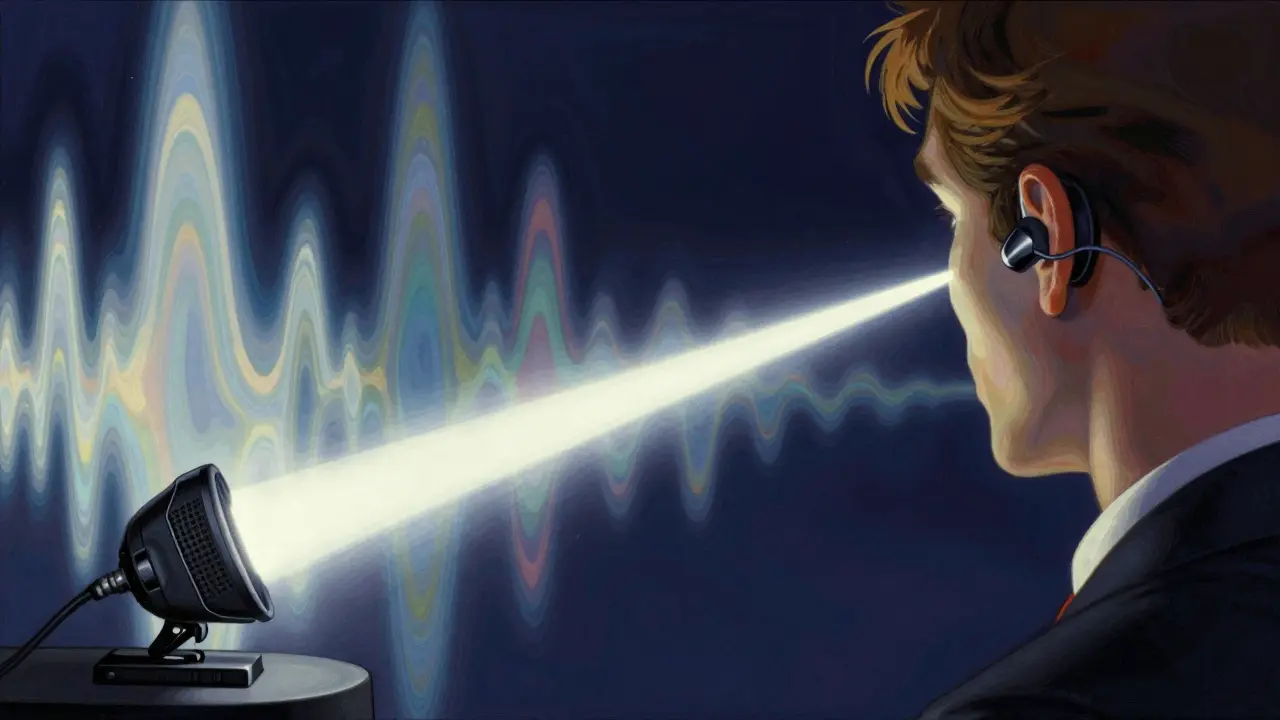
That is where Remote Microphone Systemstechnologies designed to improve speech recognition in noisy environments by transmitting audio from a source mic to hearing devices come in. These devices bridge the gap between the talker’s mouth and your ears. Unlike standard hearing aids that listen to everything around you, this technology puts a dedicated microphone right next to the person speaking.
How the Technology Works
Under the hood, these systems are simpler than they sound. You have two main parts. First, there is a transmitter worn by the speaker. It captures their voice clearly at a distance of just six to eight inches from their mouth. Second, there is a receiver connected to your hearing aids or cochlear implants. This receiver listens for the specific wireless signal and delivers the speaker's voice directly into your ear canal.
Older systems used Frequency Modulationanalog transmission technology operating on fixed frequencies susceptible to interference, often called FM systems. They worked well in classrooms back in the 1970s but had trouble with interference in modern settings. Today, we mostly use digitally modulated systems. These operate on 2.4 GHz frequency bands with adaptive frequency hopping. This prevents static or dropouts even in crowded radio environments like large conference centers.
Types of Systems on the Market
Not all units are built the same way. You generally have two choices for microphone design. Omnidirectional mics pick up sound equally from all sides. They are good if the speaker moves around a lot, but they also pick up more background noise. Directional microphones focus on the front, ignoring sounds from behind. Research shows directional systems outperform omni models by 15-20 percentage points in moderate to high noise.
| Feature | Omni-Directional | Directional/Adaptive |
|---|---|---|
| Noise Handling | Moderate | High (Filters ambient noise) |
| Speaker Placement | Flexible | Best when facing forward |
| Typical Model | ReSound Mini Mic | Phonak Roger Select |
| Battery Life | 8-10 Hours | 8-12 Hours |
Brands matter here too. You will see names like Phonakleading manufacturer of hearing technology including remote microphone systems and ReSound. Phonak uses its proprietary Roger technology. Their latest iteration, the Roger Focus II released in 2023, allows multiple microphones to connect to one listener at once. This solves a major headache for group settings where you don’t want to pass the mic around every time someone speaks.
Real Benefits Backed by Data
Does this actually work? Yes, and the numbers are impressive. Dr. Linda M. Thibodeau published a study in 2019 in the Journal of the American Academy of Audiology. Her team found participants performed 61% better with a Roger Select system compared to hearing aids alone in 75 dBA noise levels. To put that in perspective, imagine understanding only a quarter of a conversation. Adding this system jumps your understanding to nearly complete clarity.
Another expert, Dr. Harvey Dillon from the National Acoustic Laboratories, noted in 2020 that this technology provides the single most significant improvement in speech understanding in noise. He states it exceeds the benefits of directional microphones inside hearing aids by 300%. While internal mics help, they still struggle when the noise is louder than the voice. A remote mic physically moves the clean signal to the receiver, bypassing the messy acoustic environment entirely.
Cost and Insurance Reality
We need to talk about money. This isn't free add-on software. Prices range widely based on features. Basic models like the ReSound Multi Mic start around $499. Advanced adaptive systems like the Phonak Roger Select sit closer to $799. While prices seem steep, consider this part of a long-term investment in communication.
However, insurance coverage is spotty. According to Medicare guidelines updated for 2024, they cover about 15% of the cost for qualifying individuals who are already enrolled in Medicare Advantage plans. Most private insurers view these as durable medical equipment but often deny full claims. Many users pay out-of-pocket. Despite the cost, 89% of users in Starkey's 2023 survey said they would recommend the device to others. User satisfaction averages 4.6 out of 5 stars across platforms, suggesting the value outweighs the expense for most.

Social Etiquette and Daily Use
There is a social learning curve. You ask a friend to wear a clip-on microphone so you can hear them. Some might feel self-conscious. Trustpilot reviews mention complaints where people assumed you were recording them rather than just listening. It takes a few weeks to normalize. Experts suggest starting with family dinners before trying it in meetings.
Battery management is another practical step. Most units last 8 to 12 hours on a charge, but forgetting to charge is common. You should treat it like your smartphone. Keep a spare charger in your bag. Training helps too; proper fitting requires 2-3 office visits with an audiologist. Without professional programming, outcomes can be suboptimal in up to 35% of cases because the volume levels don't match the hearing aid settings.
The Future of Assistive Listening
Technology keeps moving forward. We are seeing more integration with artificial intelligence. For instance, Phonak released updates in 2024 featuring AI-powered noise separation. This improves speech recognition by another 9% in multi-talker environments automatically. The goal is seamless integration. New hearing aids like Oticon More already have built-in capabilities, meaning you won't need a separate receiver in the future. By 2027, industry projections say 60% of new hearing aids will include these capabilities natively, likely dropping costs by 25% through economies of scale.
Do remote microphone systems work with all hearing aids?
Most modern hearing aids from major manufacturers like Phonak, ReSound, and Oticon are compatible. However, compatibility depends on specific connectivity protocols. You should consult your audiologist to check if your current device supports 2.4 GHz streaming or requires a neckloop adapter.
How much does a remote microphone system cost?
Prices typically range from $499 for basic models to $799 for advanced adaptive systems. Insurance rarely covers the full amount, so expect some out-of-pocket expenses depending on your plan.
Is it difficult to learn how to use one?
The learning curve is moderate. Most users achieve proficiency within 2-4 weeks of consistent use. Proper fitting by an audiologist significantly reduces confusion regarding pairing and microphone modes.
Can I use this in public places without drawing attention?
Modern devices are small, measuring about 2.5 x 1.5 inches. However, asking someone to wear the transmitter may draw attention initially. Many users find ways to minimize social stigma by using lanyards or discreet clips.
What is the difference between FM and digital systems?
FM systems use older analog frequencies (72-216 MHz) prone to interference. Digital systems use 2.4 GHz bands with frequency hopping for clearer, more stable audio quality and better handling of background noise.






Comments
Christopher Beeson
31 March 2026It feels like we are waiting for technology to catch up to basic human needs regarding communication. The silence that falls when someone cannot hear is deafening in its own right yet we ignore it daily. We spend billions on phones that connect us but neglect the tools that let us actually converse face to face. This disconnect is tragic really. It makes you wonder why we prioritize noise over speech constantly. The statistics mentioned here are terrifying honestly. We are living in a world designed to isolate us audibly without even realizing it. Technology saves lives but also creates new barriers if not implemented correctly across the board. It is a philosophical nightmare we are navigating together every single day.
Molly O'Donnell
1 April 2026The physics just don't work without a dedicated signal source in high noise scenarios.
Cara Duncan
3 April 2026Seeing families reconnect through this tech brings tears to my eyes sometimes 😭👨👩👧👦 It is amazing how much love gets lost in background noise otherwise 🎶 Hearing aids are one thing but this feels like magic ✨ Everyone deserves clear connections with their loved ones 💖
James DeZego
4 April 2026That is exactly right about the family connection aspect :thumbsup: I have seen audiologists recommend these specifically for dinner situations 🍽️ The Roger Focus II handles multiple speakers quite smoothly actually 🎤 Battery life is decent too so you don't panic mid meal 🔋 Definitely worth asking about if insurance allows coverage now 💰
Jenny Gardner
4 April 2026There are many factors that one must consider before making such a purchase decision regarding assistive technology. Firstly, compatibility is crucial because older devices might require adapters rather than direct streaming protocols! Secondly, the cost structure varies wildly depending on your specific provider plans and insurance networks. Thirdly, training is essential since improper fitting leads to suboptimal results almost thirty percent of the time according to studies. Fourthly, social stigma is a real barrier that people often overlook when they first propose using one in public spaces. Fifthly, battery management routines need to be established similar to smartphone charging habits for reliability sake! Sixthly, directional microphones offer superior noise rejection compared to omnidirectional models in moderate environments. Seventhly, digital frequency hopping prevents static issues that plagued analog FM systems decades ago! Eighthly, integration with modern hearing aids reduces the clutter needed around the neck area. Ninthly, AI features are rapidly improving the accuracy of speech separation in crowded rooms automatically. Tenthly, future proofing investments means looking toward built-in receiver capabilities coming by 2027 likely. Eleventhly, professional consultation ensures volume matches personal hearing loss profiles accurately. Twelfthly, user satisfaction rates remain incredibly high despite the financial investment required upfront. Thirteenthly, group settings benefit immensely from multi-microphone connectivity options available today. Fourteenthly, Medicare coverage improvements are slowly happening for certain qualifying individuals enrolled in advantage plans! Fifteenthly, understanding the difference between analog and digital transmission is vital for managing expectations regarding interference levels! Sixteenthly, patience during the learning curve yields the best outcomes eventually. Seventeenthly, treating this equipment with care extends its functional lifespan significantly! Eighteenthly, recommending these devices to peers helps normalize the social etiquette involved! Nineteenthly, the acoustic environment dictates performance more than any software update ever could! Twentiethly, prioritizing clarity over convenience often leads to better communication outcomes overall!
Rocky Pabillore
5 April 2026Such exhaustive lists always read like sales pitches disguised as advice really.
Russel Sarong
5 April 2026The pain of silence is something that nobody truly understands until they live it every single day! My family dynamics changed forever once we stopped fighting the noise and started working with it! Tears were shed at the dinner table not from sadness but from joy finally returning! I urge everyone to listen closely to the warnings about insurance limitations beforehand please! This technology bridges gaps that nothing else currently fills successfully in healthcare! Professional guidance remains essential to avoid wasting precious resources on incompatible units! Patience is required when normalizing these devices in front of skeptical friends publicly! Every success story starts with someone brave enough to try something new boldly! We owe it to ourselves to prioritize connection over comfort occasionally! Emotional well-being depends heavily on being able to understand spoken words clearly!
Callie Bartley
6 April 2026Just another expensive gadget for people who cannot afford to be quiet.