When you pick up a generic pill at the pharmacy, you expect it to work just like the brand-name version. But how does the FDA make sure it actually does-after it’s already on the shelf? The answer isn’t in a lab test or a clinical trial. It’s in real-world data, patient reports, and sophisticated tracking systems that watch for problems long after approval.
Why Monitoring Doesn’t Stop at Approval
Generic drugs don’t need to repeat the same long clinical trials as new drugs. Thanks to the Hatch-Waxman Act of 1984, manufacturers only need to prove their product is bioequivalent to the brand-name version. That means the body absorbs it at the same rate and to the same extent. But bioequivalence doesn’t guarantee identical performance in every patient. A small change in filler, coating, or manufacturing process might affect how a drug behaves in someone with kidney disease, or in combination with another medication. That’s why the FDA doesn’t stop watching once the drug is approved.The Tools the FDA Uses to Watch Generic Drugs
The FDA doesn’t rely on guesswork. It uses three major systems to catch problems early:- FAERS (FDA Adverse Event Reporting System): This is the main database where doctors, pharmacists, patients, and drug companies report side effects, allergic reactions, or unexpected outcomes. In 2023 alone, over 1.2 million reports came in-about 30% of them involved generic drugs.
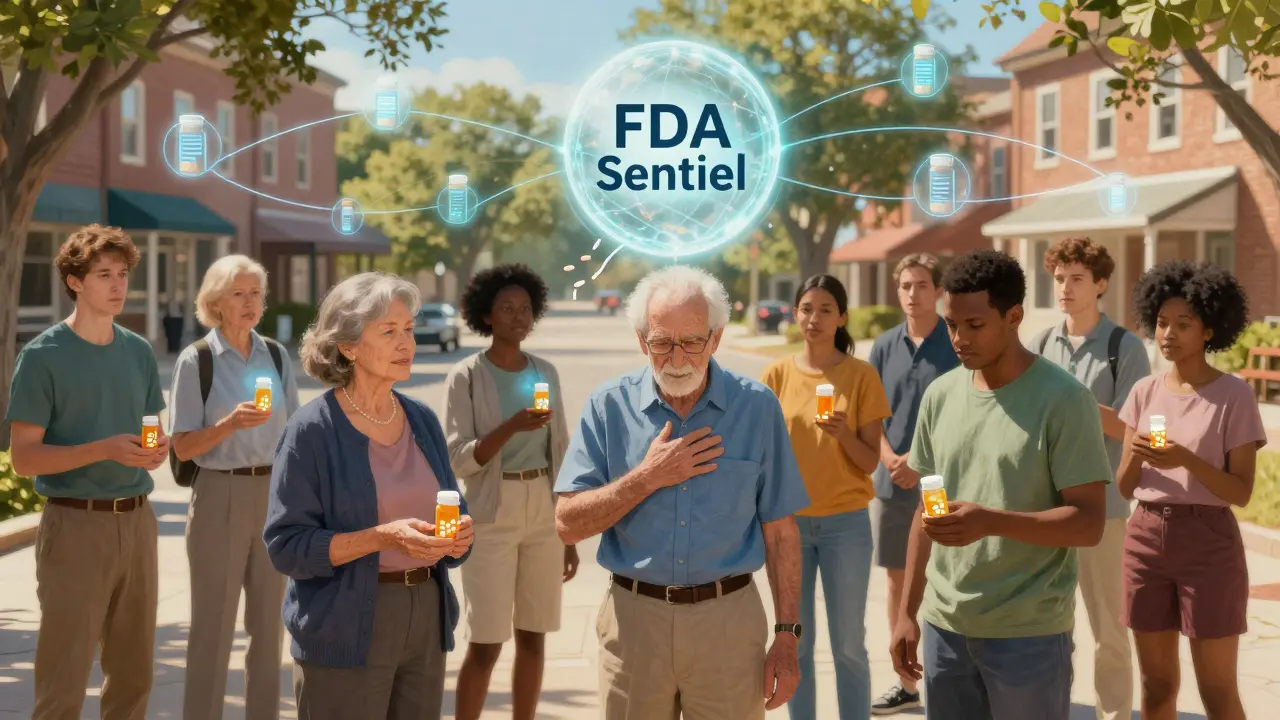
- Sentinel Initiative: This system scans electronic health records and insurance claims from over 200 million Americans. It doesn’t wait for someone to report a problem-it actively looks for patterns. For example, if a sudden spike in kidney issues appears among people taking a specific generic blood pressure pill, Sentinel flags it within weeks.
- MedWatch: This is the public-facing portal where anyone can report a bad reaction, a broken pill, or a drug that didn’t work. The FDA’s Office of Generic Drugs checks these reports daily, especially for high-volume generics like metformin or lisinopril.
These systems work together. A single report might not mean much. But if 50 similar reports come in over two months, the FDA’s team of epidemiologists and pharmacologists digs deeper. They look at age, dosage, other medications, and even the manufacturer. Sometimes, they find nothing. Other times, they find a real safety signal.
Complex Generics Are the Biggest Challenge
Not all generics are created equal. Simple pills like atorvastatin are easy to copy. But complex products-like inhalers, topical creams, or extended-release capsules-are harder. A slight difference in particle size or release mechanism can change how the drug works in the body. The FDA calls these “complex generics,” and they’re the focus of growing concern.In 2021, the National Academies of Sciences warned that current bioequivalence tests might not catch differences in complex generics. For example, a generic asthma inhaler might deliver the same amount of medicine-but if the spray pattern is off, the drug might not reach the lungs properly. That’s why the FDA launched the Center for Research on Complex Generics in 2020, partnering with universities to study these products in real patients.

When the FDA Finds a Problem
If a pattern emerges, the FDA doesn’t wait. Here’s what happens next:- Label update: The drug’s warning label might be changed to include new side effects or usage restrictions.
- Dear Healthcare Provider letter: The FDA sends out official notices to doctors and pharmacists warning them about potential risks.
- Manufacturing inspection: The FDA shows up unannounced at the plant. They check if the product matches the approved formula.
- Voluntary recall: If the issue is serious, the manufacturer pulls the batch. The FDA can also force a recall.
One notable case happened in 2020 when several generic versions of the blood pressure drug valsartan were recalled due to contamination with a cancer-causing chemical. The FDA traced the issue through FAERS reports and lab testing-showing how post-market surveillance can prevent widespread harm.
The Role of Patient Perception
Sometimes, the problem isn’t the drug-it’s the patient’s belief about it. Studies show that when people switch from a brand-name drug to a generic, they sometimes report side effects that didn’t exist before. This is called the “nocebo effect.” One 2019 study in JAMA Internal Medicine found that 15% of adverse event reports for generics mentioned reduced effectiveness, even though lab tests showed no difference in absorption.That’s why the FDA also tracks patient feedback. If a lot of people report the same issue with a specific generic-say, a headache after switching to a new manufacturer’s version of sertraline-the FDA investigates whether it’s a real chemical difference or just perception. Either way, they respond.
What’s Next? AI and Real-Time Monitoring
The FDA is investing heavily in new technology. In 2023, the agency allocated $5.2 million to develop AI tools that can scan millions of health records and detect safety signals faster. Instead of waiting months for reports to pile up, the goal is to catch problems in weeks-or even days.One project aims to compare outcomes between brand-name drugs and their generic versions using real-world data. If patients on a generic version of a heart medication have more hospital visits, the system flags it automatically. Early tests show this approach could cut detection time by 60-70% for complex generics.
The Sentinel system is also expanding. More hospitals and insurers are joining, giving the FDA access to richer, more detailed health data. By 2027, experts predict AI-driven surveillance will be standard for high-risk generics.
Why This Matters to You
Generic drugs save the U.S. healthcare system over $300 billion a year. Nine out of ten prescriptions are for generics. That’s not just a cost-saving measure-it’s a public health backbone. But that backbone only works if it’s monitored.If you take a generic drug and notice something new-dizziness, nausea, or just that it doesn’t seem to work like it used to-report it. Use MedWatch. Your report might be the one that triggers a safety review. The FDA doesn’t have eyes everywhere. But with enough people paying attention, they can see what’s happening.
Do generic drugs have the same active ingredients as brand-name drugs?
Yes. By law, generics must contain the same active ingredient, strength, dosage form, and route of administration as the brand-name drug. The difference lies in inactive ingredients like fillers, dyes, or coatings-which can sometimes affect how the drug is absorbed, especially in complex products.
Can the FDA pull a generic drug off the market?
Yes. If the FDA finds a serious safety issue-like contamination, inconsistent potency, or unexpected side effects-it can require a recall. Manufacturers can also voluntarily pull a product. The FDA can also suspend approval if a company repeatedly violates manufacturing standards.
Are generic drugs tested on people after approval?
Not in the way new drugs are. But the FDA uses real-world data from millions of patients through the Sentinel Initiative and MedWatch to monitor outcomes. This is called post-market surveillance, and it’s how they catch problems that didn’t show up in the initial trials.
How often does the FDA inspect generic drug factories?
The FDA inspects manufacturing facilities every two to three years on average, but inspections can happen more frequently if there are safety concerns or past violations. Many inspections are unannounced to ensure compliance with current standards.
What should I do if I think my generic drug isn’t working?
Talk to your doctor or pharmacist first. Don’t stop taking the medication without advice. Then, report your experience to MedWatch through the FDA’s website. Even if it turns out to be a placebo effect, your report helps the FDA spot patterns across thousands of users.
What You Can Do
You don’t need to be a scientist to help keep generic drugs safe. Here’s how:- Keep track of which manufacturer made your generic drug-different makers can have different results.
- Report any side effects, even if you’re not sure they’re related.
- Don’t assume all generics are identical. If one makes you feel worse, ask about switching to another brand.
- Stay informed. The FDA publishes safety updates on its website.
The system isn’t perfect. But it’s working. And it only works because people pay attention.





Comments
roger dalomba
25 December 2025So let me get this straight-we trust a pill made in India with chalk and hope to cure my hypertension? 🤡
Sophia Daniels
25 December 2025Oh honey, the FDA’s got a whole squad of lab-coated ninjas watching your generics like a hawk. But let’s be real-half these pills are made in factories where the AC is a dream and the inspectors show up when the moon’s full. 🐉
Becky Baker
27 December 2025If you're not taking the brand name, you're basically gambling with your life. America made these drugs. Why are we outsourcing our health to some guy in Bangalore with a spreadsheet?
Fabio Raphael
29 December 2025I’ve been on generic metformin for 5 years. Had zero issues. But I know someone who switched and got dizzy as hell. It’s weird how the body reacts differently. Maybe it’s the filler. Maybe it’s the stars. Either way, reporting it matters.
Amy Lesleighter (Wales)
29 December 2025people think generics are cheap because theyre bad but no its because they dont need to pay for ads or fancy packaging. the active stuff is the same. if your body freaks out its probably your nerves not the pill. just report it. easy.
sakshi nagpal
31 December 2025I appreciate the transparency in this post. In India, we rely heavily on generics due to cost, and it’s reassuring to know systems like Sentinel exist. Still, access to consistent quality remains uneven. More global collaboration would help ensure safety across borders.
Sandeep Jain
1 January 2026i took generic lisinopril last year and felt like a zombie for 2 weeks. switched back to brand name and boom-normal. i thought i was crazy. turns out the filler in the generic made me nauseous. medwatch got my report. hope it helps someone.
Natasha Sandra
1 January 2026I’m so proud of the FDA 🇺🇸💖 they’re the real MVPs keeping us safe while big pharma tries to cut corners. if you’re not reporting side effects, you’re part of the problem. 🙌 #GenericSafety
Steven Destiny
3 January 2026This is why we need to stop being lazy. If your generic makes you feel weird, don’t just suffer. Report it. Call your rep. Demand better. The system only works if we scream loud enough. Stop being passive and start being vigilant.
Rajni Jain
4 January 2026you’re not alone if you feel off after switching. i switched generics 3 times before i found one that didn’t give me headaches. just write down the maker’s name. it’s like finding the right coffee roast. patience + reporting = power.
Brittany Fuhs
6 January 2026The FDA’s ‘sophisticated tracking systems’ are just a bunch of interns reading 1.2 million typos in FAERS. We’re one bad batch away from a national crisis. And you? You’re still taking it because it’s $4. 🤦♂️