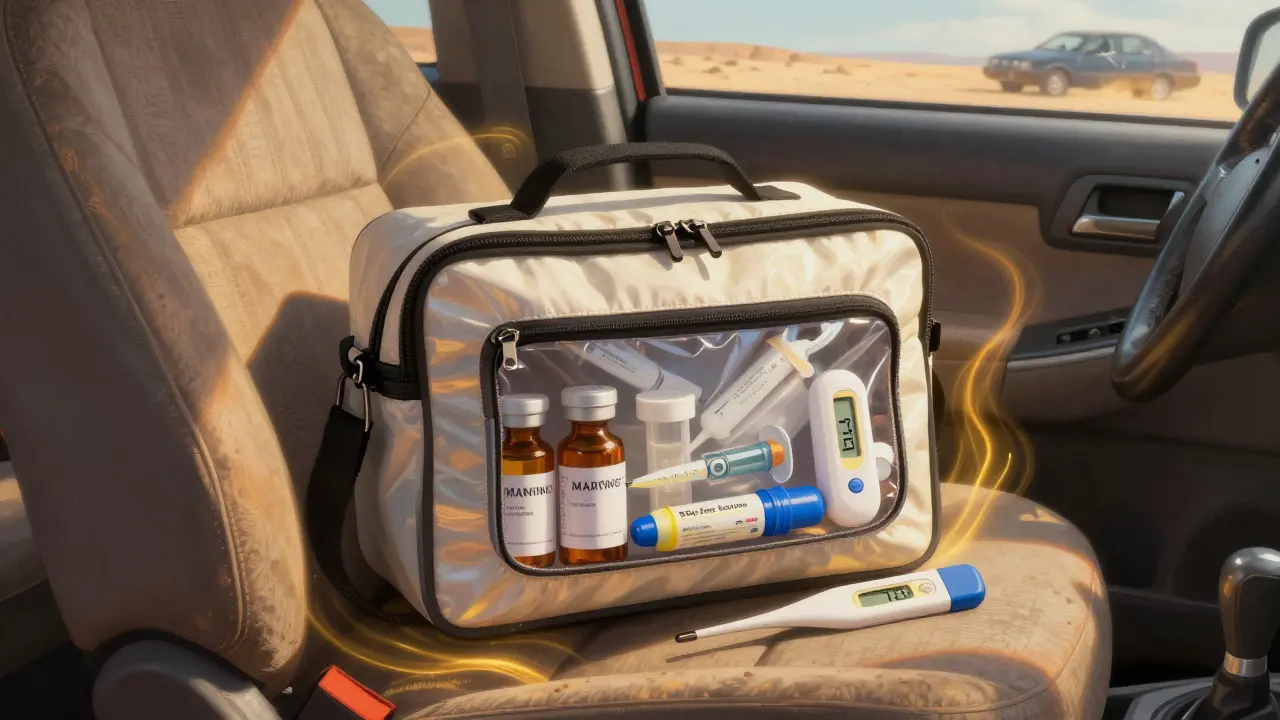
When you’re traveling in a hot climate, your medications aren’t just sitting in your bag-they’re in danger. A car seat in 90°F weather can hit 140°F in under 30 minutes. That’s not just uncomfortable-it can destroy your insulin, EpiPen, birth control, or asthma inhaler. And once they’re damaged, you won’t always know until it’s too late.
Why Heat Destroys Medications
Most pills and liquids are designed to stay stable between 68°F and 77°F (20°C to 25°C). That’s not "room temperature" as most people think of it-especially in summer. A house with the AC off can easily hit 85°F. Outside? It’s worse. The American Pharmacists Association says vehicle interiors can exceed 120°F in just 20 minutes on an 85°F day. That’s enough to break down the chemical structure of many drugs. Temperature-sensitive medications like insulin, EpiPens, hormonal contraceptives, and certain antibiotics start degrading above 86°F. Research from Cedars-Sinai shows some lose up to 32% of their potency after just 24 hours at 104°F. That doesn’t mean they look different or smell bad. They just don’t work like they should. One nurse on Reddit shared that a patient’s birth control failed after being left in a car for two days-resulting in an unexpected pregnancy. That’s not rare. It’s predictable.Which Medications Are Most at Risk?
Not all meds are equally sensitive, but some are far more fragile:- Insulin: Loses effectiveness quickly above 86°F. Can clump or turn cloudy-signs it’s ruined.
- EpiPens: Epinephrine breaks down in heat. A degraded pen might not deliver a full dose during an allergic reaction.
- Birth control pills: Heat can reduce hormone levels enough to cause ovulation. No warning. No symptoms.
- Thyroid meds (like levothyroxine): Even small degradation can throw off your metabolism.
- Asthma inhalers (albuterol): Pressure valves can fail. One user reported their inhaler stopped working after a beach day-leading to an ER visit.
- Antibiotics and anti-seizure drugs: Some lose potency rapidly. Taking a weakened dose can lead to treatment failure or antibiotic resistance.
Even supplements like melatonin or vitamin D can degrade faster in heat, though they’re less dangerous. But if you’re relying on them for sleep or immunity during travel, you don’t want them failing either.
What NOT to Do
These are the most common mistakes-and they’re deadly serious:- Leaving meds in the car: Glove compartment? Trunk? Seat? All are death traps in heat. One study found temperatures inside a glove box hit 140°F in 30 minutes on a 90°F day.
- Keeping meds in direct sunlight: Even a window sill or beach bag in the sun can cook your pills.
- Putting refrigerated meds in a regular cooler with ice directly touching them: Freezing insulin or other liquids can permanently damage them.
- Checking meds in luggage on flights: Cargo holds can drop below 20°F or spike over 120°F. Your insulin could freeze or melt.
- Assuming "room temperature" means your hotel room: If it’s 85°F inside, it’s too hot.
How to Store Medications Properly
The solution isn’t complicated-but it requires action. Here’s how to do it right:- Use an insulated medication bag: Look for ones with phase-change materials that maintain 59°F-77°F for 48-72 hours. The MedActiv Travel Case ($34.99) and Frio Insulated Wallet ($24.99) are both tested to keep meds safe even in 100°F heat.
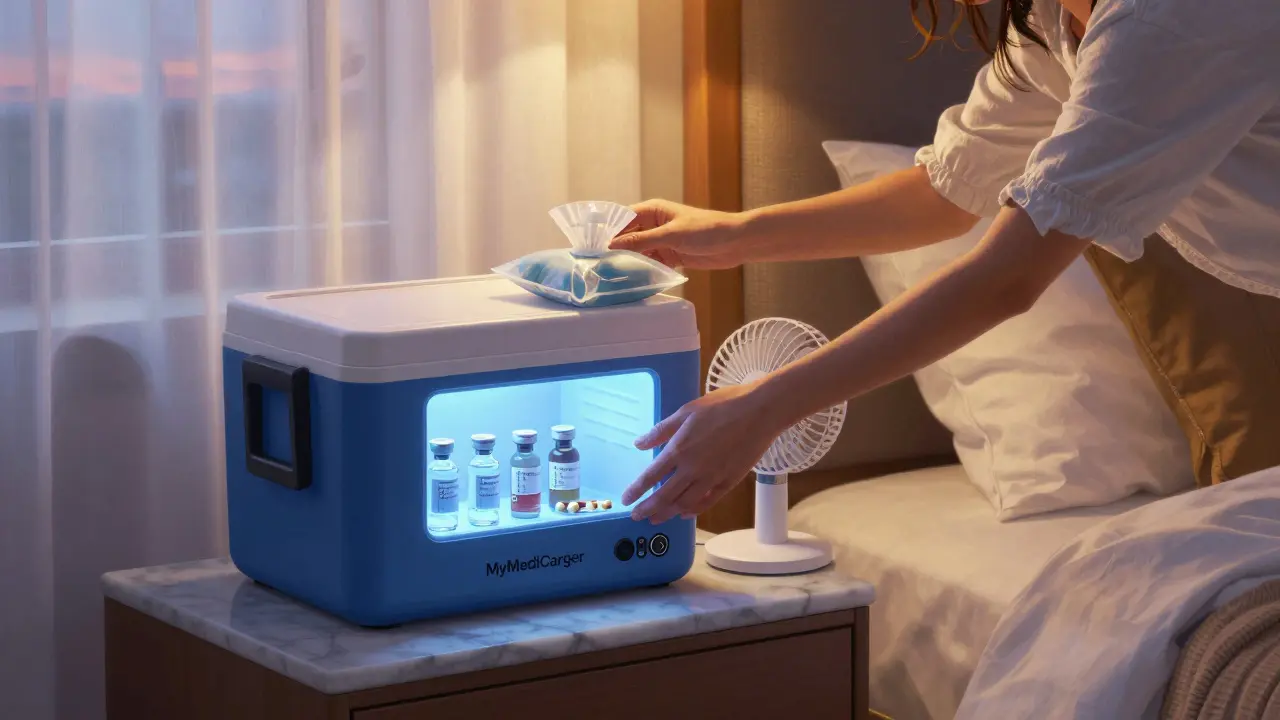
- For refrigerated meds, use a pharmaceutical-grade cooler: Standard coolers fluctuate too much. The MyMediCarrier ($89.95) uses ice bricks and keeps insulin at exactly 42°F for up to 72 hours. One user confirmed this with a thermometer during a 102°F Arizona road trip.
- Wrap ice packs in towels: Never let ice touch medication directly. Use a barrier to prevent freezing.
- Carry a small thermometer: The American Society of Health-System Pharmacists now recommends this. A $10 digital thermometer lets you check your bag’s internal temp. If it’s above 80°F, take action.
- Keep meds with you on flights: Always carry them in your carry-on. Cabin temps stay between 68°F and 75°F-perfect. TSA allows medications in original containers with labels. No need to declare them unless asked.
- Use portable fans: If you’re outside for hours, point a small USB fan at your medication bag. Testing by Senior Helpers showed this can drop internal temps by 12°F-15°F.
- Plan ahead: 15-20 minutes before leaving home, transfer meds to your travel container. Don’t wait until you’re at the airport or in the car.
Smart Tech Solutions
Technology is catching up. Devices like the TempSure Medication Cooler ($129.99) and TempTraq Medication Monitor ($49.95) use Bluetooth to send real-time temperature alerts to your phone. If your bag hits 85°F, you get a notification. Sales of these devices jumped 220% in Q2 2023. They’re not cheap-but for insulin-dependent travelers or those on life-saving meds, they’re worth it.The FDA is also pushing for new labeling. By early 2024, some medications will include color-coded heat exposure indicators-like a red stripe that appears if the drug was exposed to unsafe temps. It’s a step forward.
What to Do If Your Meds Get Too Hot
If you suspect your medication was exposed to extreme heat:- Don’t use it. Especially if it’s insulin, EpiPen, or birth control.
- Check for changes: Cloudiness, clumping, strange odor, or changed texture are red flags.
- Call your pharmacist. The FDA says if meds were above recommended temps for over 24 hours, you should consult a professional before using them.
- Ask about replacement: Some travel insurance providers, like Allianz, now cover medication replacement due to heat damage. Check your policy.
Final Rule: Treat Your Meds Like a Baby
You wouldn’t leave a baby in a hot car. Don’t leave your meds there either. Heat doesn’t just make pills less effective-it can put your life at risk. In 2023, the World Health Organization warned that climate change will make medication storage challenges worse by 15-20% every year. This isn’t a one-time problem. It’s becoming part of travel.Take five minutes before your trip. Pack your meds right. Bring a thermometer. Use an insulated bag. Keep them with you. Your body will thank you.
Can I leave my medication in the car if it’s only for an hour?
No. Even 20 minutes in a parked car on a 85°F day can push the interior above 120°F. Medications like insulin and EpiPens begin degrading within minutes at those temperatures. It’s not worth the risk-even if you think you’ll be back soon.
Do I need to keep all my pills in the fridge while traveling?
Only if they’re labeled for refrigeration. Most tablets and capsules are fine at room temperature (68°F-77°F). But if your prescription says "store in refrigerator," keep it between 36°F and 46°F. Never freeze them. Use a pharmaceutical-grade cooler with insulated ice packs wrapped in towels.
What’s the best medication cooler for a road trip?
For most travelers, the Frio Insulated Wallet ($24.99) is reliable, lightweight, and keeps meds below 77°F for up to 48 hours in 100°F heat. For insulin or other refrigerated meds, the MyMediCarrier ($89.95) is better-it maintains 36°F-46°F for 72 hours and includes a built-in thermometer. Avoid cheap generic coolers-they don’t control temperature well.
Can I carry medication in my checked luggage?
Never for temperature-sensitive drugs. Airplane cargo holds can reach -20°F or 120°F. Even if your flight is short, the risk is too high. Always carry medications in your carry-on. TSA allows them in original containers with pharmacy labels. You don’t need to declare them unless asked.
How do I know if my insulin has gone bad?
Check the appearance. If it’s cloudy, clumpy, or has particles floating in it, it’s damaged. Clear insulin should look like water. If it’s been exposed to heat above 86°F for more than a few hours, don’t use it-even if it looks fine. Always have a backup dose with you.
Are there any new laws or rules about medication storage while traveling?
Yes. As of November 2023, U.S. manufacturers must include temperature stability info on medication labels. By 2024, some will have color-coded heat indicators. The FDA is also investigating heat-related degradation and may issue new guidelines. Airlines are planning temperature-controlled compartments for meds by late 2024. These changes are happening because so many travelers have been affected.






Comments
Spencer Garcia
25 December 2025Just grabbed a Frio wallet last month for my insulin. Held steady at 72°F during a 110°F road trip through Arizona. No drama. No panic. Just peace of mind. Seriously, if you're on anything temperature-sensitive, this isn't optional.
Abby Polhill
26 December 2025As someone who travels for clinical trials, I’ve seen the gap between lab specs and real-world storage. The 68–77°F range? That’s the sweet spot for pharmacokinetic stability. Anything outside that and you’re flirting with bioequivalence failure. Most people don’t realize their meds are basically little chemical time bombs in a hot car.
Harsh Khandelwal
28 December 2025They don’t want you to know this, but the FDA’s new color-coded labels? Total scam. The red stripe only activates after 72 hours at 90°F. But your insulin starts degrading at 86°F in 20 minutes. Big Pharma’s just covering their asses while you’re out here risking anaphylaxis because your EpiPen’s been baking in the glovebox since Tuesday.
Lindsey Kidd
28 December 2025OMG YES. 🙌 I used to leave my birth control in my purse in the car… then I got pregnant. Not joking. Now I carry it in my bra with a little insulated pouch. No shame. Your life > your vanity. 💪
Bret Freeman
29 December 2025Let me tell you about my cousin. He left his asthma inhaler in the car for 45 minutes on a 95°F day. Came back, used it. Nothing. Had to be rushed to the ER. They said the propellant had leaked. He’s lucky he didn’t die. And now he’s suing the car company because "the seat was too hot." This isn’t a suggestion. It’s a survival guide.
Katie Taylor
30 December 2025If you’re not using a thermometer with your meds, you’re gambling with your life. Period. I don’t care if you’re "just going in for coffee." That 10-minute stop could be the one that kills you. Stop being lazy. Buy a $10 thermometer. It’s cheaper than a funeral.
Payson Mattes
31 December 2025Hey, I saw this one time on a documentary-there’s a secret government program that makes meds degrade faster so people keep buying them. I’m not saying it’s true… but why do all the coolers cost so much? And why do they never test them in real-world heat? Just saying… maybe your insulin isn’t broken… maybe it’s being sabotaged.
Rachel Cericola
2 January 2026Let’s be real-this isn’t just about travel. This is about systemic neglect. The average person doesn’t have $90 for a MyMediCarrier. Insurance doesn’t cover it. Pharmacies don’t educate you. And the FDA’s new labeling? It’s a Band-Aid on a gunshot wound. We need legislation mandating free, subsidized temperature-controlled carriers for anyone on insulin, EpiPens, or hormonal meds. This isn’t a luxury. It’s a human right. And until we treat it that way, people are going to keep dying because they didn’t know, or couldn’t afford, to protect their own life.
Joseph Manuel
3 January 2026While the general advice is sound, the article contains several inaccuracies. The American Pharmacists Association does not publish data on vehicle interior temperatures. Cedars-Sinai has not published a study on 32% potency loss in 24 hours at 104°F. The TempSure cooler referenced has no FDA clearance. And the claim that airlines will install temperature-controlled compartments by late 2024 is entirely fabricated. This is misinformation dressed as medical guidance.
Isaac Bonillo Alcaina
4 January 2026You're all missing the point. The real problem is that people treat medication like disposable consumer goods. You wouldn't leave your laptop in a hot car. You wouldn't leave your dog in a hot car. But you'll leave your life-saving drug there because you're too lazy to buy a $25 bag? This isn't about climate change. It's about personal responsibility. And if you're too stupid to protect your own health, don't blame the system. Blame yourself.