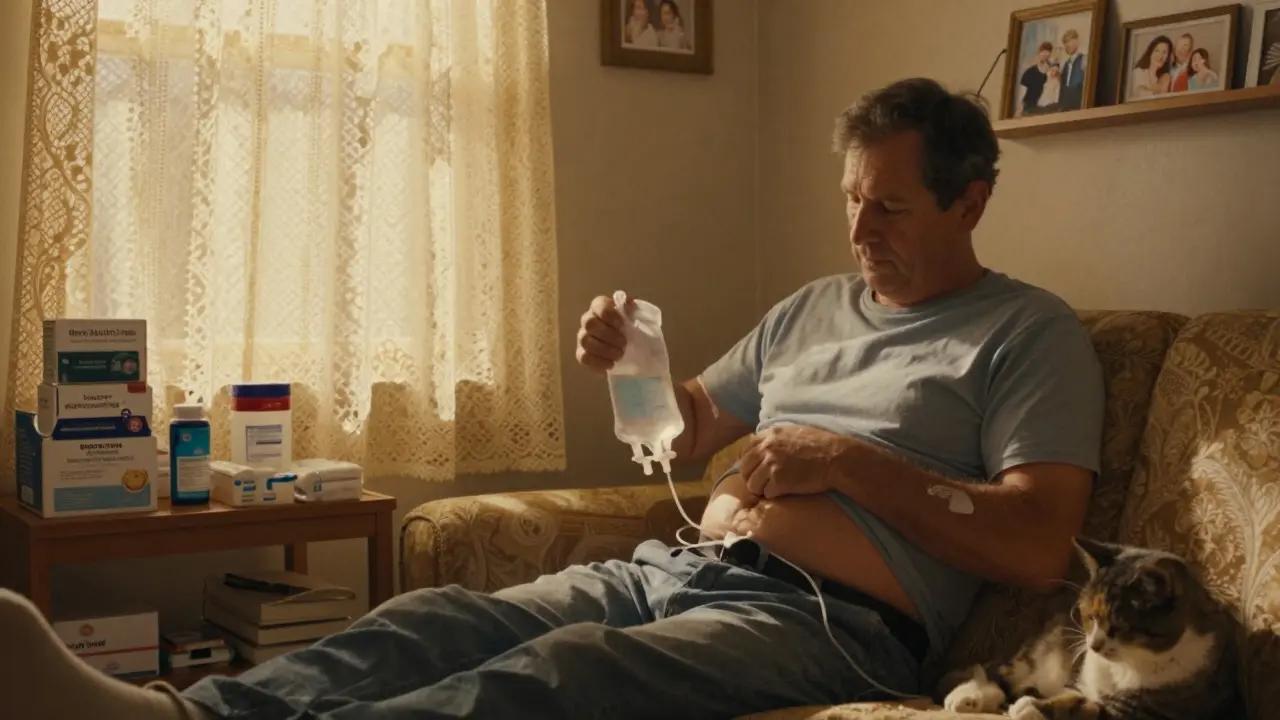
When your kidneys fail, you don’t have to stop living. Two main treatments-hemodialysis and peritoneal dialysis-can take over the job your kidneys can’t do anymore. Both remove waste and extra fluid from your blood. But they work in completely different ways, and choosing between them isn’t just about medical facts. It’s about your lifestyle, your body, and what you can manage day to day.
How Hemodialysis Works
How Peritoneal Dialysis Works
Peritoneal dialysis uses your own belly lining-the peritoneum-as a natural filter. A soft tube called a Tenckhoff catheter is placed in your abdomen during a minor surgery. After healing for about two weeks, you start filling your belly with dialysis fluid. This fluid pulls waste and extra water from your blood through the peritoneal membrane. After 4 to 6 hours, you drain the fluid out and replace it with fresh solution. This is called an exchange.
There are two main types. Continuous Ambulatory Peritoneal Dialysis (CAPD) means you do 3 to 5 exchanges by hand every day, no machine needed. You can do them while sitting, walking, or watching TV. Automated Peritoneal Dialysis (APD) uses a machine, usually at night while you sleep. It fills and drains your belly automatically, so your days are free.
Unlike hemodialysis, peritoneal dialysis runs almost constantly. That means fewer spikes in toxins and fluid between treatments. Your blood pressure tends to stay steadier. Studies show PD patients often have less strain on their heart and better control of potassium and sodium levels.
Clearance and Efficiency: What Gets Removed and How Fast
On paper, hemodialysis looks faster. Each session clears urea and toxins at a high rate-measured by Kt/V values between 1.2 and 1.4 per treatment. That’s why it’s used in emergencies, like when someone has sudden kidney failure or dangerous fluid buildup.
Peritoneal dialysis doesn’t clear as much in one go. But because it’s happening 24/7, the total weekly clearance (Kt/V) ends up being higher-between 1.7 and 2.1. That continuous process means less buildup between treatments. For many people, that translates to feeling better between sessions.
A 2023 study from the National Center for Biotechnology Information (PMC10626077) found PD patients had better control of blood pressure and less decline in their remaining kidney function compared to HD patients. Even though HD removes waste faster in a single session, PD’s steady rhythm often leads to better long-term outcomes.
Side Effects and Risks
Every treatment has downsides.
With hemodialysis, the biggest risks come from the access point. Most people get an arteriovenous (AV) fistula-a connection between an artery and vein in the arm. It takes 6 to 8 weeks to heal and mature before use. If that doesn’t work, a graft or catheter might be used instead. Catheters carry higher infection risk and can block or clot. During treatment, blood pressure can drop suddenly, leaving you dizzy, nauseous, or exhausted for hours.
Peritoneal dialysis avoids vascular problems but brings its own challenges. The biggest risk is peritonitis-an infection in the belly lining. It happens in about 0.3 to 0.7 cases per patient per year. It’s serious but often treatable with antibiotics if caught early. Strict hygiene during exchanges is non-negotiable. Even a small mistake can lead to infection.
Other issues with PD include catheter problems, hernias from pressure in the belly, and weight gain from the sugar in the dialysis fluid. Some people find the catheter uncomfortable or feel self-conscious about it. And unlike hemodialysis, you can’t just show up and let someone else do the work. You have to be able to handle the process yourself-or have someone who can help you.

Who’s a Better Fit for Each Treatment?
There’s no one-size-fits-all answer. But certain factors make one option more suitable than the other.
Peritoneal dialysis works best for:
- People who want to avoid frequent clinic visits
- Those with stable blood pressure and heart function
- Patients with good manual dexterity and the ability to follow a strict routine
- People who value independence and flexible scheduling
- Those with some remaining kidney function they want to preserve
Hemodialysis is often preferred for:
- Patients with severe fluid overload or unstable blood pressure
- Those with abdominal scarring, hernias, or obesity (BMI over 35)
- People with limited ability to perform self-care or who live alone without support
- Individuals with advanced kidney failure needing rapid toxin removal
- Those who prefer to leave treatment to medical staff
Age alone doesn’t rule either out. Many older adults do well on PD if they have support. And younger, active people can thrive on in-center HD if they can manage the schedule.
Cost, Convenience, and Daily Life
Cost isn’t just about the machine or the fluid. It’s about time, travel, and lost productivity.
Hemodialysis usually means three trips a week to a clinic, each lasting 3 to 5 hours. That’s 12 to 15 hours a week just for treatment. Add travel, waiting, and recovery time, and it’s easy to lose a full workday each session. Many patients report feeling wiped out for hours afterward.
Peritoneal dialysis costs less overall, according to the Journal of Peritoneal Therapy and Clinical Practice (2023). You don’t need to commute. You can do exchanges at home, at work, or even while traveling. APD lets you sleep through treatment. CAPD gives you control over when you do exchanges. One patient in a 2022 National Kidney Foundation survey said, “I can take my kid to soccer practice and do my exchange in the car.”
But PD requires space to store dialysis bags-usually a closet or shelf. You need clean hands, a clean surface, and discipline. If you’re forgetful, overwhelmed, or live in a messy environment, it’s harder to keep up.
What Patients Really Say
Real experiences tell the real story.
On Reddit’s r/kidneydisease, 97% of 142 HD users complained about the rigid schedule. Eighty-three percent said they felt drained after sessions. Many missed family events or work because they were too tired.
PD users had different concerns. In a group of 89, 65% worried about peritonitis. Seventy-eight percent mentioned the catheter as a constant reminder of their condition. But 68% said they were happier with the flexibility. One woman wrote, “I don’t have to miss my grandkids’ birthdays because I’m on a machine.”
Doctors see both sides. A nephrologist in Austin told me, “I’ve had patients on PD for 12 years with no infections. I’ve had others on HD for 3 years with three catheter infections. It’s not about the treatment. It’s about the person.”

What’s Changing in 2026?
Things are shifting. In the U.S., only about 12% of dialysis patients use PD. But that’s changing.
The Centers for Medicare & Medicaid Services now pushes for home dialysis or transplant education for 80% of new patients by 2025. New dialysis fluids with glucose-sparing formulas are reducing damage to the peritoneal membrane. More nephrologists are being trained in PD techniques.
Studies predict PD use in the U.S. will rise to 18-22% by 2027. Why? Because evidence is clear: PD is just as effective long-term, safer for the heart, and better for quality of life.
Still, the system is built for hemodialysis. Most clinics aren’t set up to support PD training. Insurance paperwork can be a nightmare. But if you’re willing to ask, advocate, and learn, you can find a path that fits you.
How to Decide
Here’s how to start thinking about your choice:
- Ask yourself: Do I want to go to a clinic, or do I want to do treatment at home?
- Can I manage sterile technique? Do I have someone who can help if I’m sick or tired?
- Do I have high blood pressure or heart problems? PD might be gentler.
- Am I physically able to handle daily exchanges? If not, HD might be easier.
- What’s my goal? To live as normally as possible? Then PD gives you more control.
Talk to your nephrologist. Ask to meet someone on PD and someone on HD. Watch videos. Read patient stories. This isn’t a decision you make once and forget. You can switch. Many people start on HD and move to PD-or vice versa.
Your kidneys may have failed. But your life doesn’t have to stop. The right dialysis isn’t the most common one. It’s the one that lets you live the life you want.
Can I switch from hemodialysis to peritoneal dialysis?
Yes, many people switch between dialysis types. If you’re on hemodialysis and want more flexibility, you can transition to peritoneal dialysis. The process involves surgery to place a Tenckhoff catheter, followed by training. It’s not always easy-some insurance plans require prior authorization, and your medical team will need to confirm you’re physically ready. But it’s done regularly, especially for patients who find in-center treatments too draining or restrictive.
Is one dialysis type better for older adults?
Not necessarily. Age alone doesn’t determine which dialysis is better. Many people in their 70s and 80s do very well on peritoneal dialysis, especially if they have support from family or home health aides. Hemodialysis might be easier if they have trouble with manual tasks or memory. The key is matching the treatment to the person’s abilities, not their age. A 2023 study showed older PD patients had better blood pressure control and fewer hospital visits than their HD peers.
What happens if I get an infection on peritoneal dialysis?
Peritonitis is the most common infection with PD. Symptoms include cloudy dialysis fluid, belly pain, fever, or nausea. If you notice any of these, call your dialysis team right away. Most cases are treated with antibiotics given directly into the dialysis fluid. You usually don’t need to stop PD entirely. In fact, continuing exchanges during treatment helps flush out the infection. If it doesn’t improve, your doctor may switch you temporarily to hemodialysis while the infection clears.
Can I travel with peritoneal dialysis?
Yes, and many people do. For CAPD, you can carry dialysis bags in a small cooler and do exchanges in hotel rooms, rest stops, or even airports. For APD, you can bring your cycler on trips. Dialysis suppliers ship fluid to most locations in the U.S. and many countries abroad. You’ll need to plan ahead-contact your provider before you leave, get extra supplies, and know where the nearest dialysis center is in case of emergency. Some patients even take PD on vacation to Europe or Mexico without issues.
Does dialysis cure kidney failure?
No. Neither hemodialysis nor peritoneal dialysis cures kidney failure. They replace the filtering function your kidneys lost. You’ll need to keep doing treatments for the rest of your life unless you get a kidney transplant. But dialysis doesn’t mean you can’t live well. Many people on dialysis work, travel, raise families, and enjoy hobbies. The goal isn’t just to survive-it’s to live as fully as possible while managing your condition.
How long can someone live on dialysis?
Life expectancy on dialysis varies widely. On average, people live 5 to 10 years on dialysis, but many live 20 or even 30 years. Factors like age, other health conditions (like diabetes or heart disease), and how well you follow your treatment plan all matter. Studies show that people on peritoneal dialysis often have better long-term survival rates if they’re younger and healthier at the start. The key isn’t just which dialysis you’re on-it’s how you take care of yourself between treatments.
What Comes Next?
If you’re considering dialysis, start by asking your doctor for a home dialysis evaluation. Many clinics offer free consultations with PD nurses and patient mentors. You can also reach out to the National Kidney Foundation or the American Association of Kidney Patients for free resources and peer support.
Don’t let fear or misinformation decide for you. Hemodialysis isn’t the only option. Peritoneal dialysis isn’t too hard to manage. The best treatment is the one that fits your life-not the one that’s easiest for the system.






Comments
Eileen Reilly
11 January 2026i swear pd is the only way to go if you dont wanna be chained to a machine. i did hd for 8 months and felt like a zombie after every session. now im on apd and i sleep through it. no more missing my kid's soccer games. also the fluid bags are way cheaper than clinic co-pays.
ps: dont let anyone tell you its 'too hard'-if you can fold laundry, you can do exchanges.
Monica Puglia
13 January 2026this is so helpful 😊 i’ve been researching for my mom and i’m so glad i found this. she’s 74 and was terrified of hd, but after reading about pd, she said ‘i can do this in my pajamas?’ and laughed for the first time in months. the catheter freaks her out, but the nurse showed her how to hide it under shirts. now she’s training next week. 🙏
steve ker
14 January 2026hd is the only real option. pd is for people who cant handle responsibility. the stats dont lie. if you cant sterilize your hands properly you deserve to get peritonitis. also why are we even discussing this its basic medicine
Rebekah Cobbson
16 January 2026just wanted to say thank you for writing this. my brother started pd last year after 2 years of hd. he said the difference was like waking up from a coma. he’s back to coaching little league, cooking for his family, even hiking. it’s not perfect-yes there’s risk-but it gave him his life back. if you’re choosing, choose freedom.
Audu ikhlas
17 January 2026this is why america is dying. people want convenience over discipline. in nigeria we dont have pd machines but we still survive. you dont get to pick your suffering. hd is for the strong. pd is for the lazy who want to watch netflix while their belly fills with fluid
Sonal Guha
19 January 2026pd is a scam. the sugar in the fluid causes obesity and insulin resistance. the 2023 study is funded by crenshaw medical. hd is faster more reliable and cheaper for the system. if you can't handle 3x a week you're not ready for dialysis
TiM Vince
19 January 2026i’m from nigeria and we’ve got a small pd program in lagos. it’s not perfect but it’s life-changing for people who live 3 hours from the nearest hd center. i’ve seen people walk 10km to get their bags. they don’t care about convenience-they care about living. this isn’t a luxury. it’s equity.
Jessica Bnouzalim
19 January 2026OMG YES!! I switched from HD to PD last year and it’s like I got my life back!! I can go to yoga, travel to Florida for a week, even take my dog to the park without worrying about my ‘dialysis time’!! Yes, the catheter is weird at first-but I got a cute cover for it and now I call it ‘my little robot belly friend’ 😂 I cried the first time I cooked Thanksgiving dinner without feeling like I’d been hit by a truck. This isn’t just treatment-it’s liberation!!
laura manning
20 January 2026The assertion that peritoneal dialysis offers superior long-term outcomes is not universally supported by peer-reviewed meta-analyses. While the referenced NCBI study (PMC10626077) reports improved Kt/V metrics, it fails to adequately control for confounding variables such as residual renal function, comorbidities, and patient adherence. Furthermore, the 2023 Journal of Peritoneal Therapy and Clinical Practice citation lacks a DOI and appears in a non-indexed publication. Hemodialysis remains the gold standard for patients with advanced uremia, cardiovascular instability, or compromised peritoneal membrane integrity. Clinical decision-making must be guided by evidence-based guidelines, not anecdotal testimonials.