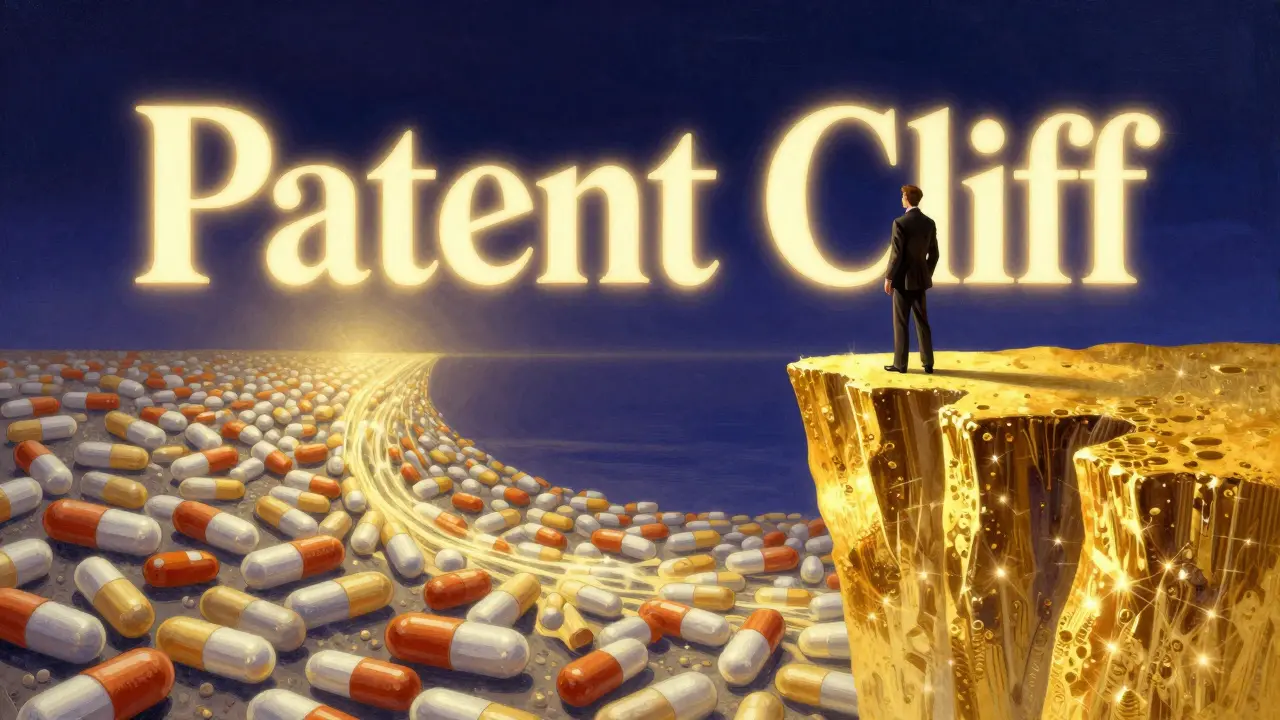
Imagine spending a decade and billions of dollars to develop a breakthrough medication, only to see your profits plummet the moment your patent expires. For pharmaceutical companies, that "patent cliff" is a financial nightmare. But there is a clever workaround: the authorized generic is a prescription drug produced by a brand-name company and sold under a private label, containing the exact same active and inactive ingredients as the original branded product. It looks like a generic, costs like a generic, but it's actually the brand-name drug in a different outfit.
The Strategic Game of Patent Expiration
When a patent expires, the floodgates open for competition. Normally, this is where traditional generics enter the scene. However, the Hatch-Waxman Act creates a unique window of opportunity. The first generic company to successfully challenge a patent is often granted a 180-day exclusivity period. During these six months, they are the only generic player in the market, allowing them to charge higher prices and capture a massive share of the switching patients.
Brand manufacturers hate this. To fight back, they launch an authorized generic. Because they already own the formula, they don't need to jump through the usual regulatory hoops. This move allows the brand company to compete against the "exclusive" generic, effectively stealing back some of that market share and revenue. It's a defensive play that ensures the brand maker doesn't just watch their customers vanish overnight.
How Authorized Generics Differ from Traditional Generics
You might wonder why we need two types of generics. The difference comes down to the "recipe." A traditional generic only needs to prove it is bioequivalent to the brand drug. This means it must have the same active ingredient, but the inactive ingredients-the fillers, binders, and dyes-can be different. For most people, this doesn't matter. But for some, a different filler can cause an allergic reaction or change how the drug is absorbed.
An authorized generic, on the other hand, is a literal clone. It uses the exact same New Drug Application (NDA) as the brand. There is no guesswork and no need for an Abbreviated New Drug Application (ANDA). This makes them incredibly attractive for "narrow therapeutic index" drugs-medications where a tiny change in dose or composition can lead to treatment failure or toxicity.
| Feature | Authorized Generic | Traditional Generic |
|---|---|---|
| Active Ingredients | Identical to brand | Identical to brand |
| Inactive Ingredients | Identical to brand | Can vary |
| FDA Approval Path | Original NDA | ANDA (Bioequivalence) |
| Orange Book Listing | Not listed | Listed |
| Manufacturer | Brand company (or partner) | Third-party generic firm |
The Impact on Your Wallet and Health
Does this corporate chess match actually help patients? It's a mixed bag. A 2011 report from the Federal Trade Commission (FTC) found that authorized generics actually lower prices during that critical 180-day exclusivity window. When a brand maker enters the generic fray, prices can drop by 15-20% compared to markets where only one exclusive generic exists. In this sense, the brand's greed for market share accidentally benefits the consumer.
From a health perspective, the consistency is a huge win. Pharmacists have reported cases where patients who failed on a traditional generic-perhaps due to a specific filler-found stability again when switched to an authorized generic. This is especially true in central nervous system medications, where 67% of authorized generics are adopted because the formulation must be exact to be effective.
The Dark Side: Market Manipulation?
Not everyone is cheering. The Generic Pharmaceutical Association (GPhA) and some academic critics argue that this is just a sophisticated way to manipulate the market. By launching an authorized generic, brand companies can fragment the market and potentially delay the entry of other, cheaper generics. Some experts, like those from Harvard Medical School, suggest that while prices drop slightly in the short term, the long-term result is a distorted market that primarily serves the brand manufacturer's bottom line.
There is also a lot of confusion at the pharmacy counter. Imagine picking up a pill that looks exactly like your brand-name drug but is labeled as a generic. Many patients feel uneasy about this. In fact, surveys show that patient sentiment is overwhelmingly positive only when they fully understand the drug is identical to the brand; otherwise, confusion and distrust set in.
Real-World Examples of the Strategy
This isn't just theoretical; it's happening with drugs you probably know. For instance, Greenstone Pharmaceuticals (the arm of Pfizer) has launched authorized generics like celecoxib (the generic for Celebrex). Other examples include Prasco Laboratories' version of colchicine (Colcrys) and Jerome Stevens Pharmaceuticals' levothyroxine (Unithroid). In all these cases, the product is chemically identical to the brand, just stripped of the fancy name and expensive marketing.
PBMs (Pharmacy Benefit Managers) like OptumRx and Express Scripts love these products. They often promote authorized generics in their formularies because they offer the quality assurance of the brand with the cost profile of a generic. In one analysis, Express Scripts saw 28% higher utilization of authorized generics over traditional ones because of this perceived quality.
What to Watch for in the Future
The trend is only growing. The FDA's updated list from October 2025 shows over 1,200 authorized generic products. Projections suggest that by 2027, nearly 45% of all major branded drugs will have an authorized generic counterpart. However, the legal landscape is shifting. The "Promoting Competition in Pharmaceutical Markets Act" is a legislative attempt to stop brand makers from launching these during the 180-day exclusivity window, which could fundamentally change the game.
Whether you are a patient, a pharmacist, or an investor, understanding the authorized generic is key to navigating the modern pharmacy. It's the intersection of high-stakes law, chemical precision, and corporate survival. The next time you see a generic that looks exactly like your brand drug, remember: it might not be a competitor's version at all, but the brand maker's way of staying in your medicine cabinet.
Is an authorized generic the same as a traditional generic?
Not exactly. While both have the same active ingredient, an authorized generic is chemically identical to the brand-name drug, including all inactive ingredients. A traditional generic is "bioequivalent," meaning it works the same way, but it may use different fillers or binders.
Why aren't authorized generics in the FDA Orange Book?
The Orange Book lists drugs approved via the ANDA (Abbreviated New Drug Application) process. Since authorized generics are marketed under the original brand's NDA, they don't go through the ANDA process and therefore aren't listed in the book.
Are authorized generics cheaper than brand-name drugs?
Yes, significantly. They are priced to compete with traditional generics, making them a much more affordable option for patients who want the exact formulation of the brand drug without the brand-name price tag.
Do authorized generics have different side effects?
No. Because they have the exact same active and inactive ingredients as the brand-name version, the side effect profile is identical to the branded drug.
How do I know if my medication is an authorized generic?
It can be tricky because they aren't always labeled as "authorized." Your best bet is to ask your pharmacist to check the manufacturer and the NDC (National Drug Code) to see if it's an authorized version from the original brand maker.


Write a comment