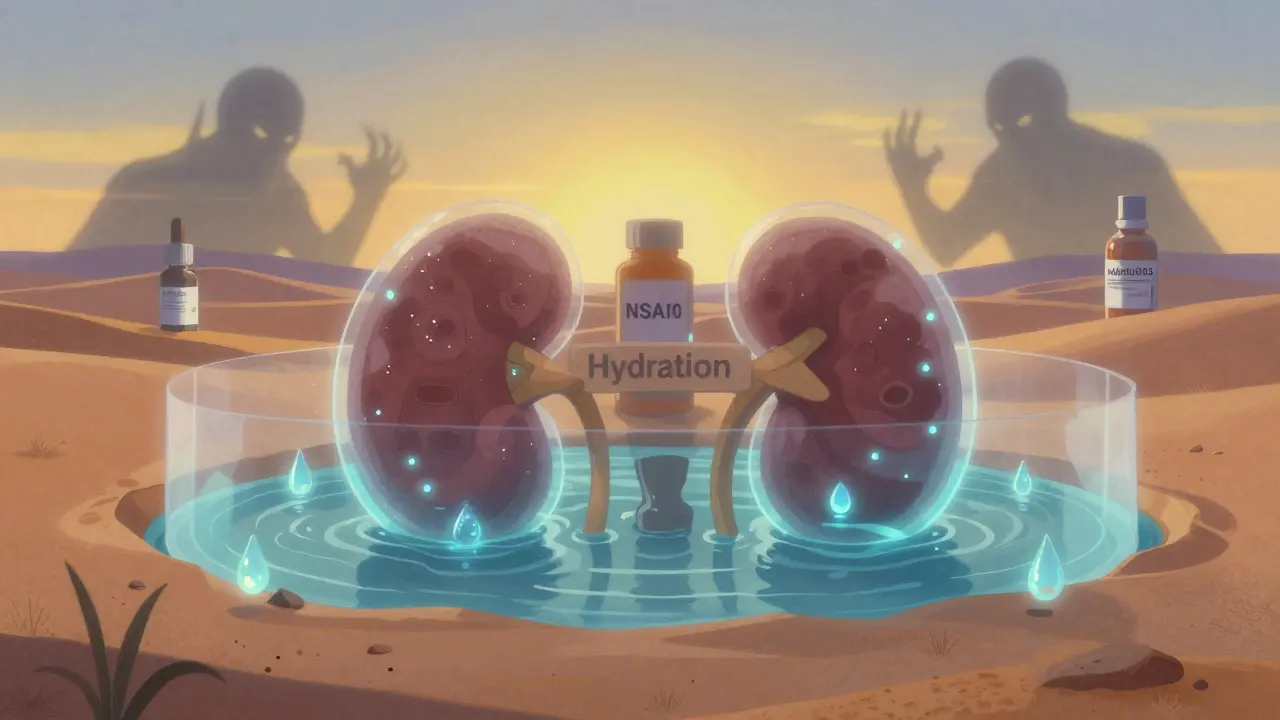
When you already have chronic kidney disease (CKD), even small stressors can push your kidneys into acute failure. This is called AKI on CKD - and it’s one of the most dangerous scenarios in kidney care. The good news? Many cases are preventable. The biggest threats? Iodinated contrast dye used in CT scans and common medications you might not even think of as harmful. Avoiding these isn’t optional - it’s life-saving.
What Happens When AKI Hits CKD?
Chronic kidney disease means your kidneys are already working at a reduced capacity. Maybe your eGFR is 40 mL/min/1.73m² - you’re in stage 3B. You’ve been told to watch your salt, control your blood pressure, and avoid NSAIDs. But then you get an injury, an infection, or need a diagnostic scan. That’s when things can go sideways fast. Acute kidney injury (AKI) is a sudden drop in kidney function. In someone with healthy kidneys, it might recover fully. In someone with CKD, it often doesn’t. Studies show that about 30% of AKI episodes in CKD patients lead to permanent kidney damage. For 10-15% of them, it means starting dialysis within five years. The problem? Many patients aren’t even identified as high-risk before they get exposed to danger. Up to 50% of hospitalized CKD patients aren’t flagged in the system when they’re given contrast dye or antibiotics. That’s why knowing what to avoid - and how to speak up - matters more than ever.Contrast Dye: The Silent Killer in Imaging Scans
Iodinated contrast is used in CT scans, angiograms, and other imaging tests to make blood vessels and organs show up clearly. It’s useful. But for people with CKD, it’s a major risk. The risk isn’t the same for everyone. If your eGFR is above 60, your chance of contrast-induced AKI (CI-AKI) is low - around 1-5%. But if your eGFR is below 30, that jumps to 20-50%. Patients with diabetes and CKD? Even higher. Heart failure plus CKD? Same story. The KDIGO 2012 guidelines - still the gold standard today - say this clearly: avoid contrast when possible. If you absolutely need it, use the smallest dose possible - ideally under 100 mL. And hydrate. Not just a little. A full 1.0-1.5 mL per kg of body weight for 6-12 hours before and after the scan. Normal saline, not fancy fluids. No dextrans. No albumin. Just salt water. Some hospitals now use cystatin C instead of creatinine to track kidney function during acute events. Why? Because creatinine can be misleading. If you’re frail, losing muscle, or sick, your creatinine drops - even if your kidneys are failing. Cystatin C doesn’t lie. It’s a better early warning sign.Medications That Can Wreck Your Kidneys
You might think your blood pressure pills are safe. Or your painkillers. But many common drugs are nephrotoxic - especially when your kidneys are already weak. NSAIDs - like ibuprofen, naproxen, and celecoxib - are the #1 offender. They block chemicals your kidneys need to maintain blood flow. In CKD patients, NSAIDs can spike creatinine by 25% or more in just a few days. The Veterans Health Administration found NSAID use in CKD patients increases AKI risk by 2.5 times. And yes - even over-the-counter doses count. ACE inhibitors and ARBs (like lisinopril or losartan) are usually good for CKD. But during an acute illness or dehydration, they can cause a sudden drop in kidney filtration. A 15-25% rise in creatinine after starting or restarting one of these isn’t a sign of failure - it’s a warning. Don’t stop them blindly. Talk to your doctor. But if you’re sick with vomiting, diarrhea, or fever, hold off until you’re hydrated. Aminoglycosides (like gentamicin) are antibiotics used for serious infections. But they’re toxic to kidney cells. Up to 25% of patients on a full course develop damage. Vancomycin? Same deal - especially if trough levels go above 15 mcg/mL. Amphotericin B? Up to 80% of patients get kidney injury. These aren’t “maybe” risks. They’re certainties in high-risk patients. And don’t forget diuretics. Furosemide (Lasix) might seem helpful if you’re swollen. But if you’re not volume overloaded, diuretics don’t protect your kidneys. They just make you dehydrated - which makes AKI worse. The KDIGO guidelines say: don’t use them to prevent AKI.What to Do Before Any Medical Procedure
You’re not powerless. Here’s what you can do - before you walk into the hospital or imaging center:- Ask: “Is this scan absolutely necessary? Is there an alternative without contrast - like ultrasound or MRI?”
- Bring a list of all your medications - including vitamins, supplements, and OTC painkillers.
- Ask if your kidney function has been checked in the last 30 days. If not, request a simple blood test (creatinine and eGFR) before the procedure.
- Hydrate well the day before and the day of the scan. Drink water - no soda, no coffee, no alcohol.
- Ask if your nephrologist has been consulted. If you have stage 4 or 5 CKD, you should have a nephrology consult before any major contrast procedure.
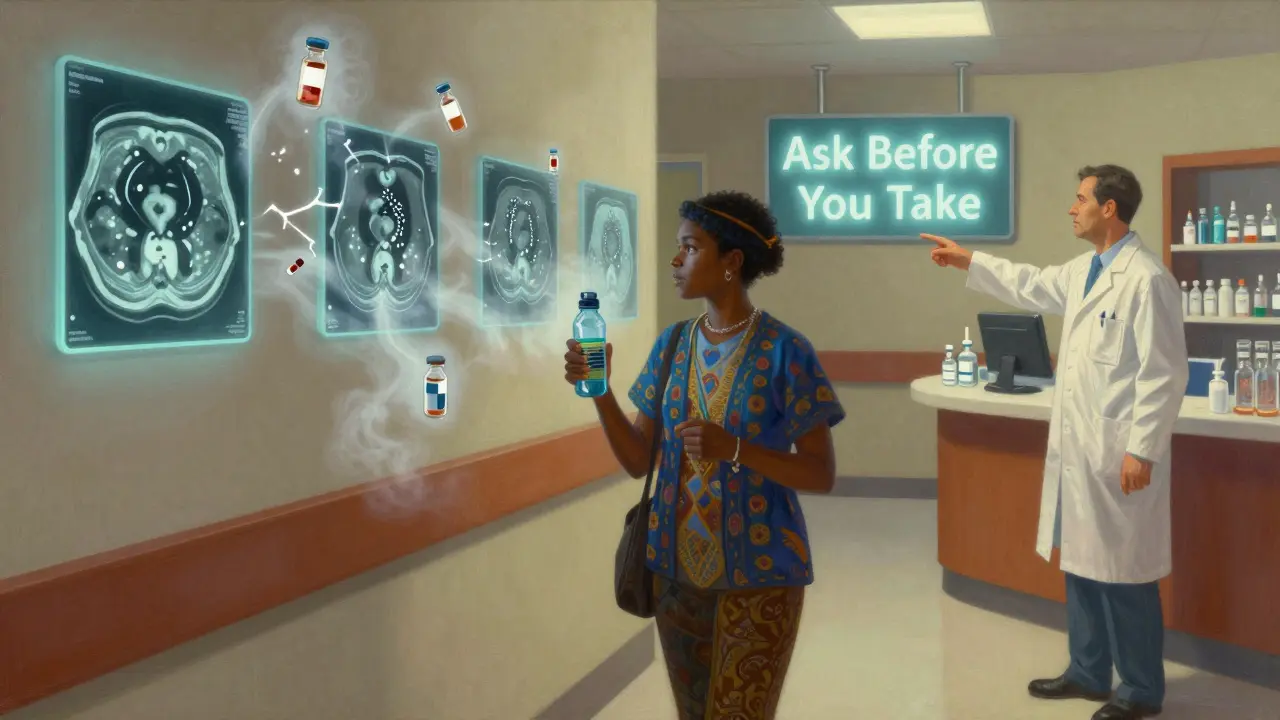
Pharmacists Are Your Secret Weapon
Most people don’t realize pharmacists are frontline defenders against AKI. They’re the ones reviewing your meds when you’re admitted. They catch the NSAID you’ve been taking for back pain. They flag the vancomycin dose that’s too high for your kidney function. Studies show pharmacist-led interventions reduce AKI rates in CKD patients by 22%. That’s huge. If you’re being discharged from the hospital, ask to speak with the pharmacist. Ask: “What meds should I stop? What should I avoid until my kidneys recover?” Electronic alerts in hospital systems help - but they’re not perfect. About 40% of doctors override them because they think the patient “needs” the drug. That’s why your voice matters. If you know you have CKD, say it. Loudly. Repeatedly.What About N-Acetylcysteine (NAC)?
You might have heard NAC helps prevent contrast damage. It’s been used for years. But the evidence is mixed. Some studies show a 15-30% drop in CI-AKI risk. Others show nothing. The KDIGO guidelines don’t strongly recommend it - but they don’t say no, either. If you’re high-risk and contrast is unavoidable, your doctor might give you NAC before and after. It’s cheap. It’s safe. But it’s not a magic shield. Hydration and dose control still matter more.Monitoring and Recovery
If you do develop AKI on CKD, your creatinine will be checked every 24-48 hours - not every few months like in stable CKD. That’s how fast things can change. And here’s something new: if your kidney function doesn’t recover in 7 days, you might have Acute Kidney Disease (AKD), not just AKI. That’s a 2019 update - meaning your kidneys are stuck in a damaged state. You’ll need follow-up testing at 3 months: eGFR and urine albumin-to-creatinine ratio (uACR). This tells you if you’re heading toward permanent decline. The good news? If you catch it early and remove the triggers - contrast, NSAIDs, dehydration - your kidneys can bounce back. But if you keep exposing them to damage, each episode chips away at what’s left.
Real-World Tips for Daily Life
You don’t need to live in fear. Just be smart.- Never take NSAIDs without checking with your doctor - even if it’s just for a headache.
- Keep a small bottle of water with you at all times. Dehydration is the most common trigger for AKI in CKD.
- If you’re sick with vomiting or diarrhea, hold off on blood pressure meds until you’re rehydrated.
- Get your eGFR checked every 3-6 months. If it drops suddenly, call your doctor - don’t wait.
- Teach your family what to watch for: swelling, less urine, confusion, fatigue. These can mean your kidneys are struggling.
What’s Changing in 2026?
New tools are coming. Biomarkers like TIMP-2 and IGFBP7 can predict AKI within 12 hours - before creatinine even rises. That’s huge. Hospitals are starting to use them in ICUs. Soon, they might be available in clinics. The KDIGO 2024 update will likely drop sodium bicarbonate as a standard for contrast protection. Recent trials show it doesn’t work better than plain saline. That’s one less thing to worry about. And the big shift? We’re moving away from rushing into dialysis for severe AKI. The 2022 AKIKI 2 trial showed early dialysis doesn’t improve survival. Watchful waiting - with careful fluid and electrolyte management - is often better.Final Takeaway
AKI on CKD isn’t a random accident. It’s usually preventable. The biggest risks? Contrast dye and nephrotoxic meds. The best defense? Knowledge, hydration, and speaking up. You don’t need to be a doctor to protect your kidneys. You just need to know what to ask for - and what to refuse. Say no to NSAIDs. Say yes to water. Say yes to asking questions. Your kidneys are counting on it.Can contrast dye permanently damage my kidneys if I have CKD?
Yes. In patients with CKD, especially stage 3B or worse, contrast dye can cause acute kidney injury that doesn’t fully recover. Studies show about 30% of AKI episodes in CKD patients lead to permanent loss of kidney function. For 10-15%, this progresses to end-stage kidney disease within five years. Avoiding contrast when possible and using the lowest dose with proper hydration reduces this risk significantly.
Are over-the-counter painkillers like ibuprofen safe for people with CKD?
No. NSAIDs like ibuprofen, naproxen, and aspirin (at high doses) are a leading cause of AKI in CKD patients. They reduce blood flow to the kidneys, which can cause sudden, sometimes irreversible damage. The risk increases 2.5-fold in CKD patients who use them. Acetaminophen (Tylenol) is safer for occasional use, but always check with your doctor first.
Should I stop my ACE inhibitor or ARB if I’m sick?
If you’re dehydrated - from vomiting, diarrhea, or not drinking enough - hold off on your ACE inhibitor or ARB until you’re rehydrated. These drugs can cause a sudden drop in kidney filtration during illness, leading to AKI. A 15-25% rise in creatinine isn’t always dangerous, but it’s a signal to pause the medication. Don’t stop it permanently without talking to your doctor.
Is it safe to get a CT scan if I have CKD?
It depends. If your eGFR is below 60, you’re at higher risk. Always ask if the scan is necessary and if a non-contrast alternative (like ultrasound or MRI) is possible. If contrast is required, insist on the lowest possible dose and full hydration before and after. Hospitals should check your kidney function within the last 30 days - if they haven’t, ask for a blood test first.
Can drinking more water prevent contrast-induced kidney injury?
Yes - and it’s the most effective prevention strategy. Hydrating with isotonic saline at 1.0-1.5 mL per kg of body weight for 6-12 hours before and after contrast reduces AKI risk by 30-40%. Plain water works too, but IV fluids are more reliable in hospitalized patients. Never rely on NAC or other supplements instead of hydration.
How often should I get my kidney function checked if I have CKD?
If your CKD is stable, check eGFR and urine albumin-to-creatinine ratio (uACR) every 3-6 months. But if you’ve had AKI, have a new illness, or are starting a new medication, get tested every 1-2 weeks until your levels stabilize. Your kidney function can change quickly - don’t wait for your next routine visit.
What role does a pharmacist play in preventing AKI in CKD patients?
Pharmacists review all your medications when you’re admitted or discharged. They catch nephrotoxic drugs like NSAIDs, antibiotics, or incorrect doses of blood pressure meds. Studies show pharmacist interventions reduce AKI rates by 22% in CKD patients. Always ask to speak with the pharmacist - they’re your best defense against preventable kidney damage.





Comments
Juan Reibelo
23 January 2026I’ve had CKD for 8 years, and I still get nervous every time I’m prescribed a new med. I once took ibuprofen for a headache and woke up with swollen ankles and a creatinine spike. Never again. I keep a little card in my wallet that says: ‘CKD Patient - Avoid NSAIDs & Contrast Without Nephro Consult.’ It’s saved me twice.
Izzy Hadala
25 January 2026While the clinical guidance presented is largely aligned with current KDIGO recommendations, one must acknowledge the significant heterogeneity in patient-specific risk stratification. The assumption that all patients with an eGFR below 30 are uniformly at high risk for contrast-induced nephropathy may overlook confounding variables such as baseline hydration status, concomitant heart failure, and renal arterial stenosis. Further prospective cohort analyses are warranted to refine predictive algorithms beyond creatinine and cystatin C thresholds.
Elizabeth Cannon
27 January 2026Y’all need to stop treating your kidneys like they’re indestructible lol. I’m a nurse and I’ve seen too many people come in with AKI because they took Advil for their back pain ‘just this once.’ Your kidneys aren’t magic. They’re fragile. If you have CKD, treat them like a newborn puppy - no caffeine, no NSAIDs, no skipping water. And yes, talk to the pharmacist. They’re the real MVPs. I’ve literally stopped 3 prescriptions this week because of this exact post. Thank you for writing this.
Phil Maxwell
28 January 2026Just wanted to say this post was really clear. I’ve got stage 3b and I’ve been avoiding CT scans for years, but I didn’t know about cystatin C. I’m going to ask my doc to check that next time. Also, I always hydrate before scans now - I keep a big water bottle next to my bed. Small things matter. Thanks for the info.
Tommy Sandri
30 January 2026The emphasis on pharmacist involvement is particularly commendable. In systems where clinical pharmacists are integrated into multidisciplinary renal care teams, reductions in iatrogenic nephrotoxicity have been consistently documented. The 22% reduction cited is not merely statistically significant - it is clinically transformative. Institutional protocols should mandate pharmacist review prior to administration of nephrotoxic agents in all CKD patients.
Josh McEvoy
30 January 2026Bro. I had a CT scan last year. They didn’t even ask if I had CKD. I was like, ‘Hey, I have stage 4.’ They shrugged. I ended up in the hospital. Now I carry a laminated card. I also yell ‘NO NSAIDS’ at every nurse. I’m not sorry. 🤬💧 #KidneyWarrior
Heather McCubbin
31 January 2026People think their kidneys are like a car battery you can just jump-start. Nope. Every time you hit them with contrast or ibuprofen you’re burning a fuse. You don’t get to reset. You don’t get to restart. This isn’t a glitch - it’s a countdown. And if you’re still drinking soda and skipping water because ‘it’s not that bad’ - you’re not protecting your future. You’re just delaying the inevitable. Wake up.
Amelia Williams
2 February 2026This post gave me chills. I’m 32 and just diagnosed with stage 3b CKD last month. I was scared, but now I feel like I actually have power. I told my mom to stop giving me Advil for headaches - she didn’t even know it was dangerous. I started carrying water everywhere. I asked my pharmacist to review my meds. I’m not cured, but I’m not helpless anymore. Thank you for giving me the words to fight back. You’re not just sharing info - you’re saving lives.