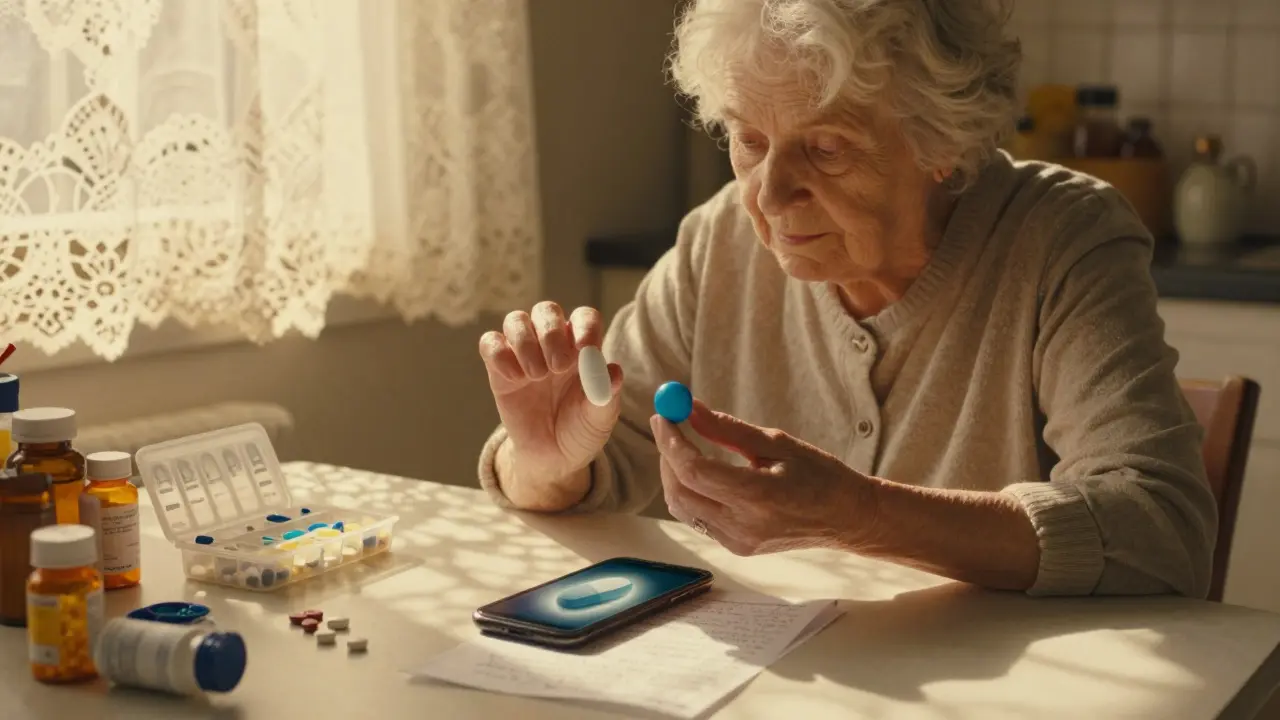
Ever opened your prescription bottle and stared at a pill that looked nothing like the last one? It’s not a mistake. It’s not a fake. And it’s not necessarily worse. But it’s happening more often than you think-and it’s causing real problems.
Generic drugs make up over 90% of all prescriptions filled in the U.S. That means most people are taking them. But here’s the catch: every time you refill, the pill might look different. Same active ingredient. Same dose. Same effect. But now it’s white instead of pink. Round instead of oval. No markings, or different ones. You’re not imagining it. You’re not crazy. You’re just caught in a system designed to keep generics from looking like brand names-and that’s causing confusion, fear, and even skipped doses.
Why Do Generic Pills Look So Different?
The reason isn’t about quality. It’s about the law.
In 1984, Congress passed the Hatch-Waxman Act, which made it easier for companies to sell generic versions of brand-name drugs. The goal? Lower costs. And it worked. Today, generics save Americans over $1 trillion a year.
But there’s a twist. U.S. trademark law says generic drugs can’t look exactly like the brand-name version. That means if Lipitor is a pink oval pill, no generic can be. Even if it’s the same medicine. So manufacturers pick different colors, shapes, and markings. Sometimes, even two different generic makers will make the same drug look completely different.
The FDA doesn’t care what the pill looks like-as long as it works the same. They require generics to match the brand in strength, dosage, and how quickly the drug enters your bloodstream. But color? Shape? Size? Those are up to the manufacturer. And since there’s no national standard, you get a lottery every time your pharmacy switches suppliers.
What Changes? Color, Shape, Size, and Markings
Here’s what you might notice when your generic pill changes:
- Color: One manufacturer uses white. Another uses pale yellow. Another uses blue. Some even use two-tone pills. The FDA doesn’t regulate this. Manufacturers pick colors based on what’s available, cheap, or what they think looks "clean."
- Shape: Round, oval, caplet, oblong, even diamond-shaped. A pill for high blood pressure might be oval one month and round the next. No clinical reason-just manufacturing choice.
- Size: Pills range from 3mm to over 20mm in diameter. A smaller pill might be easier to swallow. A larger one might be harder. But size doesn’t affect how the drug works.
- Markings: Letters, numbers, or symbols stamped on the pill. These help identify it. But when the maker changes, so do the markings. One version says "ATV 20," another says "832," another has no marking at all.
Take metformin, the most common diabetes drug. One generic version is a white, oval tablet with "1000" on one side. Another is a pink, round tablet with "M" and "500" on opposite sides. Same drug. Same dose. But if you’re taking it with levothyroxine (which is also often white and round), you could mix them up.
Why This Isn’t Just a Cosmetic Issue
It’s not just about confusion. It’s about safety.
A 2014 study from Brigham and Women’s Hospital tracked over 38,000 patients on heart medications. When their pills changed appearance, the chance they stopped taking them jumped by 34%. That’s not a small number. That’s 1 in 3 people who might stop taking life-saving drugs just because the pill looked different.
Why? Because people associate the look of a pill with its purpose. If you’ve been taking a white oval pill for years and suddenly get a blue round one, your brain says: "This isn’t right." You worry it’s the wrong medicine. Or worse-you think it’s a mistake and don’t take it.
Patients over 65 are hit hardest. A 2022 AARP survey found 37% of older adults had trouble recognizing their meds after a change. That’s compared to 22% of younger adults. Why? Many seniors take 5, 6, even 10 pills a day. They rely on sight, not labels. If the pill looks off, they skip it. Or worse-they take the wrong one.
One Reddit user wrote: "My blood pressure med changed from white oval to blue round. I almost didn’t take it. I thought I’d been given someone else’s pills. I was scared."
Another user on Drugs.com said: "I took my metformin and levothyroxine together. When metformin changed color, I accidentally took levothyroxine twice. I felt shaky for hours. I didn’t know which was which anymore."

What Pharmacists Are Seeing
Pharmacists hear about this every day.
A 2022 survey by the American Pharmacists Association found that 18.3% of generic refills trigger patient complaints about appearance changes. And 67% of those complaints come from people 65 and older.
Pharmacists can’t control which generic comes in. It’s usually decided by the pharmacy’s wholesaler or your insurance’s formulary. If the cheapest generic is from Manufacturer A this month and Manufacturer B next month, you get two different pills.
Some pharmacies now use digital tools to show patients what their pill looked like last time. But only 43% of pharmacies use them. Most still rely on verbal reminders. And if you’re not there when you pick it up? You might not even know it changed.
What You Can Do to Stay Safe
You can’t control the system. But you can protect yourself.
- Take a photo of your pill every time you get a refill. Use your phone. Save it in a folder called "My Medications." When the next refill looks different, pull up the photo. No guesswork.
- Ask your pharmacist to check the label. Even if the pill looks different, the label should say the same drug name, strength, and dosage. If it doesn’t, speak up.
- Use a pill organizer with labeled compartments. Morning, afternoon, night. Put the pill in the right slot. Don’t rely on how it looks.
- Keep a written list. Write down the drug name, dose, and what it looks like. Include color, shape, and markings. Update it every time you get a new bottle.
- Ask your insurance if you can get the same generic manufacturer. It’s not guaranteed-but some insurers will honor a request if you explain you’re having trouble with appearance changes. Call your plan and ask.
- Don’t stop taking it because it looks different. If you’re unsure, call your pharmacist. Don’t guess. Don’t skip. Ask.
A 2021 Johns Hopkins study found that patients who kept photos of their pills reduced medication errors by 27%. That’s not a small win. That’s a life-saving habit.

Is the FDA Doing Anything?
Yes-but slowly.
In 2016, the FDA released guidance asking generic manufacturers to consider appearance when developing new drugs. In 2023, they started working on "Visual Medication Equivalence Standards" under their GDUFA program. Draft guidelines are expected in mid-2024.
They’re also spending $4.7 million in 2024 to study how appearance affects patient outcomes.
But they can’t force manufacturers to make pills look the same. Trademark law still blocks it. And courts have upheld those protections. In 2022, a federal court ruled that Takeda’s pink Lipitor shape was trademarked, so generics had to look different-even if it confused patients.
Meanwhile, the European Union has taken a different path. They require generics to match the appearance of brand-name drugs when possible. Result? A 18.3% drop in appearance-related errors.
What’s Next?
By 2028, experts predict 75% of new generic approvals for high-risk drugs-like blood thinners, thyroid meds, or epilepsy drugs-will include voluntary appearance standardization. That’s up from just 32% today.
It’s not about making generics look like brand names. It’s about making them look consistent across manufacturers. One pill for one drug. No surprises.
Until then, the responsibility falls on you.
Don’t let a change in color or shape make you skip your medicine. You’re not alone. Millions of people deal with this. But you can take control. Take a photo. Ask questions. Keep a list. Stay informed. Your health depends on it.
Frequently Asked Questions
Why do generic pills look different from brand-name pills?
U.S. trademark laws prevent generic drugs from looking exactly like brand-name versions. This rule, part of the Hatch-Waxman Act of 1984, requires generics to differ in color, shape, or markings-even though they contain the same active ingredient and work the same way. The FDA allows these differences as long as the drug is bioequivalent.
Are generic pills just as effective as brand-name pills?
Yes. The FDA requires generic drugs to have the same active ingredient, strength, dosage form, and bioequivalence as the brand-name version. That means they work the same way in your body. Differences in color, shape, or filler ingredients don’t affect how the drug performs.
Can changing pill appearance make me sick?
The pill itself won’t make you sick. But if you stop taking it because you think it’s the wrong medicine, that can be dangerous. Studies show patients are 34% more likely to quit taking heart or blood pressure meds when the pill looks different. Skipping doses can lead to hospitalizations or worse.
Why does my generic pill change every time I refill?
Your pharmacy or insurance may switch between different generic manufacturers to find the lowest price. Each manufacturer uses different colors, shapes, and markings. If your pharmacy gets a new batch from a different company, your pill will look different-even if it’s the same drug.
What should I do if my pill looks different?
Don’t stop taking it. Check the label for the drug name and dose. If it matches, it’s the same medicine. Take a photo of the new pill and compare it to your old one. Call your pharmacist if you’re unsure. Never guess-ask.
Can I ask for the same generic manufacturer every time?
You can ask. But most insurance plans and pharmacy benefit managers don’t guarantee the same manufacturer. They choose based on cost. Some insurers will honor your request if you explain you’re having trouble with appearance changes. It’s worth asking, especially for critical medications.
Is there a way to avoid appearance changes altogether?
Not completely, but you can reduce them. Keep a photo log of your pills. Use a pill organizer. Ask your pharmacist to use the same generic when possible. Support future FDA efforts to standardize appearance for high-risk drugs. The goal is consistency-not identicality.





Comments
Shanna Sung
4 January 2026This is all just Big Pharma playing us. They don't want you to know generics are secretly laced with fillers that mess with your brain. The FDA? Complicit. The color changes? That's not trademark law-that's mind control. I saw a blue pill once and my dreams turned into static for three days. Don't trust the system.
Ethan Purser
6 January 2026You ever stop and think that maybe the real problem isn't the pill... but the fact that we've outsourced our trust to corporations and pharmacies? We've become so detached from our own bodies that we panic when a white oval becomes a blue circle. We used to know our medicine by feel, by smell, by ritual. Now? We're just扫码的机器人. 😔
Rory Corrigan
7 January 2026I used to freak out every time my metformin changed. Then I started taking a pic. Now I just smile. Life's too short to stress over pill shapes. 🤷♂️
Stephen Craig
8 January 2026The system is broken. But the solution isn't more regulation-it's personal accountability. If you rely on color to tell you what you're taking, you're already vulnerable. The pill doesn't change. Your awareness should.
Connor Hale
8 January 2026I've been on the same meds for 12 years. Pill changed twice. I didn't notice until my wife pointed it out. We laughed. Then I checked the label. Same name. Same dose. Same life-saving effect. Sometimes the simplest thing is the most powerful: trust the label, not the look.
Roshan Aryal
9 January 2026Americans whining about pill colors while India produces 40% of the world's generics and nobody here knows what a tablet looks like because they don't have the luxury to care. You think your blue pill is a crisis? Try taking insulin with no fridge and no label. Your first world problems are hilarious.
Jack Wernet
10 January 2026I appreciate the thoroughness of this article. It addresses a critical yet overlooked public health issue with clarity and compassion. The behavioral data cited is particularly compelling, and the practical recommendations are both accessible and actionable. Thank you for elevating this conversation.
Charlotte N
11 January 2026I took a photo... then I forgot to check it... then I panicked again... then I called my pharmacist... then I felt stupid... then I took the pill... and now I'm crying because I'm 72 and I just want to feel safe... why is this so hard?