
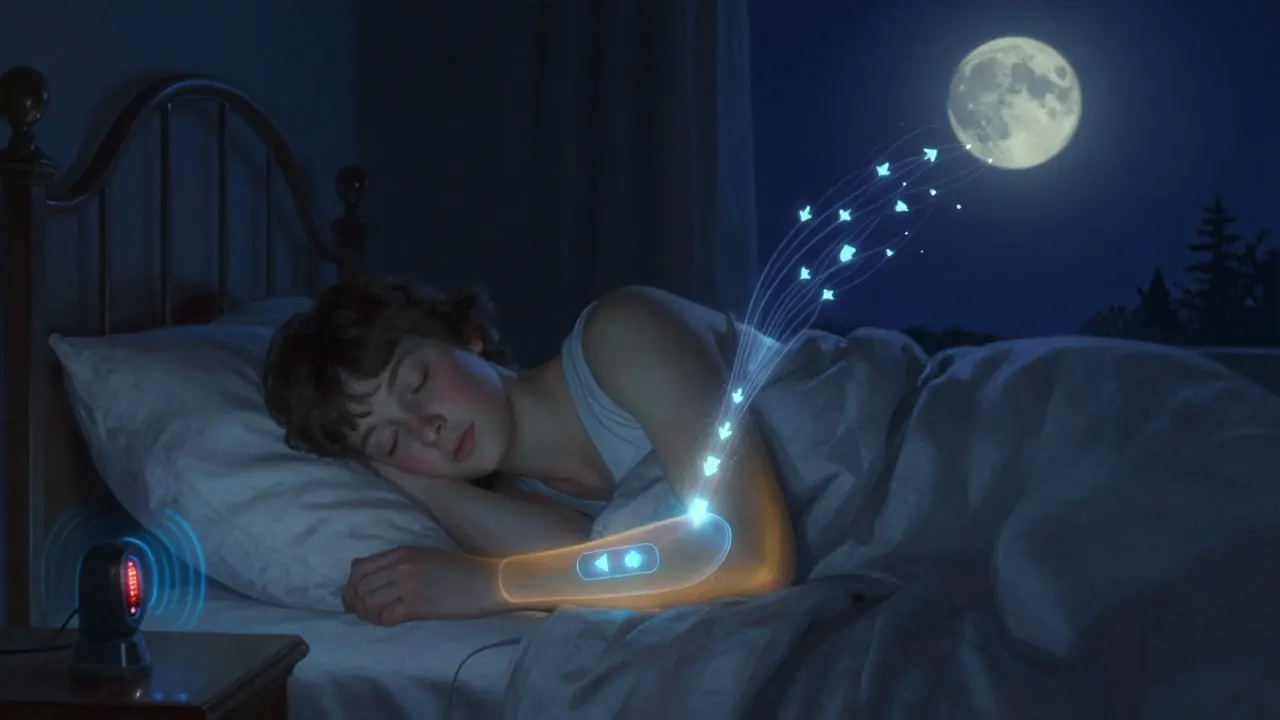
A continuous glucose monitor, or CGM, doesn't just tell you your blood sugar right now-it shows you where it's going. Think of it like a weather radar for your body. Instead of checking your glucose with a fingerstick once or twice a day, a CGM gives you updates every few minutes, day and night. This constant stream of data helps you see patterns you'd never notice otherwise: a slow drop while you sleep, a spike after lunch, or a sudden plunge during a workout. For people managing diabetes, this isn't just convenient-it can be life-saving.
How a CGM Actually Works
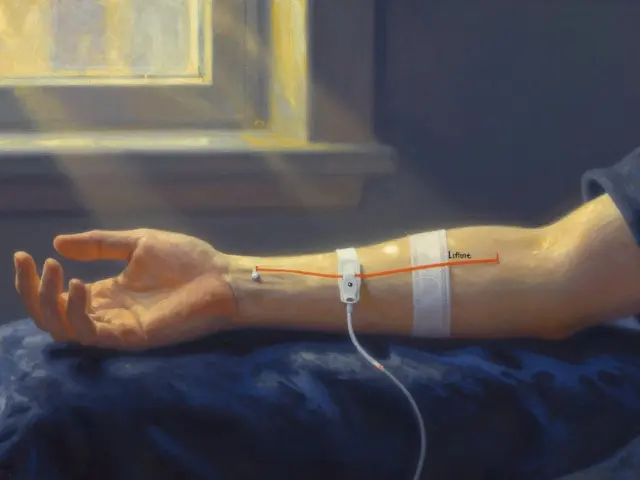
A CGM has three main parts: a tiny sensor, a transmitter, and a display device. The sensor is a small filament, about the size of a grain of rice, inserted just under the skin-usually on the abdomen or upper arm. Inside that sensor is an enzyme called glucose oxidase. When glucose in the fluid around your cells (called interstitial fluid) touches it, a chemical reaction happens. That reaction creates a tiny electric current, and the strength of that current tells the device how much glucose is present.
The transmitter, which snaps onto the sensor, sends that data wirelessly to your phone or a handheld receiver. Modern devices like the Dexcom G7 send updates every 5 minutes. The Abbott FreeStyle Libre 3 sends one every minute. That’s not just faster-it’s more detailed. You’re not guessing anymore. You’re seeing real-time movement.
But here’s the catch: CGMs don’t measure blood sugar directly. They measure glucose in the fluid between your cells. And that fluid lags behind your actual blood sugar by 5 to 20 minutes. So if your blood sugar drops fast-like during exercise or after a meal-the CGM might show a number that’s a little off. That’s why you still need a fingerstick if you feel symptoms of low blood sugar, even if the CGM says you’re fine.
Who Uses CGMs and Why
CGMs were originally designed for people with type 1 diabetes. That’s still the biggest group. But the benefits have expanded. The American Association of Clinical Endocrinologists now recommends CGMs for everyone with type 1 diabetes and for type 2 diabetes patients who use insulin multiple times a day. Why? Because the data works.
A 2022 analysis of 32 clinical trials found that CGM users had 31% fewer severe low-blood-sugar episodes. That’s huge. Severe hypoglycemia can lead to seizures, unconsciousness, or even death. One Reddit user, u/Type1Since1995, said, “My Libre 3 alarm saved me from a 32 mg/dL hypo at 3 AM last week-I’d have been dead without it.” That’s not an outlier. It’s a common story.
CGMs also help lower A1C levels. On average, users see a drop of 0.5% to 0.8%. That might sound small, but in diabetes, even a 1% drop reduces long-term complications like nerve damage, kidney disease, and vision loss. For people who’ve struggled to control their numbers with fingersticks alone, CGMs make a measurable difference.
And it’s not just diabetics anymore. More people without diabetes are using CGMs to understand how food, stress, or sleep affects their energy. A 2023 study from Zoe Health found a 18% annual increase in non-diabetic users. While insurance won’t cover it for wellness use, some are paying out of pocket to fine-tune their health.
Real-Time vs. Flash Monitoring: What’s the Difference?
Not all CGMs are the same. There are two main types: real-time and flash.
Real-time CGMs like the Dexcom G7 and Eversense E3 send data automatically. They beep if your glucose is dropping too fast or going too high. Some even connect to insulin pumps to automatically adjust doses. These are ideal for people who need constant alerts-especially those who sleep through lows or have hypoglycemia unawareness.
Flash monitors, like the FreeStyle Libre 3, don’t send alerts unless you scan them. You wave your phone over the sensor to pull up the data. No automatic alarms. But they’re cheaper, easier to wear, and don’t need calibration. For many, this is enough. A 2023 survey found that 63% of users loved the nighttime alerts, but 47% said the trend arrows were even more valuable. Those arrows tell you if your glucose is rising, falling, or steady-and how fast. That’s often more useful than the number itself.
Comparing Top CGM Systems
| Device | Measurement Frequency | Sensor Life | Accuracy (MARD) | Cost (Monthly, U.S., no insurance) | Key Features |
|---|---|---|---|---|---|
| Dexcom G7 | Every 5 minutes | 10 days | 9.1% | $399 | Real-time alerts, auto-calibration, integrates with insulin pumps |
| FreeStyle Libre 3 | Every 1 minute | 14 days | 7.9% | $110 | No fingersticks needed, slim design, factory-calibrated |
| Eversense E3 | Every 5 minutes | 180 days | 8.5% | $1,200 (device) + $150/month (transmitter) | Implantable sensor, vibration alerts, long-term use |
Accuracy matters. MARD (mean absolute relative difference) measures how close the CGM reading is to a lab blood test. FreeStyle Libre 3 leads at 7.9%, meaning it’s the most accurate. Dexcom G7 is a bit less accurate at 9.1%, but it’s more reliable during rapid changes because of its real-time alerts. Eversense E3 lasts six months, but you need a minor procedure to put it in and take it out.
What Users Actually Say
People who use CGMs consistently rate them 4.2 to 4.5 out of 5. But not everyone loves them.
Positive feedback? Nighttime alerts. Trend arrows. Fewer fingersticks. One user said, “I used to wake up at 3 a.m. every week with a headache from a low. Now I get a vibration. I eat a few grapes and go back to sleep.”
Negative feedback? Cost. Skin irritation. False alarms. Dexcom’s adhesive causes rashes for about 12% of users. Some report false lows during exercise. One cyclist said, “My Dexcom said I was at 50 mg/dL while I was biking hard. I panicked, ate a banana, and felt worse.” That’s the lag effect-your blood sugar spiked, but the interstitial fluid hadn’t caught up yet.
And then there’s the price. Without insurance, CGMs can cost $110 to $400 a month. That’s why many people in the U.S. rely on Medicare or private insurance. In the UK, the NHS gives FreeStyle Libre 2 to half a million people for free. In the U.S., Medicare only covers real-time CGMs for insulin users-not flash monitors-until recently. Coverage is improving, but it’s still a barrier.

What You Need to Know Before Starting
Getting started isn’t hard, but it’s not plug-and-play either. Most people get comfortable in 3 to 5 days. But here are the pitfalls:
- Don’t ignore the lag. If you feel shaky but the CGM says you’re fine, check with a fingerstick.
- Watch for acetaminophen. Painkillers like Tylenol can cause falsely high readings on most CGMs. Check your device’s warning label.
- Adhesion matters. If the sensor falls off, try Skin Tac wipes or Opsite Flexifix tape. They help 80% of users keep it stuck.
- Learn the trend arrows. Up, down, or flat? The direction tells you more than the number.
- Don’t overload. Some older adults or people with other health issues feel overwhelmed by constant data. Talk to your doctor if you’re unsure.
The Future of CGMs
The technology is moving fast. Dexcom G7 cut its warm-up time from two hours to 30 minutes. FreeStyle Libre 3 Plus now tracks insulin doses. Next up? Non-invasive sensors. Glucowise, a device that reads glucose through the skin without a needle, finished Phase 2 trials in 2023. Apple is rumored to be developing a glucose-sensing smartwatch. And closed-loop systems-where the CGM talks to the insulin pump and adjusts doses automatically-are getting smarter. Tandem’s Control-IQ 3.0, expected in early 2024, will predict lows 30 minutes before they happen.
One thing’s clear: CGMs are no longer a luxury. They’re becoming standard care. A 2023 study in the New England Journal of Medicine showed that CGM users had 24% fewer diabetes-related hospital stays. That’s not just better health-it’s lower costs, less stress, and more control over your life.
Can CGMs replace fingerstick tests completely?
Not entirely. While newer models like the FreeStyle Libre 3 are approved for non-adjunctive use (meaning you don’t need a fingerstick to confirm readings), you should still use one if you feel symptoms of low or high blood sugar, if your CGM reading doesn’t match how you feel, or during rapid changes like after exercise or meals. The 5-20 minute lag between blood and interstitial fluid means CGMs can miss sudden shifts.
Are CGMs covered by insurance?
In the U.S., Medicare and most private insurers cover CGMs for people with type 1 diabetes and type 2 diabetes on multiple daily insulin injections. Coverage varies by plan and device. Flash monitors like FreeStyle Libre were historically not covered, but many insurers now include them. Always check with your provider. Outside the U.S., countries like the UK and Canada provide CGMs through national health systems for eligible patients.
Can non-diabetics use CGMs?
Yes. Many people without diabetes use CGMs to understand how food, sleep, or stress affects their glucose. Athletes, biohackers, and wellness-focused individuals use them to optimize energy and avoid spikes. However, insurance won’t cover CGMs for non-diabetic use, and they’re not FDA-approved for diagnosis or treatment outside of diabetes. They’re a tool for personal insight, not medical management.
How long does a CGM sensor last?
Sensor life varies by device. Dexcom G7 lasts 10 days. FreeStyle Libre 3 lasts 14 days. The Eversense E3 implantable sensor lasts 180 days (6 months). Most users replace sensors on a fixed schedule, even if they still seem to be working. Accuracy drops after the recommended wear time, and skin irritation can increase.
Do CGMs work during exercise?
Yes, but with caution. CGMs work during physical activity, but the 5-20 minute lag can cause delays in detecting rapid glucose changes. During intense exercise, your blood sugar can spike or drop faster than the sensor can reflect. Some users report false highs or lows during workouts. Always verify with a fingerstick if you feel symptoms, and avoid making major corrections based on a single CGM reading during activity.
What should I do if my CGM gives me a false alarm?
If you get a low or high alert but feel fine, check your blood sugar with a fingerstick. False alarms can happen due to sensor lag, movement, or interference from medications like acetaminophen. Don’t panic. Don’t overcorrect. Use the fingerstick to confirm, then decide if you need to act. If false alarms happen often, talk to your provider-you may need to adjust alert settings or switch devices.
Next Steps
If you’re considering a CGM, start by talking to your doctor. Ask if you qualify for insurance coverage. If you’re paying out of pocket, compare prices. Look at sensor life, accuracy, app features, and alert options. Try to find a user community-Reddit’s r/CGM and Facebook groups have thousands of people sharing tips. And remember: the goal isn’t to obsess over every number. It’s to understand your patterns, prevent dangerous lows, and live with less fear.



Comments
Aileen Nasywa Shabira
20 March 2026Oh wow, another $400/month gadget for people who can't just eat less sugar. I'm sure the FDA didn't approve this just so rich folks could obsess over trend arrows while their kidneys slowly turn to dust. At least the fingerstick gives you time to contemplate your life choices.
lawanna major
20 March 2026The real miracle isn't the technology-it's how we've come to accept that our bodies need constant surveillance to function. We used to trust intuition, hunger cues, rhythm. Now we're told to rely on a tiny filament under our skin to tell us when to eat. It's not just medical-it's philosophical. Are we becoming data-driven organisms? Or just more anxious ones?
Ayan Khan
21 March 2026In India, we still struggle to get basic insulin access for many. Watching this conversation unfold in the U.S. feels like a luxury debate. CGMs are incredible tools, but they highlight a deeper divide: healthcare as a privilege, not a right. The real innovation needed isn't in sensors-it's in policy.
Manish Singh
22 March 2026I've been using Libre 3 for 8 months now. The biggest change? I sleep better. No more 3 a.m. panic checks. No more guessing if that headache is from stress or a crash. The trend arrows are everything. I used to think I was fine until I felt awful. Now I see the slope before the fall. It's like having a personal weather forecaster for your blood.
Michelle Jackson
22 March 2026I got one because my doc said so. First week I was like 'why am I eating a banana at 2 p.m. because a green arrow told me to?' Second week I realized I was eating carbs like they were free. Third week I lost 6 lbs without trying. Turns out my 'healthy' lunch was just sugar in disguise. Thanks, CGM. You exposed my lies.
Suchi G.
24 March 2026I used to think I was fine until I started using it. I thought my energy crashes were just 'being a mom.' Turns out, my glucose was plummeting after every snack. I thought my afternoon naps were normal. They weren't. They were my body screaming for help. I cried the first time I saw the data. Not because it was bad-but because I finally understood why I felt so broken. This isn't a gadget. It's a mirror.
becca roberts
25 March 2026So let me get this straight. We pay $400 a month for a device that tells us what our ancestors figured out by eating food that didn't come in a box? And we call this progress? I mean, sure, it's cool tech. But it also feels like capitalism turned diabetes into a subscription service. 'Want to live? Pay $110 this month.'
Andrew Muchmore
27 March 2026The lag is real. I was biking hard, CGM said 58, I felt fine. Fingerstick was 112. I almost ate a whole granola bar. Don't panic. Don't overcorrect. Just check.
Paul Ratliff
29 March 2026free style libre 3 is a game changer. no more poking my finger 6 times a day. just wave phone. done. also the 14 day sensor is a win. i dont like changing stuff often. also the app is clean. no fluff. just numbers and arrows. love it.
SNEHA GUPTA
30 March 2026There is something deeply human in the way we now outsource bodily awareness to silicon. We once learned to listen to ourselves-pulse, sweat, fatigue. Now we wait for a digital whisper. Is this empowerment? Or surrender? The science is sound, but the cultural shift is profound. We are no longer just managing glucose-we are managing our relationship with our own biology.
Gaurav Kumar
31 March 2026In India, we have 77 million diabetics. Yet here you are, debating which CGM has the prettiest app. Meanwhile, people are amputating limbs because they can't afford insulin. This isn't innovation-it's performance art for the privileged. Your trend arrows won't fix systemic neglect.
Srividhya Srinivasan
2 April 2026I've been watching this whole CGM thing for years. I'm not saying it's fake, but who really benefits? Big Pharma? The sensor companies? The app developers? The FDA? Or the patient? I've seen people get addicted to the numbers. They're not living anymore-they're optimizing. And don't get me started on how acetaminophen messes with readings. It's like your body is being hacked by your painkiller.
Prathamesh Ghodke
4 April 2026I work with older adults who use these. Some love it. Others hate it. One woman said, 'It tells me I'm low, but I feel fine. So I ignore it. Then I feel worse.' The tech is great, but it doesn't replace trust in your own body. You have to learn when to listen, and when to trust your gut. The arrows help. But the wisdom? That's still yours.
Sanjana Rajan
5 April 2026Let’s be real: if you’re using a CGM just to ‘optimize your energy’ and you’re not diabetic, you’re probably just another biohacker who thinks they’re special because they track their carbs. I’ve seen people cry because their glucose spiked after avocado. Avocado. Not cocaine. Not sugar. AVOCADO. We’ve lost the plot.
Kyle Young
6 April 2026The data presented here is compelling, yet it raises an important epistemological question: if we rely on interstitial fluid measurements as proxies for blood glucose, and those measurements lag by 5–20 minutes, are we not constructing a model of reality rather than observing it? The CGM offers a representation, not the phenomenon itself. This distinction is not trivial. It suggests that our confidence in the device may be more a function of its precision than its fidelity to physiological truth.